STORIES WE KEEP · OCTOBER 1, 2026
At the foot of Livernois Avenue, Detroit keeps a fortress that never fired a shot in battle.
Historic Fort Wayne rises from the riverfront in layers: grassy earthworks, brick-lined passages, stone barracks, officers’ homes, empty military buildings, and more than a century of memories. It was designed when Americans still feared that war with British Canada could return. It later became a place where soldiers gathered, factory-made war supplies moved out, prisoners waited, families found shelter, and generations of Detroiters came to understand the city’s military past.
Now the Gordie Howe International Bridge has changed the view—and the conversation. The new crossing and its pedestrian-and-cycling path bring thousands of people close to a historic site Detroit has struggled to protect, interpret, and reuse.
The fort was built to watch the border. Today, the border may help Detroit see the fort again.
Watch: Detroit Built This Fort to Defend Against Canada
Walk through Historic Fort Wayne with History Loves Company in the full film below. The episode explores the fort’s architecture, military history, human stories, endangered buildings, and new relationship with the Gordie Howe International Bridge.
Watch Detroit Built This Fort to Defend Against Canada—Now You Can Walk There on YouTube.
Long before the fort, this was sacred ground
The history of this land did not begin with the United States Army. The City of Detroit’s planning documents identify an Indigenous burial mound on the grounds dating to roughly 750–1100 CE. That makes the site significant not only to American military history, but also to Native nations whose relationship with the Detroit River region extends back many centuries.
The nearby Springwells area also carries the history of the War of 1812 and the 1815 Treaty of Springwells, when representatives of several Native nations and the United States met after the war. These histories deserve more than a passing reference. Any future for Fort Wayne must treat the mound and the larger Indigenous landscape as central to the story rather than as a footnote before the fort’s construction.
Fort Wayne is therefore not one historic place. It is a landscape of overlapping histories, and some of its oldest stories are the ones most easily missed.
Why Detroit expected another war with Canada
The War of 1812 had shown how vulnerable Detroit could be. The city was surrendered to British forces in 1812, later recovered by the United States, and left with a lasting awareness that the international boundary was also a military frontier.
By the late 1830s, unrest known as the Patriot War again stirred fears along the border. American sympathizers attempted to support rebellions in British-controlled Canada, and officials worried that a larger conflict might follow.
Congress authorized a new Detroit defense installation in 1841. The site was chosen near a strategic bend and narrow section of the Detroit River, close enough for artillery to command the channel and reach toward the Canadian shore. The fort was named for General Anthony Wayne, whose victory at Fallen Timbers helped establish American control of the Northwest Territory.
Fort Wayne was Detroit’s third major fortification—but unlike the earlier Fort Pontchartrain and Fort Lernoult/Fort Shelby, much of it survives.
Montgomery Meigs designed a five-point star
The Army assigned the design to Lieutenant Montgomery C. Meigs, an engineer who would later become the Union Army’s quartermaster general during the Civil War and oversee major national projects.
Meigs planned a five-point bastioned fort surrounded by a dry moat and heavy earthen walls. The angled form allowed defenders to direct fire along the faces of the fort and reduce blind spots. Brick casemates and arched passages were built into the earthworks, while the limestone barracks created a commanding centerpiece inside the defensive enclosure.
The main works rose during the 1840s and were substantially complete around 1850. Yet the international crisis that inspired the fort eased. Relations between the United States and Britain improved, weapons technology changed, and the great river-facing guns planned for the fort were never installed.
Fort Wayne never fired on an enemy. Its most important history would come from the people who passed through it.

A fort remembered for departures, not battles
During the Civil War, Fort Wayne became a mustering and training point for Michigan volunteer regiments. Soldiers arrived as civilians, received equipment and instruction, and departed for war. Families said goodbye here without knowing whether the people they loved would return.
That pattern continued in later conflicts. The fort housed troops during World War I, including construction units and an aero squadron. During the Korean and Vietnam eras, it served as one of the Midwest’s major induction centers.
This makes Fort Wayne a different kind of battlefield memorial. Its emotional history is found in thresholds: the moment before a train left, the last meal before deployment, the physical examination, the uniform issued, and the uncertainty carried through the gate.
The fort’s buildings may look silent now, but they once held thousands of private turning points.
Fort Wayne helped supply the Arsenal of Democracy
World War II transformed the installation into the Detroit Motor Supply Depot. Vehicles, parts, tires, weapons, and other materials produced across southeastern Michigan moved through the fort on their way to American and Allied forces.
Temporary warehouses and offices filled portions of the grounds. Roughly two thousand military and civilian workers supported the operation at its peak, connecting the old fort directly to Detroit’s enormous industrial war effort.
For a place designed in the age of cannon, this was an unexpected second life. Fort Wayne protected the country not by firing across the river, but by organizing the output of the factories that gave Detroit its “Arsenal of Democracy” identity.
The site also temporarily held Italian prisoners of war. Their presence adds another layer to the complex human geography of a military post that became a workplace, processing center, warehouse district, and place of confinement.

The fort also became a place of refuge
Military sites often become temporary cities, and Fort Wayne repeatedly took on responsibilities far beyond defense. During the Great Depression, parts of the grounds supported federal work and relief activity. The fort also housed military education and administrative functions as its mission evolved.
One of its most powerful chapters came during and after Detroit’s 1967 uprising. Families displaced when homes burned or became unsafe were sheltered at Fort Wayne. Some remained on the grounds for years, turning former military buildings into temporary domestic spaces.
That story complicates the familiar image of the fort. These walls were not only built to repel an imagined attack. At times, they received Detroiters who needed somewhere to go.
Preservation has moved slowly while buildings deteriorated
The federal government began transferring portions of Fort Wayne to the City of Detroit in 1948. The fort entered the National Register of Historic Places in 1971, and the city eventually took control of nearly the entire complex.
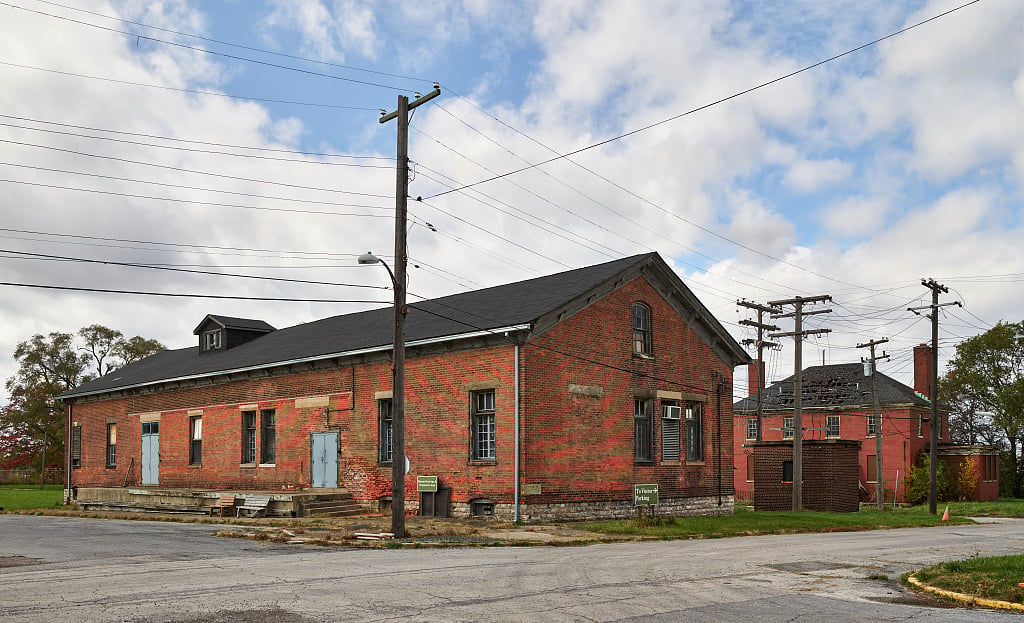
Recognition did not guarantee restoration. More than twenty historic buildings are unoccupied or neglected. Roof failures, water intrusion, damaged masonry, vandalism, outdated utilities, and years of deferred maintenance have made rehabilitation increasingly expensive.
The surviving collection is extraordinary: the star fort, limestone barracks, officers’ quarters, guard house, recreation buildings, service structures, and landscape features together show how a military post changed across generations. Preserving only one handsome building would leave much of that story behind.
Adaptive reuse could bring people and revenue to the grounds, but reuse must respect the fortifications, archaeological resources, burial mound, and stories of soldiers, workers, prisoners, and displaced families. The question is not simply, “What can fit here?” It is, “What future helps people understand what happened here?”
The Gordie Howe bridge changes the fort’s future
The Gordie Howe International Bridge opened to vehicle traffic on July 27, 2026. Its toll-free multi-use path opened to walkers and cyclists on August 5, connecting Detroit and Windsor in a way the river had never offered before.
That path places new movement, tourism, and public attention close to Fort Wayne. Visitors now approach this part of southwest Detroit not only through industrial roads, but also as part of a cross-border experience. The contrast is remarkable: an 1840s fort built from fear of the border now stands beside a twenty-first-century bridge built to cross it.
As of fall 2026, Detroit is preparing a new study of possible uses for Historic Fort Wayne. Ideas discussed over the years have included museums, cultural spaces, small businesses, recreation, hospitality, and community uses. Any serious plan will require major investment, careful archaeology, preservation expertise, and sustained involvement from southwest Detroit residents and Native communities.
The bridge does not save the fort by itself. It does, however, make forgetting the fort much harder.
Visit with respect—and follow official access
Historic Fort Wayne is not an abandoned playground. Some buildings are closed because they are unstable, and unauthorized entry can damage historic material while putting visitors at real risk.
Use City of Detroit or Historic Fort Wayne Coalition tours and events for access. Stay on approved routes, respect barriers, never remove bricks or artifacts, and remember that part of the property is a burial landscape.
If you cross the Gordie Howe International Bridge on foot or by bicycle, check the official multi-use-path hours and border-document requirements before leaving. The international crossing operates under rules that are different from an ordinary city trail.
Why Fort Wayne belongs in Detroit’s next chapter
Historic Fort Wayne is not important because a famous battle took place there. It matters because Detroit kept finding new uses for it as the city and nation changed.
It tells stories of Indigenous presence, border anxiety, military engineering, departure for war, industrial power, imprisonment, public service, housing displacement, abandonment, and preservation. Few places in Michigan bring so many histories together inside one surviving landscape.
Continue exploring Detroit through the History Loves Company topic library, watch more original films in Films & Stories, visit the recent story about Detroit’s hidden mansion forest in Palmer Woods, or explore Michigan’s historic homes.
Do you remember touring Fort Wayne, attending an event there, serving there, working there, or hearing family stories connected to the grounds? Share your story with History Loves Company. The official record tells us what an institution did. Community memory tells us what it felt like.
For the larger story of the forces that shaped Detroit, discover Christopher Hubel’s book They Lied to Us About Detroit. Visit The Foundry by History Loves Company in downtown Pontiac, and subscribe to Stories We Keep for new Detroit and Michigan history.
Every home has a story. Every city carries memory.
Sources and further reading
- City of Detroit: Historic Fort Wayne Master Plan — Indigenous significance, construction, military use, architecture, and preservation planning.
- City of Detroit: Historic Fort Wayne Strategic Planning Process — current preservation, access, and adaptive-use goals.
- Detroit Historical Society: Fort Wayne — military chronology and the fort’s changing uses.
- National Park Service: Fort Wayne—Detroit — National Register context.
- Gordie Howe International Bridge: A Historic First — July 27, 2026 vehicle opening.
- Gordie Howe International Bridge: The Multi-Use Path Opens — August 5, 2026 pedestrian and bicycle opening.
- Library of Congress: Fort Wayne Barracks, LC-DIG-highsm-60355 — photograph and rights information.
- Library of Congress: Scene at Historic Fort Wayne, LC-DIG-highsm-60312 — photograph and rights information.
