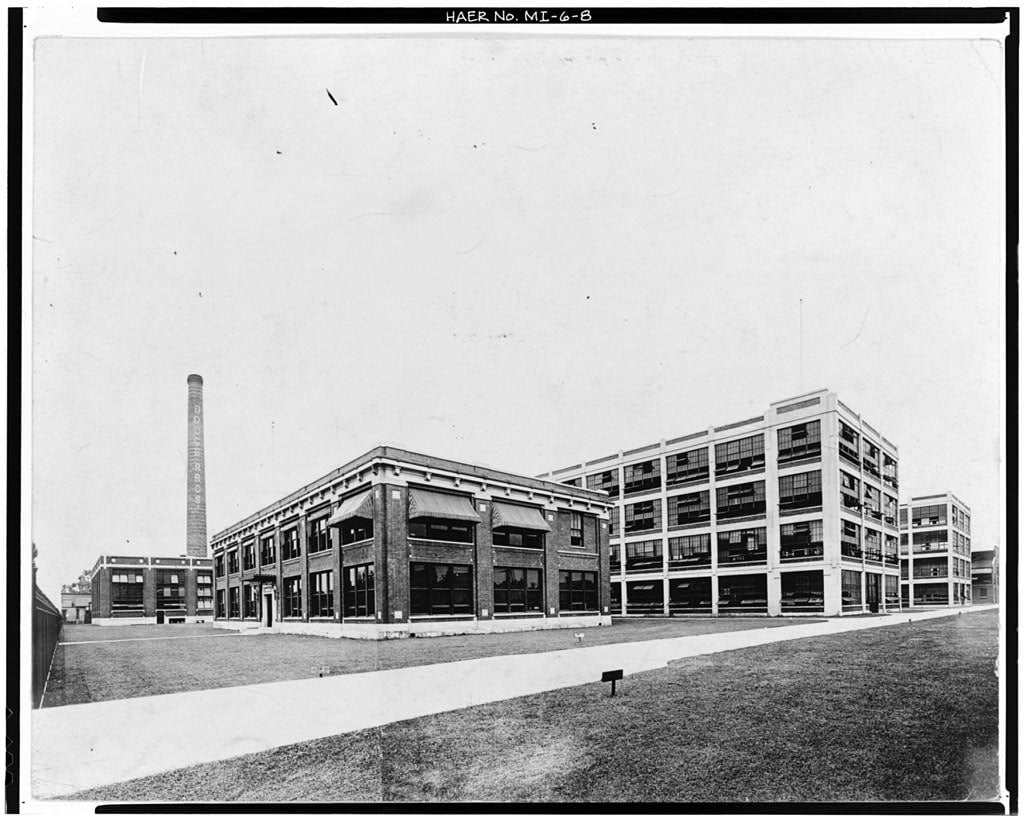

Before Dodge became a badge on a grille, it was the name over a factory gate.
The gate stood in Hamtramck, where Joseph Campau and Conant avenues framed an industrial complex so large that it functioned almost like a city. Dodge Main had its own powerhouse, hospital, fire department, post office, restaurant, railroad, repair shops, and police force. Inside, metal became engines, frames, bodies, and complete automobiles. Outside, workers built houses, opened businesses, founded institutions, and changed the population of an entire community.
Dodge Main did more than manufacture cars. It manufactured modern Hamtramck—and concentrated the promise, conflict, inequality, and human cost of Detroit's industrial age in one place.
The Dodge brothers built their reputation before they built their car
John and Horace Dodge were machinists before they were automobile manufacturers. The brothers came from Niles, Michigan, learned mechanical work from their father, and eventually established themselves in Detroit's fast-moving manufacturing world.
They produced transmissions for Ransom E. Olds and, beginning in 1903, became major suppliers to Henry Ford. Their firm made engines, transmissions, and other crucial components while John Dodge served as a Ford vice president. That relationship helped Ford scale production—and made the brothers wealthy, experienced, and increasingly capable of competing on their own.
By 1910, their existing shop was too small. They began building a new works on open land in Hamtramck, then a village north of Detroit. Rail connections, available acreage, and proximity to the growing automobile industry made the site valuable. The factory initially supplied Ford, but its design and continued expansion gave the brothers the capacity to do something much larger.
In 1914, Dodge Main became the center of a new automobile company
The brothers ended their Ford arrangement in 1913 and organized to produce a car under their own name. The first Dodge automobile was completed at Hamtramck in November 1914.
The Dodge Brothers car entered a market dominated by the Model T, but it was positioned as a durable, somewhat more expensive alternative. Its reputation for strength helped the company grow quickly. The factory expanded with it.
By 1920, the year both brothers died, Dodge Main employed approximately 22,000 people and produced about 140,000 automobiles annually, according to the federal Historic American Engineering Record. More than thirty buildings eventually filled the complex. The plant manufactured most of a Dodge automobile on site, excluding items such as tires, glass, and—in its earlier years—bodies.
This degree of integration mattered. Foundries, forges, machine shops, heat-treatment departments, stamping operations, paint facilities, assembly lines, laboratories, and support services were gathered into one production system. The plant's four miles of narrow-gauge railroad track moved material through a world built around the speed and sequence of manufacturing.
Watch: the factory system that transformed automobile production
Dodge Main developed alongside Henry Ford's Highland Park plant, another landmark of industrial architecture and production. This History Loves Company film explores how Highland Park helped change the factory—and then the world.
Watch Inside Henry Ford's Highland Park Plant: The Factory That Changed the World on YouTube.
The factory turned a village into an industrial city
Hamtramck had roughly 3,600 residents when Dodge Main began operating in 1910. By 1920, its population had reached 48,615. The plant did not cause every part of that growth, but it was the community's dominant economic engine.
Workers needed homes within reach of the gates. Stores, taverns, banks, churches, schools, and social organizations followed. The Joseph Campau streetcar carried labor to the plant and helped organize development along the corridor.
The population shift was dramatic. A community once associated with German farmers became a major destination for Polish immigrants. By 1920, about three-quarters of Hamtramck's residents were recent Polish immigrants, according to the HAER history. Polish was widely spoken inside Dodge Main into the World War II era.
That chapter is essential, but it is not the end of Hamtramck's immigration story. Ukrainian, Black, Arab, Bangladeshi, Yemeni, Bosnian, and other residents built lives there across later generations. The people changed while the pattern continued: newcomers used a dense, affordable city near employment as a place to begin.
Factory history is therefore neighborhood history. A production total cannot tell us what time a shift began, who watched the children, where a family worshipped, which languages were spoken over dinner, or how a paycheck moved through local businesses. Those stories survive in family photographs, union cards, pay stubs, tools, lunch pails, houses, and memory.
From family company to Chrysler division
After John and Horace Dodge died in 1920, their heirs sold the company to the investment firm Dillon, Read & Company in 1925. Walter P. Chrysler acquired Dodge in 1928.
The purchase gave the young Chrysler Corporation an established name, a dealer network, experienced workers, and an enormous manufacturing base. Dodge became a major Chrysler division, and the Hamtramck complex became known as the Main Plant—or simply Dodge Main—to distinguish it from the company's other facilities.
The plant struggled during the Great Depression, when automobile production collapsed, but war contracts restored activity. Employment peaked near 40,000 during World War II. In 1954, Hamtramck celebrated the fortieth anniversary of the Dodge automobile with “Dodge City Days.” The plant opened its doors, and the HAER account records 78,745 visitors in a single day.
That celebration revealed how closely company and community identities had become linked. It also hid tensions that periodically broke into public view.
Dodge Main was a battleground over who controlled work
A factory is not only a collection of machines. It is a system of authority: who sets the pace, who receives the best jobs, who is promoted, who is protected, and who is heard.
In March 1937, approximately 10,000 Dodge Main employees joined the Chrysler sit-down strike that helped win recognition for the United Automobile Workers. The plant became one of the decisive sites in the struggle to establish industrial unionism in the American automobile industry.
Three decades later, Black workers challenged both Chrysler management and the established union structure. The Dodge Revolutionary Union Movement—DRUM—emerged at Dodge Main in 1968. Its members protested production conditions, racial discrimination, unequal access to skilled and supervisory positions, and what they viewed as inadequate representation from UAW leadership.
A July 1968 wildcat strike partially shut down the plant. DRUM's example spread to other workplaces and helped inspire the League of Revolutionary Black Workers. The movement connected shop-floor demands to the wider Black freedom struggle and forced Detroit to confront a contradiction: Black labor was increasingly central to automobile production while Black workers remained underrepresented in many positions of power.
This history complicates any nostalgic image of the factory. Dodge Main created opportunity, but workers repeatedly had to organize over the terms on which that opportunity was offered.

Closure came after decades of change
Dodge Main's physical size disguised its growing disadvantages. Its multistory buildings belonged to an earlier industrial model. Newer automobile plants spread production across broad, single-story floors that made it easier to move materials and rearrange assembly lines. Chrysler transferred manufacturing processes elsewhere, demolished peripheral buildings, and increasingly used Dodge Main as an assembly operation.
Automation reduced the number of people needed. Employment fell from the wartime peak to about 8,000 in 1964 and approximately 5,000 when the plant closed. Chrysler itself faced a financial crisis at the end of the 1970s.
On January 4, 1980, Dodge Main shut permanently after seventy years. The closure eliminated thousands of jobs, but its effects extended far beyond the final workforce. Local businesses lost customers. City finances lost an industrial anchor. Families lost a workplace that had structured several generations of life.
The Historic American Engineering Record documented the complex as the end approached. That survey preserved hundreds of photographs, drawings, and pages of history even though the buildings themselves would soon disappear.
Demolition joined Dodge Main to the contested history of Poletown
General Motors proposed a new automobile complex along the Detroit-Hamtramck border soon after Dodge Main closed. The project incorporated the former Dodge property, but it required far more land. Detroit used eminent domain to clear a large surrounding area commonly associated with Poletown.
About 4,200 residents were displaced, along with roughly 1,300 homes, 140 businesses, churches, and a hospital. Supporters argued that a new plant was essential to retaining industrial jobs and rebuilding the tax base. Opponents argued that government should not destroy an established community for a private corporation.
The Michigan Supreme Court allowed the taking in Poletown Neighborhood Council v. City of Detroit in 1981. The court reversed that precedent in 2004, but it could not restore the streets and buildings already erased.
Dodge Main's demolition and Poletown's clearance were connected, but they were not the same event. The old factory occupied only part of the much larger assembly-plant site. Preserving that distinction matters because industrial ruins can disappear in one demolition while living neighborhoods are removed through another process of land assembly.
The GM plant began production in 1985. It was later transformed into Factory ZERO for electric-vehicle manufacturing. The site still makes vehicles, but almost none of Dodge Main's physical fabric remains to explain what came before.
Watch: how automobiles helped remake the landscape beyond the factory
The same industry that concentrated workers around Dodge Main also helped disperse metropolitan life after World War II. This History Loves Company film follows the policies, roads, financing, and racial inequality behind America's suburban expansion.
Watch Why America Really Built the Suburbs on YouTube.
The mansion and the factory belong to the same story
Yesterday's Stories We Keep article explored Meadow Brook Hall and Matilda Dodge Wilson's legacy. That estate and this vanished factory can look like opposite worlds: carved stone and poured concrete, private rooms and crowded production floors, country landscape and industrial city.
They are inseparable. The fortune that made Meadow Brook Hall possible came from machines, patents, contracts, automobiles, and the labor performed at Dodge Main. Reading one place without the other leaves the history incomplete.
That does not reduce Matilda's later philanthropy, nor does it turn thousands of workers into background scenery for a family biography. It shows how wealth, work, architecture, migration, and power flowed through the same regional system.
What should we keep when the factory is gone?
Dodge Main survives in federal documentation, archives, union histories, company records, museum collections, photographs, and oral testimony. Those records tell us the scale of the plant. Families can tell us how it felt.
If someone in your family worked at Dodge Main, record the details now. Ask which building or department they worked in, what they made, how they traveled to the plant, who trained them, what they carried to lunch, which languages they heard, and what changed when the factory closed. A precise memory can reconnect an individual life to a complex that otherwise risks becoming an abstract name.
Explore more Detroit history, Michigan history, and Southeast Michigan stories. If your family worked at Dodge Main or lived nearby, share your story with History Loves Company.
For a deeper examination of the decisions and myths that reshaped the city, discover Christopher Hubel's book They Lied to Us About Detroit. Visit The Foundry by History Loves Company in downtown Pontiac, and subscribe to Stories We Keep for the next chapter.
The factory is gone. The lives connected to it are not—and those are the stories we keep.
Dodge Main: key dates and research
Where was Dodge Main?
The federal Historic American Engineering Record locates the plant between Joseph Campau and Conant avenues, north of Dunn Road, in Hamtramck. Use the report's site documentation to understand the former complex; it is not a current visitor map. Read HAER MI-6 (PDF).
When did Dodge Main close?
The plant closed permanently on January 4, 1980. The closure date is separate from subsequent demolition and the wider land-clearance history. Charles K. Hyde, HAER history, printed page 3.
What can a family work record add?
Start with the department, job, shift, approximate dates, and any badge or document number. Compare those details with the federal building descriptions. Preserve conflicting memories as separate accounts until a record helps resolve them.
Follow the story
- Zug Island and the industrial supply chain
- Detroit research collections
- Contribute a Dodge Main working-life memory
Sources and further reading
- Library of Congress: Dodge Brothers Motor Car Company Plant, HAER MICH-6 — 313 photographs, measured documentation, captions, and historical data.
- Charles K. Hyde, History of the Dodge Brothers Motor Car Company Plant, Hamtramck, Michigan, 1910–1980 — Historic American Engineering Record history prepared in December 1980.
- African American Intellectual History Society: 50 Years Since Detroit's Dodge Revolutionary Union Movement — DRUM, the July 1968 strike, and Black worker activism.
- Walter P. Reuther Library: League of Revolutionary Black Workers image collection — archival photographs documenting Detroit's Black labor movement.
- Hamtramck Historical Museum — local collections and community history.
- Library of Congress: Dodge Main panoramic view, 1914 and north facade, 1980 — image records and reproduction information.