STORIES WE KEEP · SEPTEMBER 22, 2026
Meadow Brook Hall: The Dodge Fortune Behind Michigan's Tudor Revival Mansion
Built by Matilda Dodge Wilson and Alfred Wilson, the Rochester estate transformed an automotive fortune into architecture, philanthropy, and Oakland University.
By Christopher Hubel | September 22, 2026

Michigan built automobiles on an industrial scale. At Meadow Brook Hall, that industry became architecture.
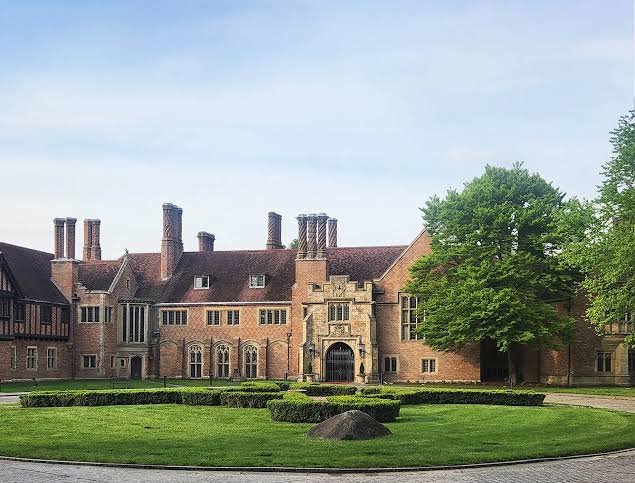
The mansion rises from the Rochester landscape in brick, stone, timber, leaded glass, and dozens of towering chimneys. It looks back toward the country houses of England, yet it was created by an American family, a Detroit architecture firm, and craftspeople working at the height of Michigan's automotive era.
Meadow Brook Hall is not simply the story of a large house. It is the story of Matilda Dodge Wilson—businesswoman, farmer, philanthropist, political figure, preservationist, and co-founder of Oakland University. The Dodge fortune made the estate possible, but Matilda's decisions determined what it became and why it survived.
Before the mansion, there was Meadow Brook Farms
The history of the estate begins in 1908, when John and Matilda Dodge purchased a 320-acre farm near Rochester as a weekend retreat. Oakland County was still largely rural. The property offered rolling land, natural resources, privacy, and room for farming, recreation, and experiments far from the city's factory floor.
John and his brother Horace Dodge had already become respected machinists and suppliers. In 1914, they launched the Dodge Brothers Motor Car Company. The Meadow Brook property became more than a country escape. The brothers tested automobiles there, while the farm grew under Matilda's management.
Over time, Meadow Brook Farms expanded to more than 2,000 acres. It developed a reputation for livestock and agricultural production. That working landscape is essential to understanding the later mansion. Meadow Brook was an estate, but it was also a place of labor, management, machinery, and production.
Matilda's life changed before the Hall was built
John Dodge died in 1920 after becoming ill during the influenza pandemic. Matilda was left a young widow with children and an immense fortune. Four years later, her young daughter Anna Margaret died from measles.
These losses complicate the easy image of Jazz Age wealth. Meadow Brook Hall emerged from a life marked by privilege, grief, responsibility, and reinvention.
Matilda married lumber broker Alfred G. Wilson in 1925. Together they began planning a home at Meadow Brook that could accommodate family life, large-scale entertaining, art, and the social expectations surrounding one of Michigan's most prominent households.
John Dodge never lived in Meadow Brook Hall; construction began six years after his death. His industrial success supplied much of the wealth behind it, but the house itself belongs to the chapter Matilda and Alfred built together.
An English country house made in America
Construction took place from 1926 to 1929. Matilda worked closely with architect William E. Kapp of the Detroit firm Smith, Hinchman & Grylls. The design drew inspiration from English manor houses while relying heavily on American materials and craftsmanship.
The Tudor Revival exterior is intentionally irregular. Steep clay-tile roofs, patterned brickwork, stone-framed windows, parapets, half-timbering, and massive chimneys create the appearance of a house expanded over centuries rather than completed in three years.
That effect was carefully designed. Revival architecture does not reproduce one historical building exactly. It selects, combines, and reinterprets older forms to create a new place with a sense of inherited age.
Meadow Brook's 39 chimneys, arranged in 14 groupings, add rhythm and vertical drama to the long horizontal building. Their forms recall celebrated English houses including Hampton Court and Compton Wynyates. Even at a distance, the roofline tells visitors that this is no ordinary residence.

Historic appearance met modern technology
The Hall's old-world appearance should not be mistaken for technological nostalgia. Behind carved wood, decorative plaster, and leaded glass was a thoroughly modern 1920s residence.
The house included advanced electrical, heating, communication, and service systems designed for a family, guests, and a substantial domestic staff. Historic styles and modern convenience existed side by side. That combination is one of the defining qualities of great American country houses from the period.
At approximately 88,000 square feet with 110 rooms, Meadow Brook Hall operated at a scale closer to an institution than a conventional home. Its plan had to support formal entertaining, private family rooms, guest accommodations, kitchens, work areas, circulation routes, and the people who kept the estate running.
The building is magnificent, but it did not maintain itself. The complete story includes architects, builders, carvers, gardeners, farm workers, cooks, housekeepers, chauffeurs, and other staff whose labor made the estate function.
Watch: the factories behind Michigan's fortunes
Meadow Brook Hall cannot be separated from the industrial world that generated the Dodge fortune. This History Loves Company visit inside the Highland Park Ford Plant explores another landmark from the era when Michigan manufacturing reshaped work, mobility, and American life.
Watch History Loves Company inside the Highland Park Ford Plant on YouTube.
Matilda was more than the widow of an auto pioneer
Descriptions of Meadow Brook often introduce Matilda as John Dodge's widow. The relationship is historically important, but stopping there diminishes her own work.
Matilda managed business and agricultural interests, collected art, supported charitable institutions, participated in civic life, and served briefly as Michigan's lieutenant governor by appointment in 1940—the first woman to hold that office. She worked with more than 40 service, political, and philanthropic organizations.
She also took a direct role in Meadow Brook's design. The official history records her involvement in details ranging from the Grand Staircase to switch-plate covers. The house reflects wealth, but it also reflects close attention, research, taste, and the authority of a client who knew what she wanted.
That makes Meadow Brook especially valuable to architectural history. It preserves not just the work of a prominent firm, but the creative influence of a woman whose role could easily be reduced to the source of the construction budget.
The family's greatest gift was not another room
In 1957, Matilda and Alfred Wilson donated Meadow Brook Hall, approximately 1,400 acres, and $2 million to establish a new university in Oakland County. The institution began as Michigan State University–Oakland and became the independent Oakland University in 1970.
The gift changed the meaning of the estate. Land once associated with private family wealth became the foundation of a public educational mission. The mansion remained, but it now stood inside a growing campus serving generations of students.
This transition also helped preserve the property. Many American estates of comparable scale were demolished, subdivided, or stripped of their contents when maintenance became impractical. Meadow Brook found a new institutional context without losing the physical evidence of its earlier life.
The Hall opened to the public as a historic house museum in 1971. In 2012, it was designated a National Historic Landmark as an outstanding example of an American country estate and monumental Tudor Revival architecture.
Watch: why Michigan's historic architecture matters
Preservation begins with recognizing that buildings hold evidence: craftsmanship, labor, technology, ambition, inequality, family life, and changing ideas about what communities value.
Watch Why Michigan's Forgotten Architecture Matters on YouTube.
How to read Meadow Brook Hall
A visit can become overwhelming if the goal is simply to notice every beautiful object. A more useful approach is to choose a few questions and follow them through the house.
- Look for age created on purpose. Which details make a 1920s building feel centuries older?
- Follow the hidden systems. Where do technology, service corridors, and staff spaces support the formal rooms?
- Notice materials and hands. Ask who carved, fitted, wired, planted, cleaned, and maintained what you see.
- Separate family chapters. Remember which parts belong to John and Matilda Dodge, and which belong to Matilda and Alfred Wilson.
- Consider the second life. Ask how the founding of Oakland University changed the estate's purpose and prospects for survival.
Architecture becomes more meaningful when we move beyond the question “How much did this cost?” and ask what the place was designed to do, whose work it required, and why it remains.
Preservation is an active use, not a frozen moment
Meadow Brook Hall survives because preservation became an ongoing practice. Tours, scholarship, conservation, events, fundraising, volunteers, and its relationship with Oakland University all help support the property.
That model requires balance. A historic house must protect fragile materials while remaining useful enough to sustain public interest and financial support. Events bring people into the building; interpretation helps those visitors understand why the setting matters beyond its beauty.
For historic homeowners, the scale may be different, but the principle is familiar. Stewardship means learning what is significant, making thoughtful changes, documenting work, and giving an old place a viable future.
Keep following the story
Before visiting, review current tours, hours, accessibility information, and photography policies on the official Meadow Brook Hall website.
Explore more Michigan history, Southeast Michigan stories, and historic-home resources. If your family worked at Meadow Brook, attended Oakland University, or has a memory connected to the estate, share it with History Loves Company.
For the broader story of the people, policies, industries, and places that shaped the region, discover Christopher Hubel's book They Lied to Us About Detroit. You can also visit The Foundry by History Loves Company in downtown Pontiac and subscribe to Stories We Keep.
Every home has a story. Some homes help build what comes after them.
Sources and further reading
- Meadow Brook Hall: History — the Dodge and Wilson families, Meadow Brook Farms, construction, and Oakland University's founding.
- Meadow Brook Hall Visitor Guide: History and Architecture — Tudor Revival features, scale, interiors, and interpretation.
- Oakland University: Buildings and Structures — university account of Meadow Brook Hall and the founding gift.
- Oakland University Archives: Meadow Brook Hall Collection — archival holdings documenting the estate and its university era.
- Oakland University: Meadow Brook Hall Named a National Historic Landmark — the significance of the 2012 designation.
- Wikimedia Commons: Meadow Brook Hall Exterior and Meadow Brook Hall Living Room — image provenance and reuse licenses.