STORIES WE KEEP · SEPTEMBER 25, 2026
Poletown: The Detroit Neighborhood Demolished for a Factory
Detroit promised jobs and survival. Poletown paid with 1,500 homes, 144 businesses, 16 churches, and a community that could never be rebuilt.
By Christopher Hubel | September 25, 2026

Imagine being told that your house, your church, your corner store, and nearly every street you know must disappear so Detroit can survive.
That was the choice presented in Poletown in 1980. General Motors wanted a vast new assembly plant. Detroit desperately wanted jobs and tax revenue. The proposed site straddled Detroit and Hamtramck, included the recently closed Dodge Main complex, and extended across an inhabited working-class neighborhood.
Officials called the project necessary. Supporters called it progress. Residents who resisted called it the destruction of a community for the benefit of a corporation.
Poletown became one of the most consequential battles over property, power, and economic development in modern Michigan history. The neighborhood was erased, the factory was built, and the legal decision that allowed it stood for more than two decades before the Michigan Supreme Court repudiated its own precedent.
Poletown was more than a Polish neighborhood
The name came from generations of Polish immigration, but by 1980 Poletown was not ethnically uniform. Polish Americans lived beside African American families and immigrants from across Europe and beyond. Some Black residents had already been displaced from Black Bottom and other parts of Detroit by freeway construction and urban renewal.
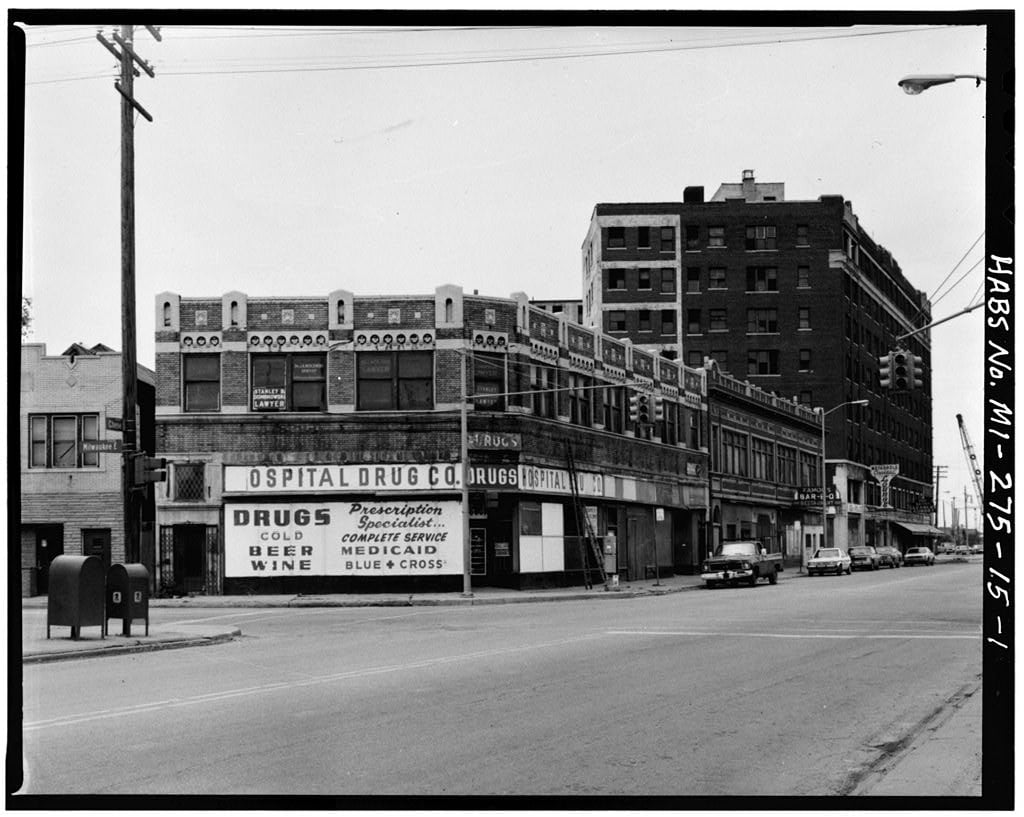
The neighborhood occupied northeast Detroit along Hamtramck's border. Chene Street formed a commercial spine lined with stores, restaurants, banks, apartments, and everyday services. Houses stood close together on narrow lots. Churches provided worship, education, social life, mutual aid, and a sense of continuity.
Poletown had serious problems. Population loss, disinvestment, industrial decline, and vacant buildings were visible by the late 1970s. But decline is not the same as emptiness. Archival photographs show children playing, residents cleaning porches, families packing, customers entering businesses, and people continuing ordinary life while demolition approached.
The Walter P. Reuther Library describes Poletown as a multiethnic, multiracial working-class neighborhood known for affordable housing, access to shops and services, and unusual racial integration. That history matters because official redevelopment language often converts inhabited places into abstract “sites.” Poletown was not merely acreage waiting for a more profitable use.
Detroit and General Motors were both under pressure
Detroit entered the 1980s in a severe economic crisis. Manufacturing employment had fallen, residents and businesses had moved outward, municipal revenue had weakened, and unemployment was rising. The closing of Dodge Main in January 1980 removed thousands of jobs and a major share of Hamtramck's tax base.
General Motors was also changing how it manufactured automobiles. The company wanted a modern plant with an enormous, unified footprint, access to rail and freeways, and space for contemporary single-story production. GM considered keeping production within Detroit, but only if the city could assemble and clear an acceptable site quickly.
Mayor Coleman Young's administration saw the proposal as a chance to retain industrial employment inside the city. The factory was presented as an answer to plant closings, shrinking tax revenue, and the fear that more automobile production would move to suburban or out-of-state greenfield sites.
This context explains the urgency. It does not erase the consequences. The central question was whether public officials could take property from thousands of people and transfer the assembled land to a private company because the promised economic benefits were considered a public purpose.
A neighborhood became the Central Industrial Park
In plans and legal documents, the selected area was renamed the Central Industrial Park. The language made the project sound like the redevelopment of a vacant industrial zone. In reality, the roughly 465-acre footprint contained about 1,500 homes, 144 businesses, 16 churches, schools, and other community institutions.
Estimates commonly place the number of displaced residents at more than 4,000. The clearance also absorbed the former Dodge Main property and numerous industrial structures. Detroit and Hamtramck had to acquire hundreds of separate parcels on a schedule shaped by GM's demands.
Not every resident opposed the plan. Some owners accepted buyouts and moving assistance, welcomed the chance to relocate, or believed the new plant offered Detroit its best hope of retaining jobs. Others felt the offered compensation could not replace an affordable house, nearby relatives, familiar businesses, or a lifetime of community ties.
Those differences divided neighbors. Poletown should not be remembered as a single united community facing a single obvious choice. People evaluated the project from different positions: homeowners and tenants, workers and retirees, business owners and parishioners, supporters of Mayor Young and critics of corporate power.
What they shared was that the final decision would not be theirs.
Watch: the larger forces behind Detroit's crisis
Poletown is often reduced to one mayor, one corporation, or one court case. This History Loves Company film examines the larger network of industrial change, segregation, suburbanization, infrastructure, and public policy that left Detroit fighting to retain jobs by 1980.
Watch The Real Reason Detroit Collapsed on YouTube.
Immaculate Conception became the symbol of resistance
Immaculate Conception Catholic Church stood at 3414 Trombly Avenue. Its congregation had deep roots in Poletown, and the building became the most visible center of opposition after the Archdiocese of Detroit agreed to sell church properties within the project area.
Parishioners and supporters organized the Poletown Neighborhood Council, wrote letters, held demonstrations, attracted national attention, and challenged the use of eminent domain. Consumer advocate Ralph Nader joined the cause. The argument was larger than the price of any one parcel: opponents believed government should not be able to condemn an established neighborhood primarily to transfer land to a private corporation.
After the legal challenge failed, protesters occupied Immaculate Conception for 29 days. Police removed the remaining demonstrators in July 1981. The church was demolished soon afterward.

The Michigan Supreme Court expanded eminent domain
The residents' challenge reached the Michigan Supreme Court as Poletown Neighborhood Council v. City of Detroit. In March 1981, the court ruled 5–2 that the taking could proceed.
The majority accepted the argument that the project served a public purpose because it promised employment, tax revenue, and economic development, even though General Motors would own and operate the resulting plant. The decision expanded the meaning of “public use” under Michigan's constitution and became an influential precedent in eminent-domain disputes across the country.
The dissent warned that the claimed public benefits were not sufficient to justify transferring condemned property to a private corporation. That warning became more important as the promises surrounding the project met the realities of automation, industrial restructuring, and employment levels below early projections.
In 2004, the Michigan Supreme Court overturned the Poletown precedent in County of Wayne v. Hathcock. The court held that taking land for a private business and technology park did not qualify as a valid public use under the state constitution. It could change the law, but it could not restore Poletown.
Documentation preserved what demolition removed
Because federal approvals and historic-preservation requirements were involved, historians, architects, and photographers documented parts of the project area before clearance.
The Historic American Buildings Survey recorded churches, schools, factories, apartments, and the Chene Street commercial district. Architect William Kessler's firm investigated the area's cultural and architectural resources. Photographer Bruce L. Harkness made hundreds of images between February and December 1981, recording both buildings and people.
These collections are invaluable, but they also expose the limits of documentation. A measured drawing can preserve a church's dimensions without preserving its congregation. A photograph can show a storefront without recording every relationship sustained inside it. An archive can keep evidence of a neighborhood, but it cannot substitute for the neighborhood itself.
Preservation should begin before demolition becomes inevitable. When documentation is treated as the final condition of approval, history may be recorded at the exact moment communities lose the power to continue making it.
The plant opened, but the argument never ended
The Detroit-Hamtramck Assembly Center opened in 1985. It produced automobiles for decades and employed thousands of people, though automation meant the workforce fell short of the 6,000 jobs emphasized during the campaign for the project.
The factory was real. The jobs were real. So were the public costs, displaced residents, demolished institutions, and legal precedent. Poletown resists a simple verdict because economic development and community destruction occurred in the same project.
General Motors later retooled the complex as Factory ZERO for electric-vehicle production. The name signals a technological future, but the site's past has not vanished. Beneath the plant and its surrounding land is an erased map of homes, businesses, streets, churches, factories, and family histories.
Even the continuing name “Poletown plant” shows that geography remembers what official branding tries to replace.
Watch: how policy moved people and investment outward
The decision to clear Poletown cannot be separated from the earlier policies that subsidized outward development while weakening neighborhoods inside Detroit. This History Loves Company film explores the financing, roads, housing policy, and racial inequality behind America's suburban expansion.
Watch Why America Really Built the Suburbs on YouTube.
Poletown asks who gets to define progress
The deepest lesson is not that cities should never pursue large projects or that industrial employment did not matter. Detroit's crisis was real, and public officials faced choices with serious consequences no matter what they did.
The lesson is that urgency can narrow public debate until a corporation's requirements begin to look like natural law. A project may promise broad benefits while concentrating its costs on people with the least ability to change the plan. Compensation can purchase property without replacing community.
Better decisions require questions that Poletown made impossible to ignore:
- Were alternative sites and designs investigated honestly?
- Were promised jobs and tax benefits independently tested?
- Who carried the risk if projections failed?
- Could residents meaningfully influence the project, or only negotiate their departure?
- What cultural, architectural, and social value would be impossible to replace?
Those questions belong in every conversation about economic development, stadiums, highways, industrial campuses, and large-scale redevelopment.
Help preserve the lives behind the numbers
If your family lived, worked, worshipped, attended school, or operated a business in Poletown, record the street address and the names of nearby places. Scan photographs front and back. Preserve relocation documents, church records, business advertisements, and letters. Ask where people moved and whether neighbors remained connected.
Explore more Detroit history, Michigan history, Southeast Michigan stories, and the places remembered through Buildings We've Lost. You can also share your Poletown story with History Loves Company.
For the larger story of how policy, industry, segregation, infrastructure, and power reshaped Detroit, discover Christopher Hubel's book They Lied to Us About Detroit. Visit The Foundry by History Loves Company in downtown Pontiac, and subscribe to Stories We Keep.
Poletown was cleared from the map. Remembering the people who lived there keeps the decision—and its cost—from becoming invisible.
Sources and further reading
- Detroit Historical Society: Poletown — neighborhood boundaries, residents, the GM agreement, displacement, protest, and plant history.
- Walter P. Reuther Library: Looking at Poletown — neighborhood life, clearance, historic documentation, and the Bruce L. Harkness photographs.
- Walter P. Reuther Library: Bruce L. Harkness Poletown Photographs — collection description for 200 archival prints documenting Poletown in 1981.
- State Bar of Michigan: Poletown and Eminent Domain — the 1981 decision and its 2004 reversal in County of Wayne v. Hathcock.
- Library of Congress: Poletown Historic District, Chene Street Commercial District — Historic American Buildings Survey photographs and records.
- Library of Congress: Immaculate Conception Catholic Church — exterior and interior documentation made before demolition.
- Walter P. Reuther Library: William Kessler and Associates Records — correspondence, studies, maps, and documentation from the GM Poletown project.
