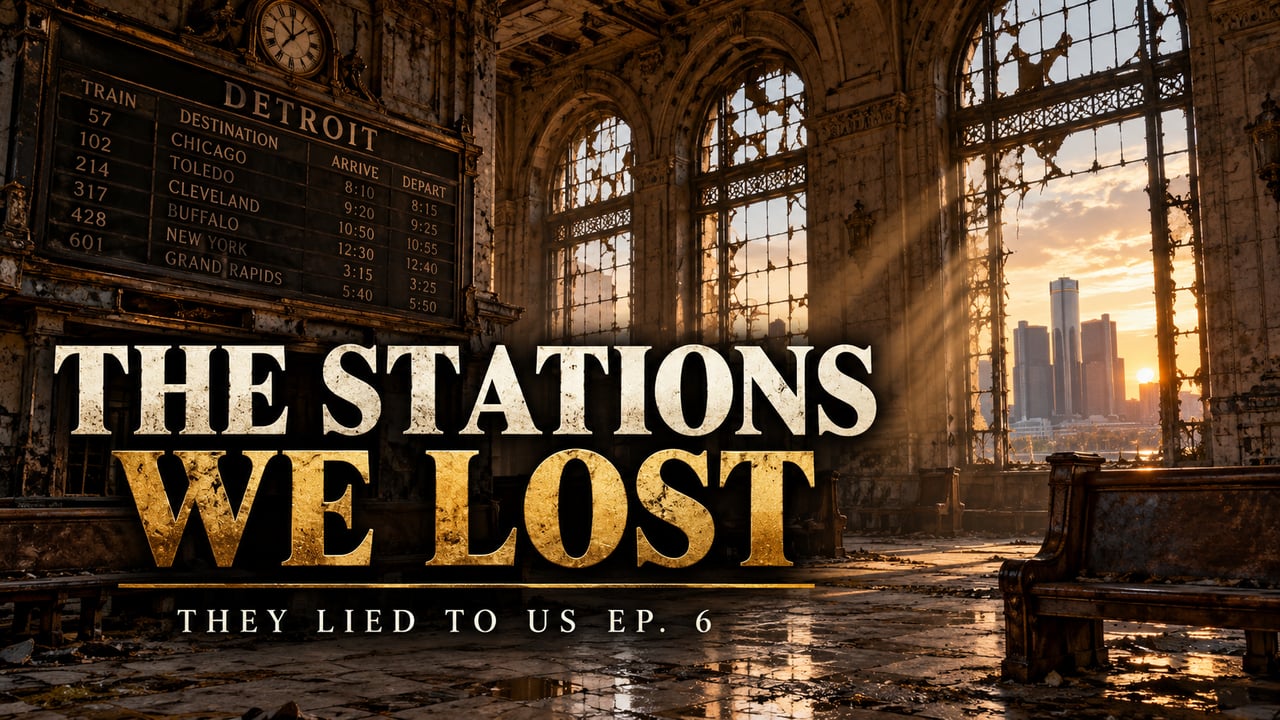
THE STORIES WE KEEP · THEY LIED TO US · EPISODE 6 · OCTOBER 4, 2026
Passenger rail declined—but that alone does not explain why America demolished so many of its grandest public buildings. Episode 6 follows the money, maintenance, laws and second chances behind the stations we lost and the landmarks that survived.

In 1963, workers began tearing down the original Pennsylvania Station in New York.
But the trains did not stop running.
They dismantled the monumental building above the tracks while passengers continued traveling underneath it. This was not simply an abandoned station left behind after the railroad disappeared. The transportation survived. The architecture did not.
That distinction changes the story.
We are often told that America lost its great train stations because people bought cars, started flying and stopped riding trains. Passenger rail did decline, but that explanation is incomplete. If changing travel habits made demolition inevitable, why did some stations disappear while others survived? Why did New York lose Penn Station but save Grand Central? Why was Detroit's Michigan Central Station ultimately restored by an automobile company?
Episode 6 of They Lied to Us looks beyond the familiar explanation and into the decisions underneath it.
Watch Episode 6: Why America Destroyed Its Train Stations
A city's front door
A great station was never merely a place to buy a ticket. It was a city's front door.
Before travelers saw the skyline from a hotel room or met the person waiting for them, the station introduced them to the city. New York's Pennsylvania Station opened in 1910 with monumental columns, a vast waiting room and a concourse of steel and glass. Its architects, McKim, Mead & White, drew inspiration from ancient Roman public buildings.
Detroit created its own unforgettable arrival. Michigan Central Station opened in December 1913. Designed by Warren & Wetmore and Reed & Stem—the firms associated with New York's Grand Central Terminal—it paired an extraordinary passenger station with an eighteen-story office tower.
These buildings were designed to make travel feel important. Their architecture gave public life a sense of ceremony.
The railroad saw a facility. The traveler remembered a goodbye.

The decline was real—but it was not the whole story
Transportation changed dramatically after World War II. Automobiles gave travelers control over when and where a trip began. Commercial aviation offered speed over long distances. Federal investment in the Interstate Highway System made automobile travel easier across a growing national network.
Those changes placed enormous pressure on passenger rail. People were not irrational for choosing cars or airplanes. They were comparing time, convenience, cost and access.
But declining ridership does not explain why every particular building had to be destroyed.
A station built for thousands of daily passengers could become oversized for its original role. The roof did not shrink when ridership fell. Neither did the windows, heating bill, security costs or maintenance needs. A building could remain architecturally important while becoming financially difficult for its owner to carry.
Then there was the value of the land.
Why Penn Station came down
The Pennsylvania Railroad faced a declining passenger business and the cost of maintaining its enormous Manhattan station. It also controlled an unusually valuable development opportunity above the underground tracks.
A redevelopment agreement allowed the railroad to retain its tracks and platforms while replacing the structure above them with Madison Square Garden and office space. Once the transportation system and the architecture were treated as separate assets, the trains could continue without the monumental public rooms.
Demolition began in 1963 and continued for several years.
Penn Station's destruction became a turning point in the American preservation movement. New York adopted its landmarks law in 1965. The law could not bring Penn Station back, but it helped shape the outcome when another famous terminal faced a major redevelopment proposal.
Why Grand Central survived
Grand Central Terminal became a designated New York landmark in 1967. Proposals soon emerged for a large office tower that would have dramatically altered the historic building. Preservationists organized, with Jacqueline Kennedy Onassis among the terminal's most prominent defenders.
The dispute reached the United States Supreme Court. In 1978, the Court upheld New York's application of its landmarks law to Grand Central.
Penn Station and Grand Central were not identical buildings or identical cases. Their finances, uses and redevelopment proposals differed. Yet their different outcomes reveal an essential truth: passenger numbers were not the only forces determining whether a station lived or died. Ownership, development value, preservation law and timing mattered too.
Detroit lost one station and saved another
Michigan Central was not Detroit's only great passenger terminal.
Fort Street Union Depot opened in 1893 near Fort and Third. Its Romanesque architecture and clock tower gave it an entirely different silhouette from Michigan Central. Multiple railroads used it for generations, but its final passenger train departed on April 30, 1971.
Demolition began in January 1974.
Fewer than three years separated the final train from the wrecking crews. A building can take generations to become part of a city's identity and still have only a brief window to find a new purpose once its income disappears.
Michigan Central faced a longer period of uncertainty. The main station building closed in 1988, but passenger rail did not disappear from Detroit. Amtrak continued using smaller facilities and eventually moved to New Center. Once again, the transportation service and the historic architecture were separate questions.
For decades, Michigan Central's broken windows and deteriorated interiors became internationally recognized symbols of Detroit's struggles. Its condition made a new future difficult to imagine.
Abandonment is a condition. It is not an architectural purpose.
Michigan Central's second life
Ford purchased Michigan Central Station in 2018. Following a six-year restoration, the station reopened to the public in June 2024 as the centerpiece of an innovation district with workplace, community and cultural uses.
An automobile company had given a railroad landmark another life.
The restoration was far more than a symbolic gesture or cosmetic repair. It required expertise, skilled labor, recovered and recreated materials, enormous investment and a new operating purpose. Michigan Central does not prove that every abandoned station could have been saved under identical terms. It demonstrates what became possible when the right conditions finally came together.
For decades, the building's next use remained uncertain. That uncertainty ended without the building disappearing first.
Adaptive reuse changes the question
Adaptive reuse lives in the space between the job a building was designed to perform and the job it might perform next.
Cincinnati Union Terminal offers another example. The Art Deco landmark opened in 1933. Passenger service later moved elsewhere, and much of its original train concourse was demolished in 1974. Not everything survived.
But the main terminal did. The Cincinnati Museum Center opened there in 1990, and Amtrak returned in 1991. A single building could support museums, cultural institutions and passenger service rather than being limited forever to one identity.

New York later found another opportunity across from Penn Station. Moynihan Train Hall opened in 2021 inside the historic James A. Farley Post Office. A former mail-sorting space became a passenger hall connected to the Penn Station rail complex.
At the original Penn Station, the rail function remained while the great building disappeared. At Moynihan, a historic building created for the mail gained a new role serving rail travelers.
So why did America destroy its train stations?
There is no single answer that explains Penn Station, Grand Central, Fort Street Union Depot, Michigan Central and Cincinnati Union Terminal.
Passenger demand changed. Monumental buildings became expensive relative to their remaining use. Some properties offered lucrative redevelopment opportunities. Others could not attract investment for a new purpose. Maintenance, ownership, preservation laws and timing varied from one city to another.
Those pressures were connected, but they were not interchangeable.
One station might be endangered because its land was valuable. Another might be endangered because investment was difficult to attract. One could lose its trains. Another could keep its trains while losing its waiting room.
The familiar explanation needs more than a picture of a highway followed by a picture of a wrecking ball. The real story lives in the choices between those images.
Someone looking at Michigan Central in 1988 could not know exactly what would happen in 2018. A use that appears impossible in one decade may become feasible in another. Preserving a building through that uncertainty is not free or easy—but demolition eliminates every future option at once.
A building's original job can end before its possible uses are exhausted.
Which station does your city remember?
Was it demolished, left standing or given a new purpose? Share its story in the YouTube comments and help us document the places America lost—and the landmarks that found another chapter.
Continue the story in print
They Lied to Us About Detroit looks beyond the easiest explanations to examine the policies, people, power and places that shaped Detroit from its beginning to today.
Visit The Foundry
The Foundry by History Loves Company is a creator marketplace, business incubator and storytelling hub in downtown Pontiac. Start small. Grow downtown.
Sources and further reading
- National Archives: National Interstate and Defense Highways Act
- U.S. Supreme Court: Penn Central Transportation Co. v. New York City
- Historic Detroit: Fort Street Union Depot
- Michigan Central
- Cincinnati Museum Center: Union Terminal
They Lied to Us is a History Loves Company series examining the familiar stories we repeat about American cities—and the evidence, decisions and people those explanations often leave out.