A History Loves Company Original
Detroit did not earn the name “Hockeytown” overnight.
It was not a marketing slogan.
It was not a trend.
It was not manufactured.
It was built — decade by decade — inside cold arenas filled with noise, loyalty, heartbreak, and championships.
For more than a century, hockey has been woven into Detroit’s identity. The teams changed. The buildings changed. The city changed. But the culture never left.
This is the story of 100 Years of Hockeytown — the arenas, the players, and the city that made hockey part of who it is.
The Birth of Professional Hockey in Detroit
Detroit entered the NHL in 1926 as the Detroit Cougars, playing their first season at the old Border Cities Arena in Windsor before moving into a new Detroit arena shortly thereafter.
By 1930, the team had been renamed the Detroit Falcons, and in 1932, under new ownership, the franchise adopted the name that would define it forever:
The Detroit Red Wings.
The Winged Wheel logo — a nod to Detroit’s automotive industry — permanently tied hockey to the city’s industrial identity.
From that point forward, Detroit wasn’t just a hockey market.
It was a hockey city.
Olympia Stadium: Where Legends Were Forged (1927–1979)
If Hockeytown has a birthplace, it is Olympia Stadium.
Opened in 1927 on Grand River Avenue, Olympia became one of the most iconic hockey venues in North America.
Inside its walls:
-
The Red Wings won multiple Stanley Cups.
-
The “Production Line” era took shape with Gordie Howe, Sid Abel, and Ted Lindsay.
-
Generations of Detroiters experienced hockey as ritual.
Olympia was not glamorous in a modern sense. It was intimate. Loud. Unforgiving. It felt close.
When the Red Wings left Olympia in 1979, an era ended. The building would eventually be demolished in 1987, but its memory remains foundational to the Hockeytown identity.
Joe Louis Arena: A Riverfront Fortress (1979–2017)
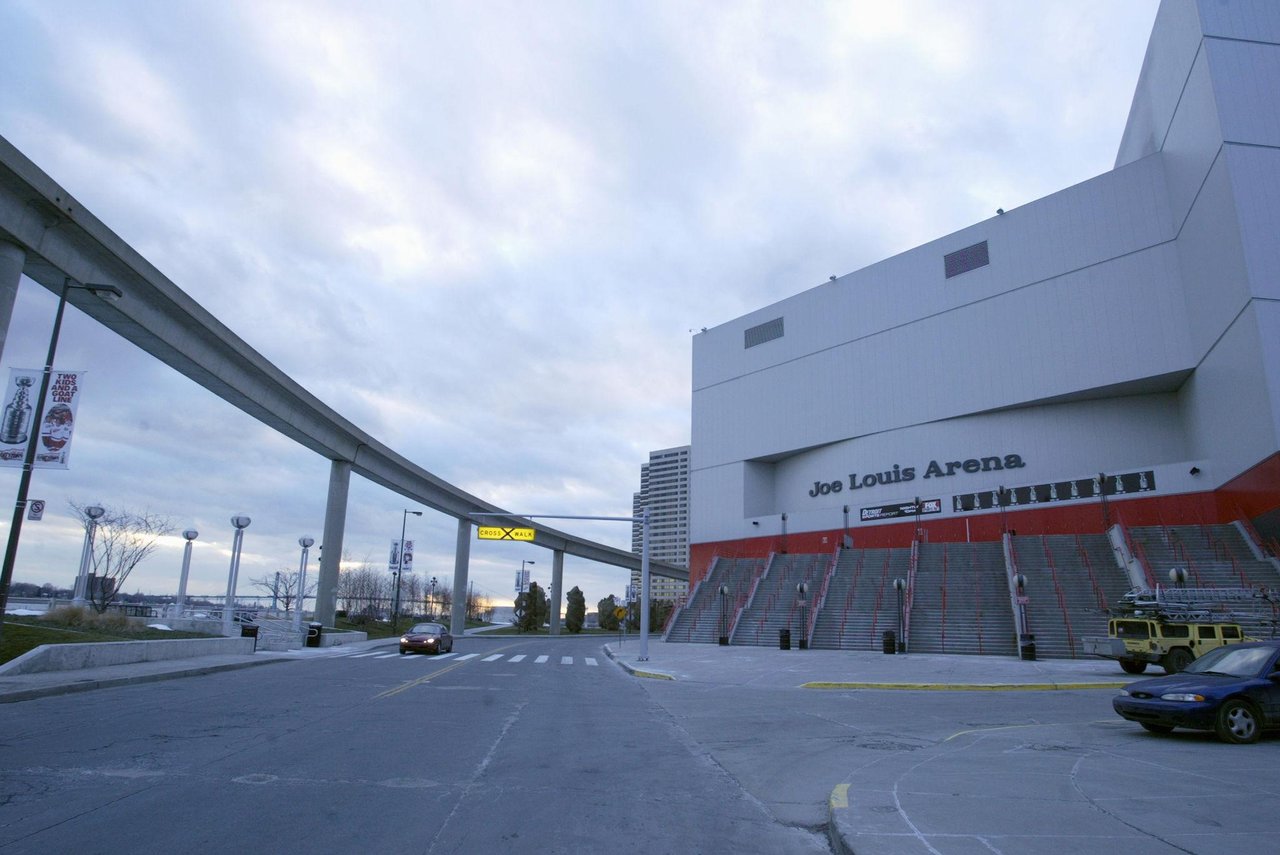
In 1979, the Red Wings moved into Joe Louis Arena, located along the Detroit River.
Joe Louis Arena represented a new chapter — a modern facility that carried the team through some of its most historic years.
It was here that Detroit experienced:
-
The resurgence of the 1990s
-
The Russian Five era
-
The 1997, 1998, 2002, and 2008 Stanley Cup championships
-
The transformation of the Red Wings into a dynasty franchise
The sound inside Joe Louis Arena during playoff hockey became part of the city’s collective memory.
When the building closed in 2017 and was later demolished, Detroit lost another physical landmark — but not the identity formed inside it.
Little Caesars Arena: A New Generation (2017–Present)
In 2017, the Red Wings moved to Little Caesars Arena, located in Detroit’s District Detroit development.
The arena represents a new era — modern, technologically advanced, and built as part of a broader downtown revival effort.
But even in a new building, the culture traveled with the team.
The chants.
The jerseys.
The generational loyalty.
Hockeytown is not defined by brick and steel. It is defined by continuity.
The Legends Who Defined the City
You cannot tell the story of Hockeytown without the players who shaped it:
-
Gordie Howe, whose longevity and physical style embodied Detroit toughness
-
Steve Yzerman, whose leadership anchored the franchise for two decades
-
Nicklas Lidström, a model of precision and quiet dominance
-
Sergei Fedorov, part of the revolutionary Russian Five
-
Ted Lindsay, both champion and labor advocate
-
And many more whose numbers hang in rafters across generations
These players were not just athletes. They were symbols of work ethic, endurance, and loyalty — values deeply aligned with Detroit’s industrial roots.
Why “Hockeytown” Means More Here
Detroit officially embraced the nickname “Hockeytown” in the 1990s, but the sentiment existed long before that branding push.
In Detroit, hockey has historically been:
-
Multi-generational
-
Blue-collar
-
Neighborhood-driven
-
Resilient
The sport thrived even during Detroit’s hardest decades.
When factories closed.
When population declined.
When headlines turned negative.
The arena lights still turned on.
That consistency matters.
The Arenas as Civic Landmarks
Each arena carried symbolic weight beyond the sport itself:
-
Olympia Stadium reflected early 20th-century industrial confidence.
-
Joe Louis Arena stood during Detroit’s late-century challenges and revival.
-
Little Caesars Arena signals a new phase of downtown investment and optimism.
The buildings changed, but each one reflected Detroit’s economic and cultural moment.
Hockeytown as Cultural Memory
Hockeytown is not just about championships.
It’s about:
-
Walking through freezing air toward a glowing arena
-
Hearing the organ echo across a packed building
-
The red jerseys filling Woodward Avenue after a playoff win
-
The Winged Wheel stitched onto jackets for decades
It is one of the most durable cultural throughlines in Detroit history.
Watch the Full Episode
This blog accompanies our Streets of History documentary exploring 100 Years of Hockeytown — from the early Cougars era through Olympia Stadium, Joe Louis Arena, and into Little Caesars Arena.
🎥 Watch the full episode here:
https://youtu.be/5nkhFR0dIZA
After the premiere, the video will also be embedded on this page.