A History Loves Company Original
At the edge of downtown Pontiac, along Rapid Street, stands a building defined by adaptability.
Today, many people recognize 34 Rapid Street as the former home of Planet Rock, a climbing gym that helped introduce indoor rock climbing to a broader Midwest audience. But the building’s story began long before harnesses, climbing walls, and chalk-covered floors.
This structure was born in Pontiac’s industrial era — designed not for leisure, but for work — and its ability to evolve over time is exactly why it still stands today.
This is the history of 34 Rapid Street: its industrial origins, its reinvention as Planet Rock, and what it represents for Pontiac’s future.
Where 34 Rapid Street Is — And Why That Location Matters
34 Rapid Street sits just west of downtown Pontiac, within an area historically shaped by:
-
rail access
-
warehousing and light manufacturing
-
proximity to downtown commerce
Rapid Street developed as a functional corridor, not a ceremonial one. Buildings here were constructed to move goods, house equipment, and support Pontiac’s industrial expansion in the early 20th century.
That utilitarian context shaped the form of the building — and ultimately allowed it to be reused rather than erased.
Early History: An Industrial Building by Design
The building at 34 Rapid Street was constructed during Pontiac’s period of industrial growth, likely in the early-to-mid 20th century, when durable brick-and-masonry structures defined working districts across the city.
Architectural characteristics consistent with industrial use include:
-
heavy masonry construction
-
tall ceilings
-
wide, open interior spans
-
limited exterior ornamentation
-
loading-oriented access rather than storefront glazing
This was a building designed for production, storage, or distribution — not display.
Its value lay in strength and flexibility.
Pontiac’s Industrial Shift and the Space for Reinvention
As manufacturing patterns changed in the mid-to-late 20th century, many buildings like this faced uncertainty.
Factories closed.
Warehouses emptied.
Entire corridors lost their original purpose.
But industrial buildings with open interiors and structural integrity offered something rare: possibility.
34 Rapid Street survived because it could become something else.
Planet Rock: A New Use for an Old Structure
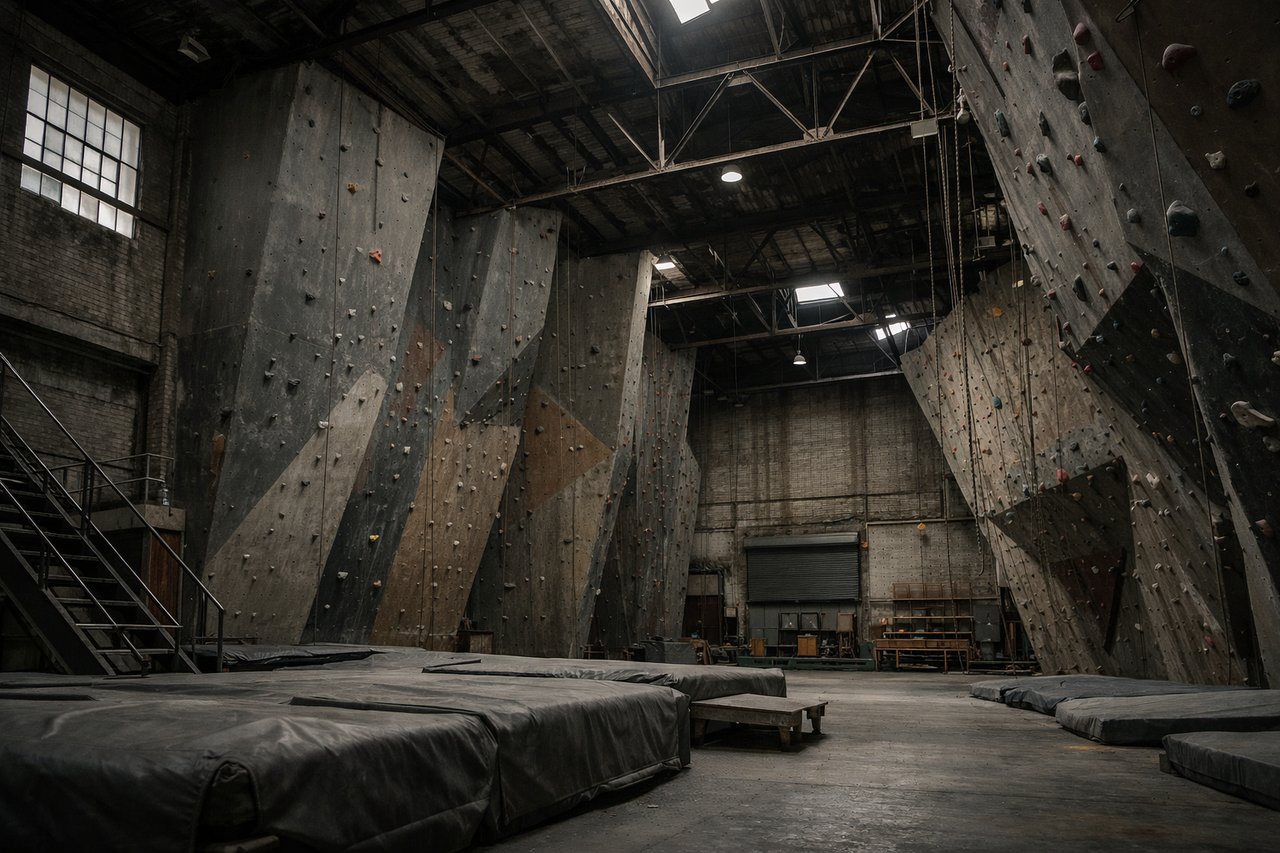
In the late 1990s, the building entered a new chapter as Planet Rock, an indoor climbing gym.
This transformation made sense.
The building’s:
-
height
-
open floor plan
-
structural capacity
were ideally suited for climbing walls, safety systems, and large-scale recreation.
Planet Rock became:
-
a regional destination for climbers
-
a training ground for beginners and experienced athletes
-
a place where industrial architecture supported physical challenge and community
Rather than disguising the building’s industrial past, the gym embraced it. Exposed structure, scale, and raw surfaces became part of the experience.
Cultural Impact Beyond the Building
Planet Rock helped position Pontiac as a place of adaptive reuse, showing that former industrial spaces could support modern, active, community-driven uses.
For many visitors, their first experience inside this building — and sometimes their first time in Pontiac — came through Planet Rock.
That matters.
It reframed how people encountered the city: not as a relic of decline, but as a place where old structures still had purpose.
After Planet Rock
Like many adaptive reuse projects, Planet Rock eventually moved on, leaving the building once again in transition.
What remains is a structure that still carries:
-
its original industrial framework
-
traces of its climbing gym era
-
the capacity for yet another reinvention
Its continued existence is itself significant.
Architecture That Enables Survival
The importance of 34 Rapid Street is not stylistic — it is structural.
This is the kind of building cities either:
-
demolish too quickly
-
or reuse intelligently
Its architecture supports:
-
cultural uses
-
recreational facilities
-
creative industries
-
light commercial or mixed-use redevelopment
It is not fragile. It is not precious. It is useful.
What 34 Rapid Street Represents Today
Today, 34 Rapid Street stands as a reminder that:
-
Pontiac’s industrial buildings were built to last
-
adaptive reuse can extend a building’s life by decades
-
preservation does not require freezing a structure in time
Buildings like this do not ask to be remembered — they ask to be used.
Exploring 34 Rapid Street With Pontiac Pulse
In this Pontiac Pulse episode, we explore:
-
the building’s industrial origins
-
its transformation into Planet Rock
-
how architecture enabled reuse
-
what buildings like this mean for Pontiac’s future
Because Pontiac’s story isn’t just about what it once was.
It’s about what still stands — and what comes next.
Explore More Pontiac History
Pontiac Pulse Archive
https://www.youtube.com/playlist?list=PLu3Y5ZTkLTBMdQmUsZy9ST2U3yth5ZlTM