Olympia Stadium
Where Hockeytown Was Forged
Streets of History — Season 3, Episode 3
Before Little Caesars Arena.
Before Joe Louis Arena.
Before “Hockeytown” was stitched onto jerseys.
There was Olympia.
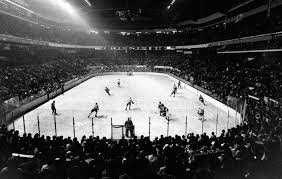
For more than fifty years, Olympia Stadium stood at Grand River and McGraw on Detroit’s west side — a concrete cathedral where championships were won, legends were made, and Detroit’s hockey identity was carved in steel and ice.
This wasn’t just an arena.
It was the birthplace of Hockeytown.
Built for a New League (1927)
Olympia Stadium opened in 1927, built for the newly established Detroit NHL franchise — then known as the Detroit Cougars.
Designed during a period when professional hockey was still solidifying its place in American cities, Olympia represented Detroit’s entry into the big leagues.
The building originally seated roughly 15,000 spectators for hockey and would expand in later years. From the beginning, it was intimate — closer to the ice than modern arenas — which gave it an edge.
You didn’t just watch hockey at Olympia.
You felt it.
The Production Line Era
If Olympia has a golden chapter, it belongs to the 1940s and 1950s.
Inside those walls skated:
-
Gordie Howe
-
Sid Abel
-
Ted Lindsay
Together, they formed what became known as the “Production Line.”
Their style of play — physical, disciplined, relentless — mirrored Detroit’s industrial character.
The Red Wings won multiple Stanley Cups during the Olympia era, including championships in:
-
1936
-
1937
-
1943
-
1950
-
1952
-
1954
-
1955
Olympia was where the Red Wings became a dynasty.
More Than Hockey
Though synonymous with the Red Wings, Olympia hosted far more than hockey.
It was a multi-purpose venue that brought Detroit:
-
The Detroit Pistons (before the NBA team relocated elsewhere)
-
Boxing matches
-
Political rallies
-
Concerts
-
Ice shows
-
Community events
It was one of Detroit’s primary gathering spaces for decades.
In many ways, Olympia functioned as a civic commons.
An Arena Built for Noise
Olympia was known for something modern arenas often struggle to replicate: atmosphere.
Low ceilings. Tight sightlines. Proximity to the ice.
The sound inside the building was overwhelming during playoff games.
When the Red Wings surged in the 1950s — and later during the rise of players like Alex Delvecchio — Olympia’s crowd became part of the team’s identity.
The building amplified Detroit’s voice.
Decline & Transition
By the 1970s, Olympia was aging.
Though beloved, it lacked the modern amenities and revenue streams newer arenas offered. Ownership sought a new downtown venue that could anchor redevelopment efforts along the riverfront.
In 1979, the Red Wings moved to Joe Louis Arena.
Olympia closed that same year.
For a brief time, it sat empty — a concrete reminder of a finished era.
In 1987, Olympia Stadium was demolished.
Today, the site is home to a distribution facility.
There is no grand plaque. No preserved façade.
Only memory.
Why Olympia Still Matters
Olympia matters because it represents a foundational era in Detroit sports culture.
It represents:
-
Detroit’s rise in professional hockey
-
The forging of Hockeytown identity
-
Mid-century civic gathering spaces
-
A style of arena design that prioritized intimacy over spectacle
Olympia wasn’t glamorous.
It was tough.
And that toughness became synonymous with Detroit.
The Emotional Weight of Lost Arenas
When buildings like Olympia disappear, something intangible disappears with them.
Arenas hold sound. They hold ritual.
They hold generational memory.
Fathers taking sons.
Stanley Cup parades.
The hum of anticipation before puck drop.
Olympia Stadium was not just where games were played.
It was where Detroit learned how to win.
Streets of History — Season 3
Season 3 explores Detroit’s civic and cultural landmarks — not just their architecture, but the stories they carried.
The Guardian Building showed us financial ambition.
Olympia Stadium shows us athletic identity.
Next week, we continue the story of Detroit’s arenas — and the evolution of Hockeytown beyond its birthplace.
Watch the Full Episode
🎥 Streets of History — Season 3, Episode 3: Olympia Stadium
Premieres at 6:00 PM EST tonight.
After the premiere, the full documentary will be embedded here.
If you attended a game at Olympia, remember a specific playoff moment, or have old photos — share your story.
Because Hockeytown wasn’t built in a slogan.
It was built at Olympia.
https://www.youtube.com/playlist?list=PLu3Y5ZTkLTBOvXxug9omo2baY2aEUXlYf