A History Loves Company Original
Pontiac didn’t rise quietly.
Long before freeways cut through neighborhoods and before empty lots replaced cornerstones of civic life, Pontiac was a city that built big — bold architecture, ambitious institutions, and monumental buildings designed to announce its importance to the region.
These structures weren’t decoration.
They were statements of confidence, industry, culture, and permanence.
Many of them are gone now.
Some barely survive.
Others are hiding in plain sight, stripped of context but still standing.
This is the story of Pontiac’s forgotten icons — the grand buildings that shaped the city we know today.
A City Built to Be Seen
At the height of its growth, Pontiac was one of Michigan’s most influential cities. Automotive manufacturing, rail access, education, government, and entertainment all converged here.
With that came architecture designed to impress.
Pontiac’s leaders, institutions, and industrialists believed buildings mattered. They commissioned architects to create structures that projected stability and success — structures meant to last generations.
For decades, Pontiac’s skyline told a story of ambition.
The Buildings That Defined Pontiac
The Oakland County Courthouse Complex
The original sandstone courthouse once stood as a symbol of authority and civic pride. Its Romanesque massing and heavy stone construction anchored downtown Pontiac as the seat of county power.
While later government buildings replaced portions of the original complex, the loss of the sandstone courthouse marked one of Pontiac’s earliest architectural wounds — a moment when permanence gave way to modernization.
The Pontiac State Hospital
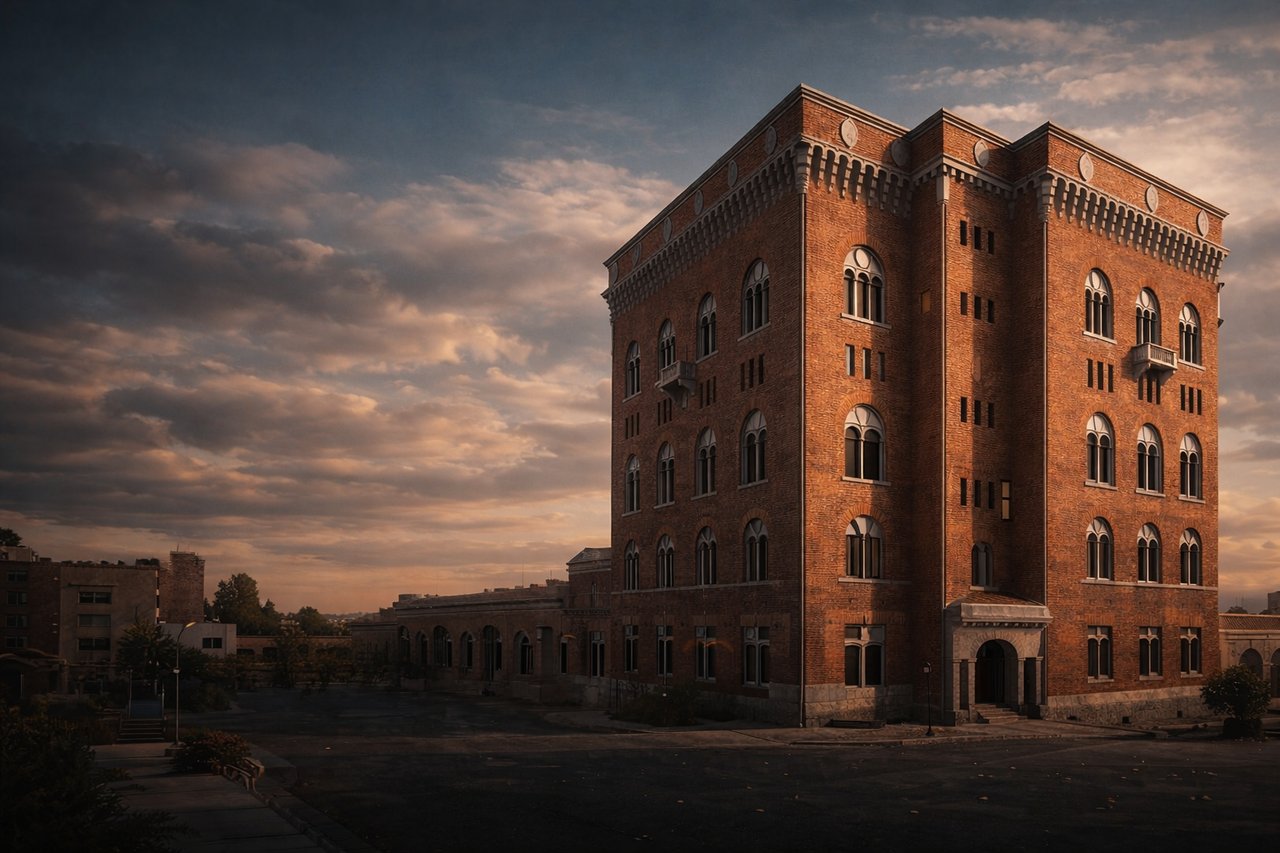
Once one of the largest psychiatric institutions in Michigan, the Pontiac State Hospital was a city unto itself. Massive brick buildings, tunnels, service corridors, and landscaped grounds housed thousands of patients and staff.
It shaped entire neighborhoods, employment patterns, and infrastructure decisions.
Today, nearly all of it is gone. What remains are memories, photographs, and the undeniable imprint it left on the city’s geography.
The Phoenix Center
Built during the era of urban renewal, the Phoenix Center was meant to signal Pontiac’s rebirth. Elevated walkways, modernist forms, and a centralized civic vision promised a new future.
Instead, it became a symbol of an era that misunderstood cities.
Its recent demolition marks another chapter in Pontiac’s evolving identity — and raises difficult questions about preservation, planning, and what cities choose to erase.
The Pontiac Central High School Era
Pontiac once invested heavily in monumental educational buildings. Schools were designed not just to teach, but to inspire — large auditoriums, ornate facades, and civic-scale architecture meant to reflect the importance of public education.
Many of these buildings have been demolished or drastically altered, removing physical reminders of how seriously the city once took its institutions.
Downtown Theaters and Commercial Palaces
Pontiac’s downtown once featured grand theaters, department stores, and commercial blocks that rivaled larger cities. These buildings hosted performances, shopping, meetings, and civic life.
Some survive with altered facades.
Others exist only in photographs.
All played a role in shaping daily life in Pontiac.
Why These Buildings Were Lost
Pontiac’s architectural losses were not caused by a single decision or decade. They resulted from overlapping forces:
• deindustrialization
• population loss
• suburban expansion
• urban renewal policies
• maintenance costs
• shifting economic priorities
In many cases, buildings were removed before preservation was even considered. By the time their value was recognized, they were already gone.
What Still Remains
Despite the losses, Pontiac is not a city without history.
Historic churches, surviving commercial blocks, schools, and civic buildings still anchor neighborhoods across the city. Some are restored. Some are vacant. Some are waiting.
Pontiac’s story is not finished. It is layered.
And understanding what was lost is essential to protecting what remains.
Walking the City With Pontiac Pulse
In this episode of Pontiac Pulse, we revisit the sites of Pontiac’s grand buildings — both standing and vanished.
We explore:
• where they stood
• why they mattered
• what replaced them
• and what their absence tells us about Pontiac’s evolution
This is not a story about blame.
It’s a story about memory, identity, and the choices cities make.
Watch the Full Pontiac Pulse Episode
The complete video exploration is available now on YouTube.
https://youtube.com/@historylovescompany
Pontiac’s past wasn’t small.
And it deserves to be remembered at full scale.