Detroit’s Arsenal of Democracy: When These Streets Powered World War II
Before Detroit became known for abandoned factories…
Before the ruins of massive industrial complexes began appearing across the landscape…
These streets once powered the free world.
During World War II, Detroit transformed almost overnight into something extraordinary.
It became what President Franklin D. Roosevelt famously called:
The Arsenal of Democracy.
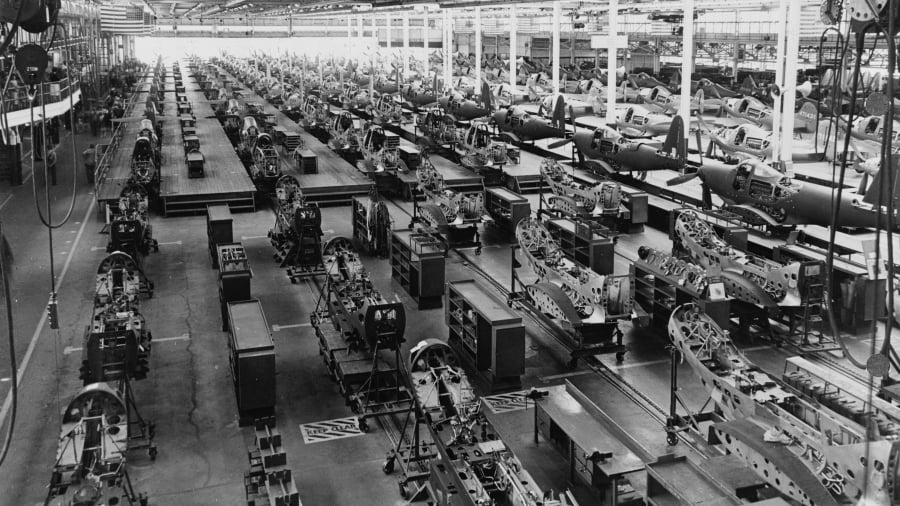
Factories that once built automobiles suddenly began producing tanks, aircraft engines, bombers, and military equipment on a scale the world had never seen.
And for a few critical years in the 1940s, Detroit became one of the most important industrial cities on earth.
A City Built for Manufacturing
Long before the war began, Detroit had already become the industrial heart of America.
Automobile companies like Ford, General Motors, Chrysler, and Packard had built enormous factories across the region.
These plants employed hundreds of thousands of workers and perfected the art of mass production.
Assembly lines stretched across massive factory floors.
Railroads delivered steel, rubber, and raw materials directly to the plants.
Finished automobiles rolled out to dealerships across the country.
Detroit wasn’t just building cars.
It had become the most powerful manufacturing city in the world.
That industrial power would soon be called upon for something much larger than automobiles.
When America Entered the War
On December 7, 1941, the attack on Pearl Harbor pushed the United States into World War II.
Almost immediately, American industry began preparing for wartime production.
Factories across the country were asked to convert their assembly lines to build the machines needed for war.
Detroit was uniquely prepared for this challenge.
Within months, automobile production across the United States stopped almost entirely.
Assembly lines that once produced family sedans were dismantled and reconfigured.
The factories that built America’s cars would now build the equipment needed to fight a global war.
Factories Turn Into War Machines
Detroit’s automakers quickly became the backbone of the Allied war effort.
Factories that once produced automobiles began manufacturing:
• Tanks
• Aircraft engines
• Military trucks
• Bombers
• Weapons and ammunition
One of the most famous examples was Ford’s Willow Run plant, located just west of Detroit.
The enormous factory produced the B-24 Liberator bomber, one of the most important aircraft used during World War II.
At its peak, a bomber rolled off the Willow Run assembly line roughly every 63 minutes.
Meanwhile, Chrysler’s Detroit Arsenal Tank Plant in Warren began producing tanks that would be used by Allied forces across Europe.
Packard, once famous for luxury automobiles, produced powerful aircraft engines used in American fighter planes.
Factories that once built civilian vehicles had become massive wartime production centers.
The Workers Who Powered the Arsenal
Of course, factories do not run themselves.
Millions of Americans stepped forward to support the war effort by working in industrial jobs.
Men who had previously built automobiles began assembling military equipment.
And for the first time on a massive scale, women entered factory work across the country.
The image of “Rosie the Riveter” became one of the defining symbols of the era.
Women welded steel.
Women assembled aircraft.
Women operated heavy machinery that had once been considered industrial work reserved for men.
Across Detroit, factories ran around the clock.
Day shift.
Night shift.
Production never stopped.
Detroit’s Streets During the War
At the height of wartime production, Detroit was one of the busiest industrial cities in the world.
Rail yards moved materials day and night.
Factory lights illuminated the skyline long after sunset.
Workers filled the streets at every hour.
Lunch pails in hand.
Boots hitting pavement.
Thousands of people moving toward the same factory gates.
The city had become the industrial engine behind the Allied war effort.
The Legacy of the Arsenal of Democracy
When World War II ended in 1945, Detroit’s factories slowly returned to producing automobiles.
But the scale of what had happened during the war was extraordinary.
American factories had produced:
• Nearly 300,000 aircraft
• More than 100,000 tanks
• Millions of military vehicles
• Vast quantities of weapons and ammunition
A significant portion of that production came directly from Detroit and the surrounding region.
For a few critical years in history, these streets helped power the defense of democracy.
Watch the Streets of History Series
This story is part of the Streets of History series from History Loves Company, where we explore the places, buildings, and neighborhoods that shaped Michigan’s past.
From Detroit’s industrial giants to forgotten landmarks and historic districts, each episode dives into the stories hiding in plain sight.
The latest episode exploring Detroit’s Arsenal of Democracy premieres tonight at 6PM and will be added to the series.
🎬 Watch the full Streets of History series on YouTube:
https://www.youtube.com/playlist?list=PLu3Y5ZTkLTBOvXxug9omo2baY2aEUXlYf
Preserving the Stories Behind These Streets
Today, many of the factories that powered Detroit’s wartime production have disappeared.
Some have been demolished.
Others sit abandoned.
But the stories behind them remain part of the city’s identity.
At History Loves Company, we explore the places where history happened — the streets, buildings, and neighborhoods that shaped the past.
Because sometimes the most important chapters of history are written not in books…
…but in the places where people lived and worked.