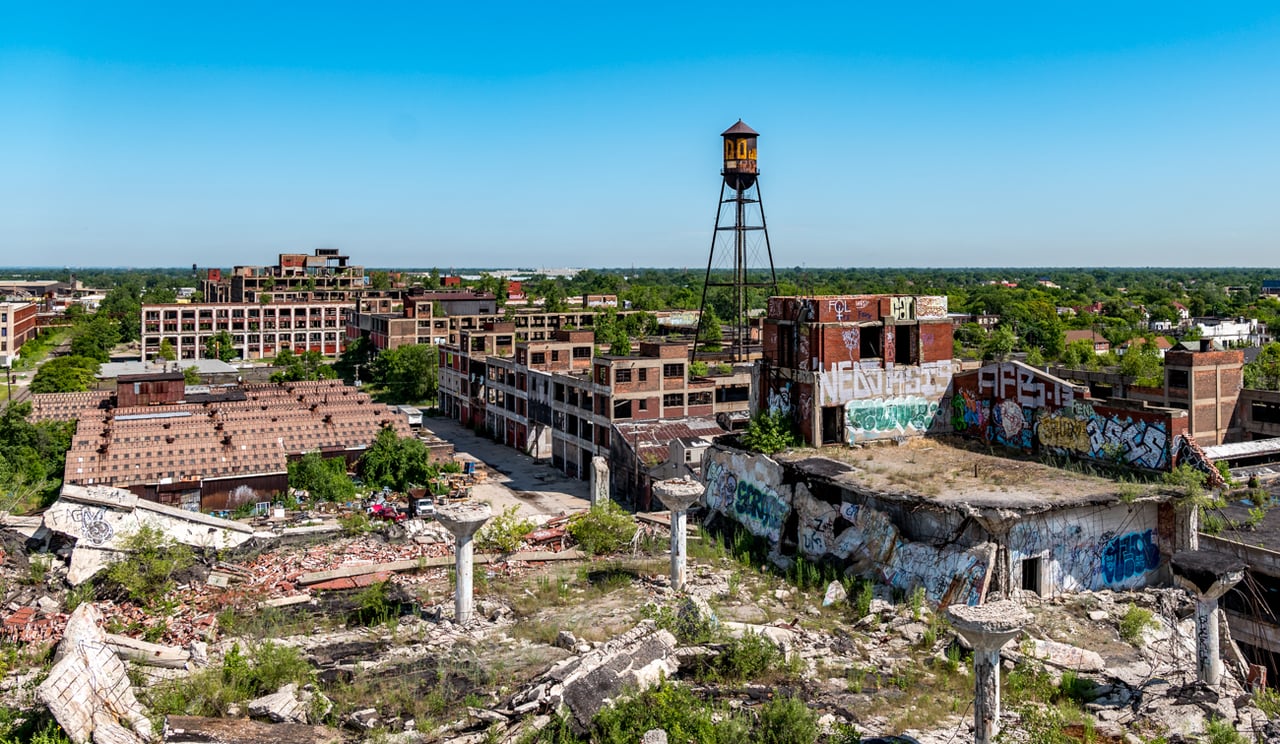
The Rise, Fall, and Uncertain Future of the Packard Plant
Detroit’s Most Famous Industrial Ruin
On Detroit’s east side, stretching along East Grand Boulevard, sits one of the most recognizable ruins in the world.
For decades, the Packard Automotive Plant symbolized the cutting edge of American manufacturing. Later, it became one of the most photographed abandoned places in the United States — a haunting monument to the collapse of industrial Detroit.
But the story of the Packard Plant is far more complex than ruin alone.
It is a story of innovation, architectural revolution, industrial dominance, decline, and now — an uncertain attempt at rebirth.
The Birth of a Revolutionary Factory (1903–1911)
The Packard Motor Car Company was founded in 1899 by brothers James Ward Packard and William Doud Packard in Warren, Ohio. By the early 1900s, Packard had moved operations to Detroit, quickly becoming one of the most respected luxury automobile manufacturers in America.
To keep up with growing demand, Packard commissioned a new factory complex on East Grand Boulevard in 1903.
The architect was Albert Kahn, who would go on to become one of the most influential industrial architects in the world.
The Packard factory introduced a revolutionary design concept:
Reinforced concrete daylight factories.
Large windows flooded the interior with natural light. Concrete framing allowed wider open spaces for machinery and assembly lines. This design would become the template for modern industrial architecture.
In many ways, the Packard Plant helped define how factories would be built across the world.
A Massive Industrial City
Over the next several decades, the complex expanded dramatically.
At its peak, the Packard Plant covered over 3.5 million square feet and included more than 80 buildings spread across roughly 40 acres.
It was not just a factory — it was an industrial city.
Inside were:
-
Assembly lines
-
Machine shops
-
Foundries
-
Power plants
-
Engineering departments
-
Testing areas
-
Offices and design studios
Thousands of workers passed through its gates daily. Entire neighborhoods on Detroit’s east side grew around the factory.
During its golden years, Packard represented luxury, precision engineering, and prestige.
Their motto said it best:
“Ask the Man Who Owns One.”
War Production and the Arsenal of Democracy
During World War II, the Packard Plant played a critical role in American wartime production.
The company produced Rolls-Royce Merlin aircraft engines under license, powering the legendary P-51 Mustang fighter plane used by Allied forces.
The engines were manufactured with incredible precision, and Packard became one of the key contributors to the wartime industrial effort that turned Detroit into the Arsenal of Democracy.
Decline of the Packard Motor Car Company
After the war, Packard struggled to compete in a rapidly changing automobile market.
Large competitors like General Motors, Ford, and Chrysler dominated production and distribution.
Packard attempted to merge with Studebaker in 1954, but the partnership failed to reverse declining sales.
In 1956, the Packard brand ceased Detroit production.
Soon after, manufacturing operations left the East Grand Boulevard factory entirely.
For the first time in over half a century, the massive complex sat largely empty.
From Industrial Giant to Urban Ruin
Over the following decades, the Packard Plant slowly deteriorated.
Various small businesses and industrial tenants occupied portions of the complex during the 1960s and 1970s, but much of the property fell into disrepair.
By the 1990s and early 2000s, the Packard Plant had become one of the most famous abandoned industrial sites in the world.
Urban explorers, photographers, and filmmakers documented its crumbling concrete, shattered windows, and graffiti-covered walls.
The factory became a global symbol of:
-
Detroit’s industrial decline
-
The collapse of American manufacturing
-
The haunting beauty of abandoned architecture
At its worst, fires, scrappers, and weather destroyed large portions of the structure.
Demolition and Redevelopment Attempts
For decades, the future of the Packard Plant remained uncertain.
Multiple redevelopment plans were proposed, but most failed to move forward.
In 2013, Spanish developer Fernando Palazuelo purchased the property with ambitious plans to transform the site into a mixed-use development including offices, housing, and creative spaces.
Some demolition and stabilization work began in the following years.
However, progress slowed dramatically, and the site remained largely unchanged.
Eventually the property fell into tax foreclosure.
What Still Stands Today
In recent years, Detroit officials began a new strategy: clearing much of the collapsing complex while preserving a small portion for future redevelopment.
Large sections of the Packard Plant have now been demolished, removing the most dangerous structures.
However, a portion of the original factory along East Grand Boulevard still stands today.
This remaining section is intended to serve as the foundation for a possible redevelopment project.
Even after decades of decay, the reinforced concrete structures designed by Albert Kahn remain surprisingly resilient.
They stand as one of the last visible fragments of what was once one of the most advanced factories in the world.
Inside the Remaining Structure
In our latest video, we take you inside the remaining structure of the Packard Plant.
Walking through the site today reveals a strange mixture of past and present:
-
Massive concrete columns
-
Broken skylights pouring sunlight onto the factory floor
-
Graffiti layered across a century of industrial walls
-
Quiet corridors where thousands of workers once passed each day
It’s a place where Detroit’s industrial past feels incredibly close.
You can watch the full exploration here:
Why the Packard Plant Still Matters
Few places capture Detroit’s story as clearly as the Packard Plant.
It represents:
• The birth of modern factory architecture
• The rise of Detroit as the automotive capital of the world
• The collapse of American industrial giants
• The ongoing struggle to reinvent historic industrial spaces
For decades it stood as a warning.
Today, what remains may yet become an opportunity.
The Future of the Site
Detroit officials continue to pursue redevelopment options for the remaining structures.
The long-term vision has included possibilities such as:
-
Mixed-use development
-
Commercial space
-
Industrial innovation hubs
-
Creative or cultural spaces
However, the scale and cost of redevelopment remain enormous challenges.
For now, the Packard Plant exists in a kind of limbo — no longer the massive ruin it once was, but not yet fully reborn.
Detroit’s Industrial Memory
Factories like Packard were never meant to last forever.
They were built for production, not preservation.
But the impact they had on cities, workers, and families lasts far longer than the concrete walls that housed them.
The Packard Plant may be a ruin — but it remains one of Detroit’s most powerful historical landmarks.
Watch the Full Video
Our latest episode takes you inside the remaining structure of the Packard Plant, exploring what still stands and the stories hidden inside.
🎥 Watch the video below and step inside one of Detroit’s most legendary industrial sites.