A History Loves Company Original
Long before parking decks, concrete plazas, and large-scale downtown redevelopment, Pontiac hosted a very different kind of civic space.
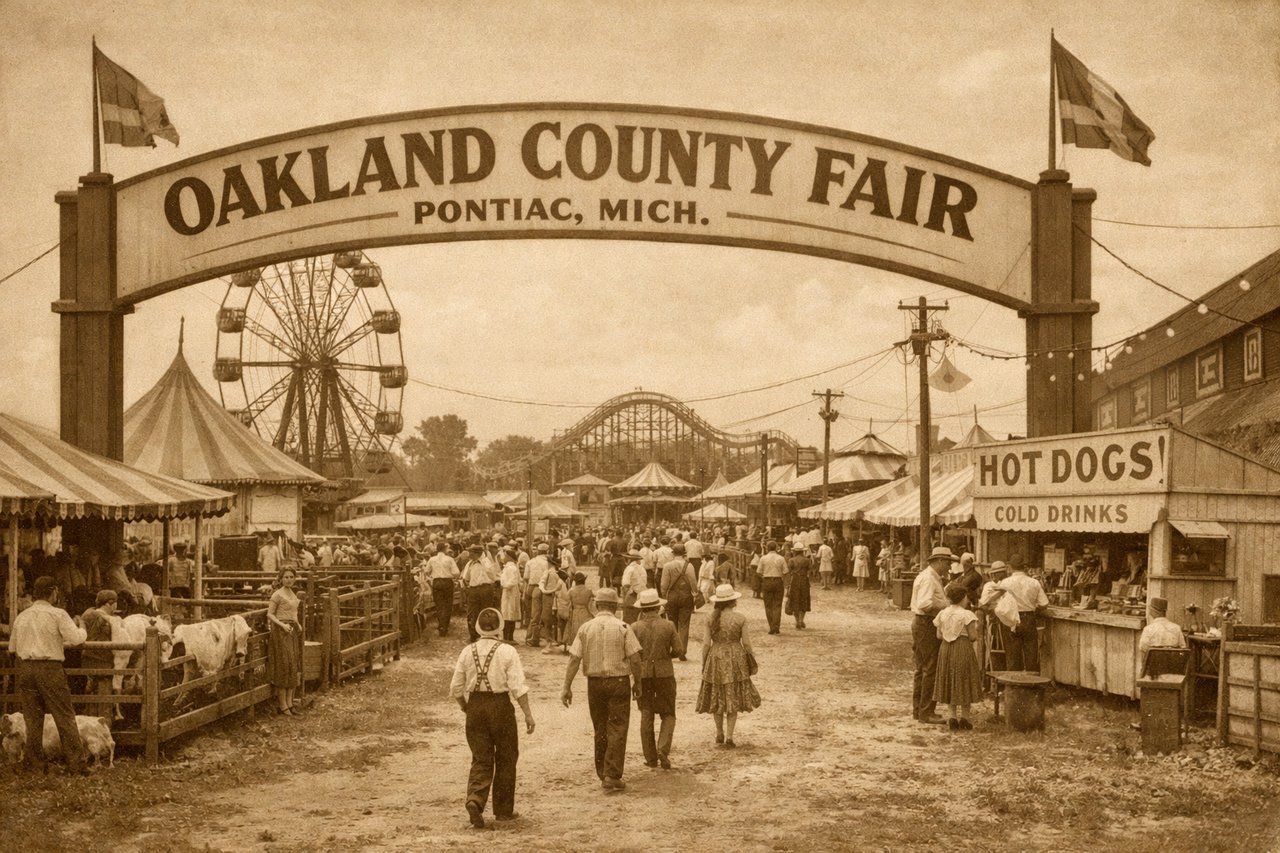
For many years, the Oakland County Fair was held within the city of Pontiac, transforming open land at the edge of the city into a temporary gathering place for agriculture, education, and community life.
It was not a permanent landmark, but it was a powerful one — and today, almost nothing remains to indicate where it once stood.
Pontiac as the County Seat
Pontiac’s role as the county seat of Oakland County made it a natural home for the county fair.
In the late nineteenth and early twentieth centuries, county fairs were not primarily entertainment venues. They served as:
-
agricultural exhibitions
-
livestock competitions
-
public education events
-
demonstrations of new farming equipment and methods
Holding the fair in the county seat reinforced Pontiac’s civic importance and accessibility, bringing rural and urban residents together in one place.
Where the Fairgrounds Were Located
Historic records indicate that the Oakland County Fairgrounds were located on the southeastern edge of Pontiac, in an area that sat just beyond the city’s dense core at the time.
This location was intentional.
Fairgrounds required:
-
large tracts of open land
-
easy access for wagons, rail, and later automobiles
-
distance from residential neighborhoods
-
proximity to government offices and transportation routes
Over time, this area would become increasingly shaped by transportation infrastructure and downtown redevelopment, making it difficult to identify the fairgrounds’ precise location today without historic maps.
A Temporary City
When the fair came to Pontiac, the fairgrounds became a temporary city.
Seasonal structures typically included:
-
livestock barns
-
exhibition halls
-
judging rings
-
food vendors
-
midway attractions
-
grandstands or racetracks
For a short period each year, the fairgrounds drew people from across Oakland County. Farmers showcased their work. Families attended exhibits. Children experienced rides and games unavailable elsewhere.
The fair was both practical and celebratory — reflecting a county still deeply connected to agriculture.
The Changing County
As Oakland County moved through the twentieth century, its identity shifted.
Agriculture declined as suburban development expanded. Automobile ownership changed how people traveled. Large open tracts of land near downtown Pontiac became increasingly valuable for other uses.
At the same time, county fairs themselves evolved, requiring:
-
more parking
-
modern infrastructure
-
larger, more flexible sites
These changes gradually made the fairgrounds incompatible with Pontiac’s urban core.
Relocation and Absence
Eventually, the Oakland County Fair ceased being held in Pontiac.
The fair continued elsewhere for a time, but its physical presence in the city ended. The former fairgrounds were absorbed into the city’s changing landscape, shaped by transportation projects and civic redevelopment.
Later projects, including downtown complexes such as the Phoenix Center, emerged within the same broader redevelopment zone — not as direct replacements, but as part of a new vision for the city.
By then, the fairgrounds themselves had faded from view.
Why the Fairgrounds Were Forgotten
Unlike grand buildings, fairgrounds were never designed to last.
They left behind:
-
few permanent structures
-
limited documentation
-
memories rather than monuments
As generations passed and land use changed, the fairgrounds slipped quietly out of public consciousness.
What the Fairgrounds Represent Today
The Oakland County Fairgrounds represent a different era in Pontiac’s history — one defined by:
-
agriculture and education
-
seasonal public space
-
civic gathering rather than permanent development
They also reflect how cities change, and how certain kinds of places disappear not because they failed, but because they no longer fit modern priorities.
Revisiting the Fairgrounds With Pontiac Pulse
This Pontiac Pulse exploration revisits the Oakland County Fairgrounds to better understand:
-
why Pontiac hosted the fair
-
how the fairgrounds functioned
-
why they disappeared
-
and what replaced them
Because understanding a city’s present requires acknowledging what once occupied its open ground.
Explore More Pontiac History
Discover more stories of Pontiac’s buildings, streets, and forgotten spaces.
Pontiac Pulse Archive
https://www.youtube.com/playlist?list=PLu3Y5ZTkLTBMdQmUsZy9ST2U3yth5ZlTM