Part 2: What Stands There Now
In Part 1, we walked through the stadiums Detroit lost — the places where tens of thousands gathered, where noise shook steel, and where memories were burned into concrete. But history doesn’t end with demolition. It just changes shape.
So we went back. We stood in the exact footprints of Detroit’s lost stadiums to see what replaced them — and what, somehow, still remains.
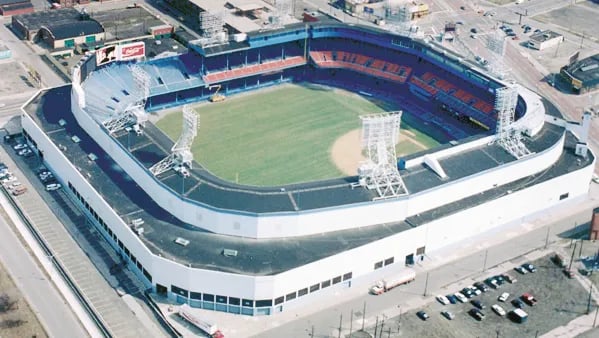
Tiger Stadium → The Corner Ballpark (Michigan & Trumbull)
Where the roar of 50,000 once rolled through Corktown, you now hear something quieter — kids playing ball.
Tiger Stadium’s footprint still lives on as The Corner Ballpark, a community field that preserves the diamond’s original orientation. It’s smaller, humbler, but deeply intentional. The foul lines still follow history. Home plate still sits where generations of Detroiters once watched legends.
It’s not a monument — it’s a continuation.
Olympia Stadium → Olympia Park (Grand River & McGraw)
Detroit’s original hockey cathedral is now a neighborhood park.
Where Gordie Howe and the Red Wings once played, you’ll find skate parks, ball fields, walking paths, and benches. Some of the original light posts still stand nearby — quiet artifacts of what once lit the ice.
It’s one of the most poetic transformations in the city: a place once dedicated to sport, still serving movement and community — just in a different form.
Joe Louis Arena → Riverfront Promenade
Joe Louis Arena didn’t disappear — it dissolved into the river.
The site where Stanley Cups were lifted is now part of Detroit’s revitalized riverwalk, open to joggers, families, and cyclists. The building is gone, but the location is more public than ever.
If you stand still long enough, you can still feel the energy — not from the walls, but from the water.
Pontiac Silverdome → Amazon Fulfillment Center
This is the transformation that still shocks people.
Where 90,000 watched WrestleMania III, where the Lions once played, now stands a massive Amazon logistics facility. The scale is still there — the footprint is unmistakable — but the purpose has changed completely.
It’s a reminder of how the modern economy repurposes space, even when that space once held history.
The Palace of Auburn Hills → Mixed-Use Development
The Palace, once considered one of the best arenas in the country, is gone.
Its replacement is still taking shape — a blend of commercial and mixed-use development — with no single building yet able to replace the cultural weight the arena carried.
For many, this one still feels unresolved.
Cobo Arena → Convention Expansion
Often confused with Joe Louis, Cobo Arena once stood beside it, hosting concerts, boxing, wrestling, and political conventions. Today, its footprint is folded into the expanded Huntington Place Convention Center.
The events are different now — but people are still gathering.
What This Tells Us About Detroit
Detroit doesn’t erase history — it repurposes it.
Some sites became parks.
Some became jobs.
Some became public spaces.
Some became quiet.
But none of them are empty.
Every former stadium still holds a purpose, even if it’s not the one we remember. And that may be the most Detroit thing of all — the city keeps moving, even when it carries loss with it.
Help Us Keep These Stories Alive
If you attended a game, a concert, or a moment in any of these places, we want to hear it. Your stories are part of the record now.
Share them in the comments, or send them to us for future episodes of Streets of History.
Because buildings can disappear —
but memory doesn’t have to.
This blog is Part 2 of our Lost Stadiums of Detroit series. Watch the full video episode to see these locations side by side — past and present.