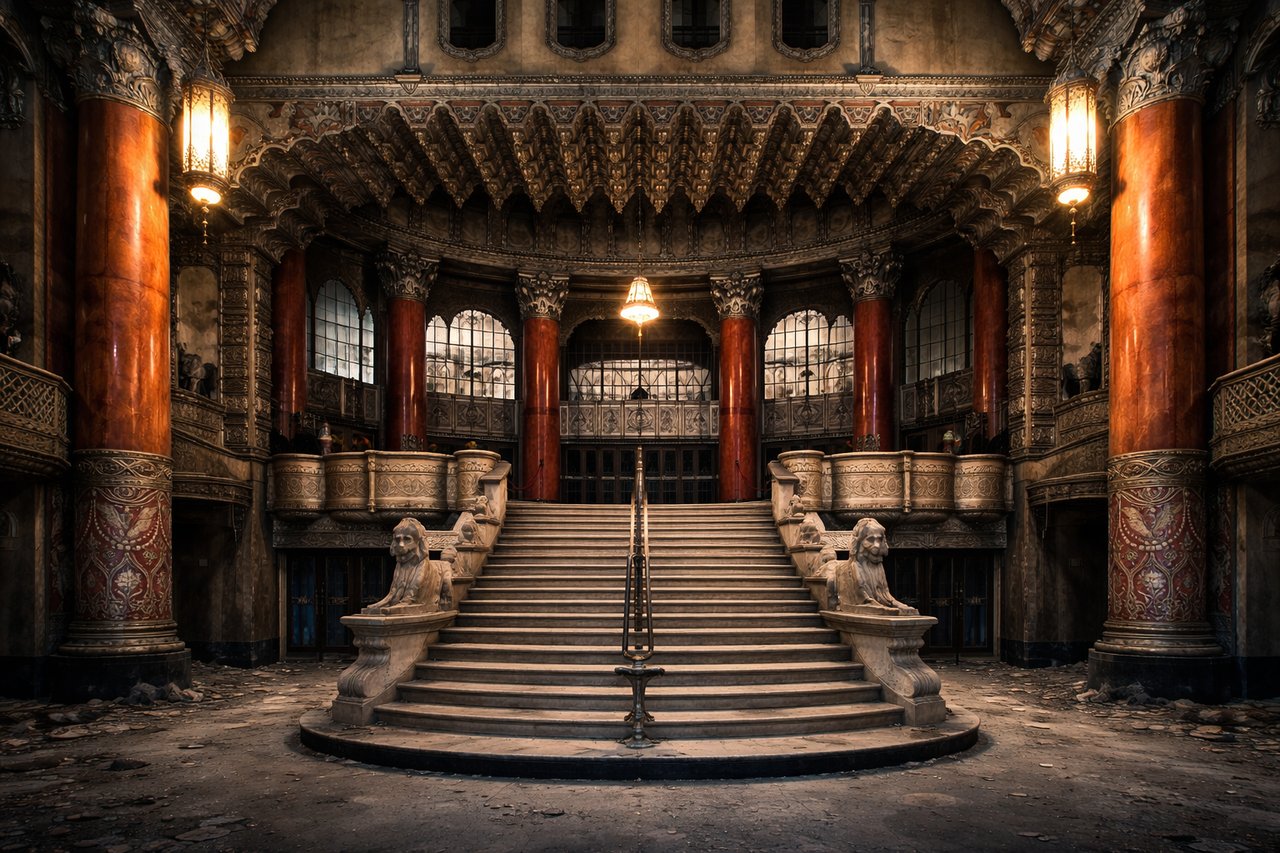
Detroit’s Lost Theatres
The Movie Palaces and Performance Halls That Once Defined the City
In the early 20th century, Detroit was one of the great theatre cities in America.
Long before television and long before suburban multiplexes, Detroiters gathered downtown to experience entertainment as a shared civic ritual. Theatres were not merely places to watch a film or performance — they were architectural statements, cultural anchors, and economic engines.
Many of those theatres are gone now. Some were demolished outright. Others were altered beyond recognition. A few survived through preservation and reinvention.
Together, they tell a story about Detroit’s rise, decline, and the cost of forgetting.
Detroit’s Theatre Boom (1900–1930)
Detroit’s explosive population growth during the early 20th century created demand for large-scale entertainment venues. As the city’s industrial economy expanded, so did its cultural ambition.
Between roughly 1900 and 1930, Detroit saw the construction of:
-
vaudeville theatres
-
opera houses
-
silent movie palaces
-
early sound-era cinemas
These theatres clustered along Woodward Avenue, Broadway, Monroe Street, and near Grand Circus Park, turning downtown into an evening destination city.
Many were designed by nationally prominent theatre architects — most notably C. Howard Crane, whose work defined Detroit’s entertainment architecture.
The Michigan Theatre (1926–1976)
Detroit’s Most Infamous Cultural Loss
The Michigan Theatre opened in 1926 as one of the grandest movie palaces ever built in the United States.
Designed by C. Howard Crane with interior work by the firm Rapp & Rapp, the Michigan Theatre featured:
-
a French Renaissance–inspired interior
-
a grand staircase and mezzanine
-
massive chandeliers
-
seating for over 4,000 patrons
Unlike earlier theatres, the Michigan was conceived specifically as a movie palace, reflecting the cultural shift from live vaudeville to film.
By the 1960s and 1970s, declining attendance, rising maintenance costs, and downtown disinvestment left the theatre vulnerable. In 1976, the building was demolished. A parking garage was constructed within the remaining structure, leaving the former lobby shell visible for decades.
The Michigan Theatre became a national symbol of urban loss — frequently cited in preservation literature as a cautionary example.
The Madison Theatre (1927–1976)
The Madison Theatre, also designed by C. Howard Crane, opened in 1927 on Broadway Street.
Smaller than the Michigan Theatre but still richly ornamented, the Madison served as both a movie house and live-performance venue. It remained in operation longer than many of its contemporaries but ultimately closed during the same period of downtown decline.
The Madison Theatre was demolished in 1976, the same year as the Michigan Theatre — a coincidence that underscored how rapidly Detroit’s entertainment landscape was being erased.
The National Theatre (1911–1975)
The National Theatre opened in 1911 on Monroe Street as a vaudeville house.
Like many theatres of its era, it transitioned from live performance to film as audience tastes changed. The National Theatre served working-class audiences and remained an active venue for decades.
It closed in the 1970s and was demolished in 1975, leaving little documentation beyond photographs and archival references.
The United Artists Theatre (1928–Present, Altered)
Not all lost theatres disappeared completely.
The United Artists Theatre, located near Grand Circus Park, opened in 1928 with a Spanish Gothic design.
Though the theatre ceased operation in its original form, the building survived. Portions of its interior were altered or removed, but significant architectural elements remain integrated into later redevelopment projects.
Its survival demonstrates how adaptive reuse — even imperfect — can preserve fragments of cultural history.
Paradise Theatre (1928–1951; demolished 1956)
A Cultural Loss Beyond Architecture
The Paradise Theatre opened in 1928 in Detroit’s Paradise Valley neighborhood, the center of Black cultural life during segregation.
The Paradise Theatre hosted:
-
jazz legends
-
touring Black performers
-
concerts excluded from white-only downtown venues
It was not merely a theatre — it was a cultural institution during an era of restricted access.
The Paradise Theatre closed in 1951 and was demolished in 1956 during urban renewal projects that erased much of Paradise Valley.
Its loss was both architectural and cultural, severing a critical space of Black artistic expression.
Other Lost or Altered Theatres
Detroit’s losses extend far beyond the most famous names.
Numerous smaller theatres once lined downtown streets and neighborhood corridors. Many were:
-
converted to retail or office use
-
stripped of ornamentation
-
demolished without documentation
Each loss narrowed Detroit’s architectural diversity and reduced its cultural footprint.
Why Detroit’s Theatres Fell
Detroit’s theatre collapse was not inevitable — it was cumulative.
Key factors included:
-
suburbanization and population loss
-
television reducing movie attendance
-
rising costs to maintain massive interiors
-
lack of preservation policy
-
prioritization of parking and road infrastructure
These buildings were expensive to maintain and difficult to repurpose without coordinated investment.
What Replaced the Theatres
In many cases, theatres were replaced by:
-
surface parking lots
-
parking structures
-
low-rise commercial buildings
The replacements rarely matched the cultural or architectural value of what was lost.
This imbalance is why Detroit’s lost theatres continue to resonate decades later.
What Survived — And Why
Some theatres survived because they:
-
remained in continuous use
-
attracted preservation funding
-
found new performance models
-
benefited from changing public attitudes
The survival of venues like the Fox Theatre and Detroit Opera House illustrates what was possible — and what might have been saved.
Why Detroit’s Lost Theatres Still Matter
These theatres mattered because they:
-
created shared public experiences
-
anchored downtown nightlife
-
democratized access to culture
-
reflected Detroit’s confidence as a city
Their disappearance reshaped how Detroit gathers and entertains.
Remembering the Lost Palaces With Streets of History
This Streets of History exploration revisits Detroit’s lost theatres to understand:
-
where they stood
-
how they functioned
-
why they vanished
-
and what their absence reveals
Because history is not only what survives — it’s also what disappears.
Explore More Streets of History
Discover more lost places, surviving landmarks, and forgotten stories across Detroit and Michigan.
Visit History Loves Company
https://www.historylovesco.com