A History Loves Company Original
When people talk about Detroit’s amusement park history, one name usually comes up first.
Boblo.
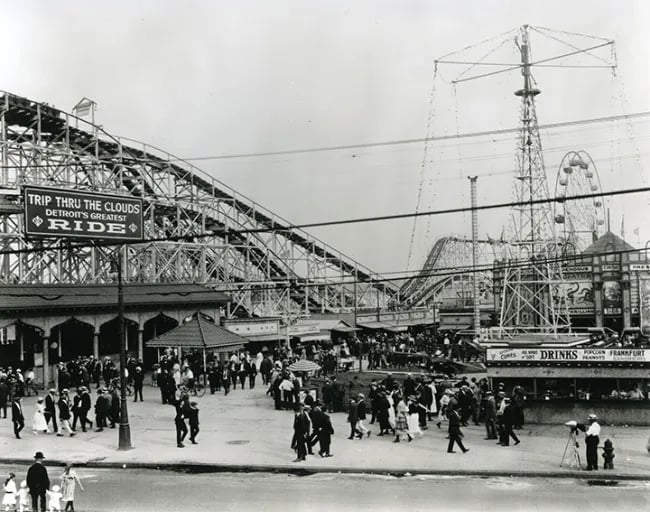
But for decades on Detroit’s west side, another park quietly shaped summer memories — one that didn’t require a boat, a passport, or a full day commitment. It sat at the edge of the city, woven into neighborhood life, and became a refuge during some of Detroit’s hardest years.
This was Edgewater Amusement Park — Detroit’s other amusement park — and its story is inseparable from the people who lived around it.
Where Edgewater Was — And Why That Matters
Edgewater Amusement Park was located at Seven Mile Road and Berg Road, near Grand River Avenue, on Detroit’s west side.
This location mattered.
Unlike Boblo Island, Edgewater was:
-
accessible by streetcar and automobile
-
embedded in residential neighborhoods
-
inexpensive and informal
-
part of everyday city life
It wasn’t a destination you planned weeks in advance. It was somewhere you went after dinner, on a weekend afternoon, or whenever you needed a break from the city.
Opening During Uncertain Times
Edgewater Amusement Park opened on July 2, 1927, just two years before the Great Depression.
At the time, Detroit was booming — but that prosperity was fragile. When the Depression hit, Edgewater unexpectedly became something more important than entertainment.
It became escape.
For a few cents, families could forget unemployment, rationing, and uncertainty. During the Depression and later through World War II, Edgewater provided affordable joy when joy was in short supply.
Early Attractions and Growth
In its earliest years, Edgewater was modest in scale, but carefully designed to appeal to families.
Initial attractions included:
-
small rides
-
concession stands
-
games of chance
-
open picnic areas
But the park’s biggest transformation came in 1947, when it was purchased by Henry Wagner, a former employee of Detroit’s Electric Park.
The Wagner Era: Expansion and Identity
Henry Wagner was no stranger to amusement parks.
After acquiring Edgewater in 1947, Wagner dramatically expanded the park:
-
increasing the number of rides from seven to twenty-three
-
investing in larger attractions
-
modernizing infrastructure
Under Wagner and later his sons, Edgewater developed its defining features.
Notable attractions included:
-
the Wild Beast, a wooden roller coaster
-
a 110-foot Ferris wheel
-
the Hall of Mirrors
-
midway games and family rides
Edgewater wasn’t trying to compete with destination parks. It leaned into being local, familiar, and accessible.
A Park for the Neighborhood
Edgewater mattered because it belonged to its surroundings.
It served:
-
west side families
-
teenagers meeting friends
-
couples on casual dates
-
kids experiencing their first rides
It was loud, colorful, imperfect, and deeply human.
This was not a polished resort. It was a neighborhood institution.
Innovation: Pay One Price
In 1960, Wagner’s son Milton Wagner introduced an idea that would change the amusement industry: Pay One Price, or POP.
Instead of paying per ride, visitors paid one admission fee for unlimited rides.
This concept:
-
increased accessibility
-
encouraged longer visits
-
became an industry standard
Edgewater was not just following trends — it was shaping them.
The Beginning of the End
By the 1970s, the forces that would eventually close Edgewater were becoming unavoidable.
These included:
-
rising insurance and operating costs
-
aging rides and infrastructure
-
competition from modern theme parks
-
suburban sprawl pulling families farther away
-
declining neighborhood population
What once made Edgewater strong — its local roots — also made it vulnerable.
Closure and Demolition
Edgewater Amusement Park closed permanently in 1981.
The rides were dismantled.
The lights went dark.
The sounds disappeared.
The land was eventually redeveloped, erasing most physical traces of the park’s existence.
Today, nothing immediately signals what once stood there — except memory.
What Edgewater Represents Now
Edgewater is rarely discussed in national amusement park histories, but it holds enormous local significance.
It represents:
-
working-class leisure
-
neighborhood-scale entertainment
-
joy during hardship
-
innovation born from necessity
It also represents how easily everyday history disappears when it isn’t monumental enough to protect.
Why Edgewater Still Matters
Edgewater matters because it reminds us that history is not only found in grand estates or famous landmarks.
It lives in:
-
places people gathered
-
memories passed down quietly
-
corners of cities that never made postcards
Detroit didn’t just have one amusement park.
It had many — and Edgewater was one of the most human.
Revisiting Edgewater With Streets of History
In this Streets of History exploration, we revisit Edgewater to understand:
-
where it stood
-
why it mattered
-
how it served its community
-
and why it disappeared
Because places don’t have to be famous to be important.
Explore More Streets of History
Discover more neighborhoods, lost places, and surviving landmarks across Michigan.
Streets of History Archive
https://www.youtube.com/playlist?list=PLu3Y5ZTkLTBN1xQZIwibbwllscpmW1bEr