A History Loves Company Original
For nearly a century, Pontiac State Hospital stood as one of the largest, most influential institutions in Oakland County.
It employed thousands.
It reshaped neighborhoods.
It altered the physical and social landscape of Pontiac.
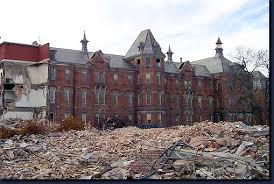
And today, almost all of it is gone.
Yet the impact of Pontiac State Hospital is still felt — not just in memory, but in the city’s layout, infrastructure, and identity.
This is the story of an institution that once functioned as a city within a city.
Where the Hospital Stood
Pontiac State Hospital was located on the north side of Pontiac, occupying a massive campus bounded roughly by Telegraph Road, Elizabeth Lake Road, and surrounding residential areas.
At its height, the hospital complex covered hundreds of acres, containing dozens of buildings, internal roadways, utility systems, farms, and underground service tunnels.
Its size alone made it impossible to ignore.
Origins and Early Construction
The hospital was authorized by the State of Michigan in the late 19th century as part of a broader movement toward centralized state-run psychiatric care.
Construction began in the 1890s, and the hospital officially opened in 1893 under the name Eastern Michigan Asylum. It was later renamed Pontiac State Hospital.
The facility was designed according to the prevailing psychiatric philosophy of the era, which emphasized:
-
isolation from urban centers
-
fresh air and farmland
-
regimented daily routines
-
large institutional buildings
This approach reflected both medical theory and social attitudes of the time.
Architecture and Campus Design
Pontiac State Hospital was built using a Kirkbride-influenced institutional model, characterized by:
-
massive brick ward buildings
-
symmetrical layouts
-
long corridors and wings
-
centralized administration buildings
-
service structures such as laundries, kitchens, and power plants
The architecture was utilitarian but monumental — meant to communicate order, authority, and permanence.
Over time, additional buildings were added as patient populations increased, resulting in a dense and complex campus.
A City Within a City
At its peak in the early- to mid-20th century, Pontiac State Hospital housed thousands of patients and employed well over a thousand staff members.
The campus included:
-
housing for staff
-
medical wards
-
kitchens and bakeries
-
a power plant
-
farms and gardens
-
workshops
-
recreational facilities
Patients often worked on the grounds as part of treatment and daily operations — a common practice at the time.
For many residents of Pontiac, the hospital was one of the city’s largest employers for generations.
Treatment, Reality, and Changing Attitudes
Like many large psychiatric institutions of its era, Pontiac State Hospital reflected evolving — and often troubling — approaches to mental health care.
Early treatment methods included:
-
confinement
-
labor-based therapy
-
rigid routines
As medical understanding progressed, treatment models changed, but the hospital also became overcrowded, underfunded, and strained.
By the mid-20th century, large state hospitals across the country were facing criticism for:
-
patient overcrowding
-
outdated facilities
-
insufficient staffing
-
ethical concerns
Pontiac State Hospital was not unique in this regard — it was part of a national system undergoing reevaluation.
Decline and Closure
Beginning in the 1960s and 1970s, Michigan — like many states — began shifting away from large institutional psychiatric care toward community-based treatment.
Patient populations declined.
Buildings aged.
Maintenance costs soared.
By the 1980s, large portions of the campus were underutilized. The hospital officially closed in 1991, ending nearly a century of operation.
Demolition and What Replaced It
Following closure, most of the hospital buildings were demolished throughout the 1990s and early 2000s.
Redevelopment of the site included:
-
residential neighborhoods
-
commercial development
-
road expansions
Today, very little physical evidence of Pontiac State Hospital remains visible above ground.
However, remnants such as foundations, landscape features, and underground infrastructure continue to fuel interest, speculation, and local memory.
Myths, Tunnels, and What’s Documented
Pontiac State Hospital has long been the subject of stories about underground tunnels and hidden passageways.
What is documented:
-
service tunnels existed to move supplies, utilities, and staff between buildings
-
underground infrastructure was common in large institutional campuses
What is not documented:
-
secret escape tunnels
-
vast unexplored underground networks
Like many former institutions, legend has grown where documentation ends. Separating fact from folklore is part of understanding the site’s legacy.
How the Hospital Shaped Pontiac
Pontiac State Hospital influenced:
-
population growth
-
employment patterns
-
transportation routes
-
housing development
-
the city’s northward expansion
Entire neighborhoods grew to support hospital staff and their families. Roads and utilities were extended because the hospital required them.
Even after demolition, the hospital’s footprint continues to shape the city.
Remembering Pontiac State Hospital Today
Pontiac State Hospital no longer stands, but its story matters.
It represents:
-
a major chapter in Michigan’s mental health history
-
the rise and fall of institutional care
-
the impact of large state facilities on local cities
-
how places can disappear while their influence remains
Understanding Pontiac requires understanding this institution.
Walking the Site With Pontiac Pulse
In this Pontiac Pulse exploration, we examine:
-
where the hospital stood
-
how it operated
-
why it closed
-
what replaced it
-
and how memory persists even after demolition
Pontiac State Hospital shaped the city — even in absence.