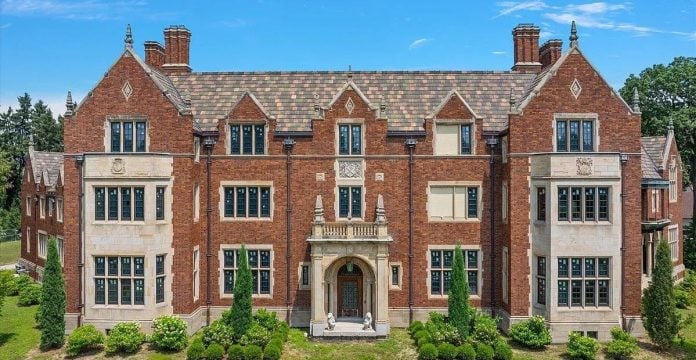
The Bishop Mansion
From Gilded Age Grandeur to Collapse — and What Comes Next
For more than a century, the Bishop Mansion has stood as one of Detroit’s most imposing and misunderstood homes.
Towering in scale, ambitious in design, and burdened by decades of uncertainty, the mansion’s story is not a simple rise-and-fall narrative. It is a reflection of Detroit itself — optimism, overreach, abandonment, and now, the possibility of renewal.
This is the full story of the Bishop Mansion — where it came from, how it nearly disappeared, and what its future may finally hold.
A Mansion Built for Status, Not Subtlety
Constructed in the early 20th century during Detroit’s period of immense industrial wealth, the Bishop Mansion was designed to project authority and permanence. Homes of this scale were not built to blend in. They were meant to be seen.
With its massive footprint, elaborate masonry, and commanding presence, the mansion reflected a time when Detroit’s elite expressed success through architecture. These homes were physical proof of confidence — not just in personal wealth, but in the city’s future.
From the beginning, the Bishop Mansion stood apart.
Changing Hands, Changing Purpose
Like many of Detroit’s grand homes, the mansion’s original residential life did not last forever.
As neighborhoods evolved and maintenance costs grew, the building passed through multiple phases of use and ownership. Over time, the mansion transitioned away from private residential life and into institutional and commercial roles — a common fate for large historic homes in Detroit.
Each transition chipped away at the original intent of the building. While the structure remained, its identity blurred.
Decline and Speculation
By the late 20th and early 21st centuries, the Bishop Mansion had become a symbol of stalled ambition.
Highly publicized listings, ambitious redevelopment proposals, and long periods of vacancy placed the mansion in the spotlight — often without progress to match the attention. Deferred maintenance took its toll. Interiors deteriorated. Weather and neglect did what time alone never could.
At one point, the mansion was famously listed at $9 million, a price that captured headlines but failed to reflect the reality of its condition or the scale of restoration required.
The disconnect between perception and reality became part of the story.
A Sale That Turned Heads
In a move that surprised many, the Bishop Mansion ultimately sold for approximately $800,000 — a fraction of its once-publicized asking price.
To some, the sale looked like a collapse in value. In reality, it represented a reset — a moment where fantasy gave way to feasibility.
Restoring a property of this scale is not about purchase price alone. It requires vision, capital, patience, and a willingness to work within historic constraints.
For the first time in years, the mansion had an owner prepared to confront those realities.
The New Owner and a Different Approach
The mansion’s new owner has approached the property with a markedly different mindset.
Rather than promising instant transformation, the focus has shifted to stabilization first — addressing structural integrity, safety, and preservation before aesthetics. This is a critical distinction.
Plans shared publicly indicate an emphasis on:
-
securing and weatherproofing the structure
-
preserving historic architectural elements
-
evaluating long-term adaptive reuse options
-
avoiding rushed or speculative redevelopment
While final use plans may evolve, the priority appears clear: save the building first.
In a city where too many historic properties were lost while waiting for perfect plans, this approach matters.
Why the Bishop Mansion Still Matters
The Bishop Mansion matters not because it is perfect — but because it survived.
It represents:
-
Detroit’s Gilded Age ambition
-
the dangers of speculation without stewardship
-
the real cost of neglect
-
and the possibility of thoughtful restoration
Few homes capture Detroit’s contradictions as clearly as this one.
A Story Still Being Written
The Bishop Mansion’s future is not finished — and that is part of what makes this moment important.
For the first time in decades, the conversation is no longer centered on unrealistic valuations or vague promises. It is grounded in the work required to keep the building standing.
Whether the mansion ultimately becomes a restored residence, a cultural space, or a carefully adapted reuse project, its survival alone marks a turning point.
Watch the Full Homes of Michigan Episode
This blog accompanies our in-depth Homes of Michigan video exploring the Bishop Mansion’s full story — from its origins to its collapse, and now, its uncertain but hopeful future.
🎥 The full video premieres at 6:00 PM on YouTube the same day this blog is published.
The building still stands.
The narrative has shifted.
And for the first time in years, the Bishop Mansion’s story is moving forward.
Homes of Michigan
This story is part of Homes of Michigan, a weekly series documenting historic homes across the state — not just their beauty, but their full, complicated histories.
🕕 New Homes of Michigan episodes premiere every Friday at 6:00 PM EST
Explore more at:
https://www.historylovesco.com