A History Loves Company Original
West Canfield Historic District doesn’t announce itself the way other Detroit neighborhoods do.
There are no gates, no sweeping boulevards, no monumental estates designed to impress from a distance. Instead, what you find is something far more deliberate — a single residential street where architecture, scale, and daily life were carefully considered as a whole.
West Canfield is not about grandeur.
It is about how people were meant to live.
That quiet intention is what makes it one of Detroit’s most important historic districts.
Where West Canfield Is — And Why It’s Unique
The West Canfield Historic District is located in Midtown Detroit, consisting of one block of West Canfield Street between Second Avenue and Third Avenue.
Though small in size, the district stands out because it represents a rare moment in Detroit’s development when residential planning prioritized cohesion, comfort, and permanence rather than status or spectacle.
Its significance comes not from scale, but from execution.
The Birth of a Planned Residential Street
West Canfield was developed primarily between 1886 and 1897, during a period when Detroit was rapidly transitioning into an industrial city.
Unlike earlier elite neighborhoods along East Jefferson or Woodward Avenue, West Canfield was intended for upper-middle-class professionals — people tied to Detroit’s growing commercial and industrial economy rather than its wealthiest families.
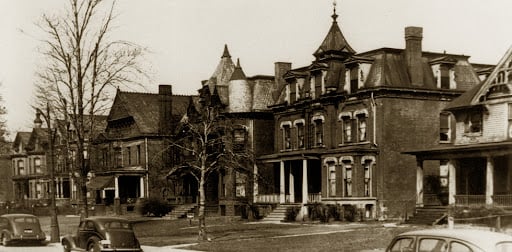
The homes were built in a relatively short time frame, which resulted in a rare level of architectural harmony across the block.
This was not accidental growth.
It was intentional residential design.
Architecture That Works Together
West Canfield features a variety of late-19th-century architectural styles, including:
-
Queen Anne
-
Romanesque Revival
-
Colonial Revival
-
Early Beaux-Arts influences
Despite the variety, the street feels unified.
Homes share:
-
consistent setbacks
-
similar heights and proportions
-
brick construction with stone detailing
-
prominent front porches
-
narrow lots that create rhythm along the block
No single house dominates the street. Each contributes to a balanced streetscape designed for everyday life.
Builders, Not Showpieces
Unlike neighborhoods associated with a single architect, West Canfield was developed by multiple builders and designers, many of them local.
This resulted in:
-
individuality without chaos
-
variety within a shared framework
-
durable construction intended for long-term use
The district’s success lies in coordination rather than architectural celebrity.
Who Lived on West Canfield
Residents of West Canfield in the late 19th and early 20th centuries included:
-
business managers
-
engineers
-
clerks
-
professionals connected to Detroit’s industrial growth
These were not the city’s elite, but rather its stabilizing middle class — people invested in Detroit’s future and rooted in the city long-term.
West Canfield offered proximity to downtown while maintaining a residential atmosphere, making it both practical and desirable.
Surviving Detroit’s Hardest Decades
Many historic Detroit neighborhoods were dramatically altered or erased during the 20th century due to:
-
urban renewal
-
freeway construction
-
disinvestment
-
mass demolition
West Canfield survived largely intact.
Its narrow scale, purely residential character, and strong neighborhood identity helped shield it from the forces that reshaped much of the surrounding area.
In 1975, the district was listed on the National Register of Historic Places, formally recognizing its architectural cohesion and historical significance.
While National Register status alone does not prevent demolition, it played a role in elevating awareness and encouraging preservation.
West Canfield Today
Today, West Canfield remains one of Detroit’s most intact historic residential streets.
Homes are:
-
actively lived in
-
carefully maintained
-
restored with attention to original materials and proportions
The street still functions exactly as it was intended over a century ago — as a place for daily life, community, and continuity.
Why West Canfield Matters
West Canfield challenges the idea that history must be monumental to be meaningful.
Its importance lies in:
-
livability over luxury
-
cohesion over spectacle
-
planning over prestige
-
continuity over reinvention
It represents a Detroit that planned for people first.
And in a city shaped by extremes, that quiet success is worth preserving.
Walking West Canfield With Streets of History
In this Streets of History exploration, we walk West Canfield block by block, examining:
-
why the street feels different
-
how its design still works today
-
the architectural details that tie it together
-
how preservation succeeded where it often failed elsewhere
West Canfield doesn’t demand attention.
It earns it by still working.