STORIES WE KEEP · SEPTEMBER 27, 2026
Black Bottom and Paradise Valley: The Detroit Neighborhoods Erased for Progress
More than a freeway story, this is the history of Black homes, businesses, music, displacement, and the policies that cleared an irreplaceable part of Detroit.
By Christopher Hubel | September 27, 2026

Stand near the depressed lanes of I-375 today and try to imagine a different sound.
Not highway traffic. Music spilling from clubs. Customers moving between pharmacies, restaurants, barbershops, groceries, hotels, and theaters. Children on porches. Church doors opening. Streetcars running along Hastings Street. Families arriving from the South and building new lives in Detroit.
That city existed.
Black Bottom and Paradise Valley became the center of Black life in Detroit during the Great Migration. They were also overcrowded, under-resourced, and physically deteriorating after decades of discrimination and neglect. Beginning in the 1940s, officials used those conditions to justify clearance. By the 1960s, urban renewal, redevelopment, and freeway construction had removed most of the community from the map.
Detroit did not merely demolish buildings. It broke apart a network of homes, businesses, institutions, culture, and accumulated Black wealth that could not be reconstructed somewhere else.
Black Bottom was named for the soil—not its residents
The name “Black Bottom” predates the neighborhood's African American majority. The area occupied low ground associated with the former Savoyard River, buried as part of Detroit's sewer system in 1827. Its dark, rich marsh soil gave the district its name.
Black Bottom stood on Detroit's near east side, generally between Brush Street and the Grand Trunk railroad or Chene Street, with Gratiot defining part of its northern edge and the riverfront area to the south. Exact boundaries change depending on the period and the person describing them.
Paradise Valley overlapped the larger story but was not simply another name for the entire neighborhood. It referred especially to the business and entertainment district extending north of Gratiot, centered on Hastings and nearby streets.
That distinction matters. Black Bottom was where many people lived. Paradise Valley was where Detroiters worked, shopped, performed, danced, stayed in hotels, received medical care, and built businesses. The two places were inseparable without being identical.
The neighborhood changed with each migration
Before the Great Migration, Black Bottom included German, Irish, Italian, Eastern European Jewish, and other immigrant residents. Hastings Street was an important center of Jewish settlement and commerce before World War I.
Detroit's automobile factories then drew Black migrants escaping Jim Crow violence, agricultural exploitation, and restricted opportunity in the South. Detroit's Black population grew from roughly 5,700 in 1910 to approximately 120,000 by 1930.
The promise of industrial wages did not bring equal access to the city. Restrictive covenants, discriminatory real-estate practices, redlining, violence, and white resistance prevented Black families from living in many neighborhoods. Black Bottom absorbed a rapidly growing population into an aging housing stock that had not been built for such density.
Houses were divided into apartments and rooms. Some buildings lacked adequate plumbing and heating. Rents could be high relative to the quality of housing because discrimination constrained where Black Detroiters could live.
Those conditions were real. But they did not prove that the community itself had failed. They showed the consequences of forcing a growing population into limited territory while denying it equal access to credit, housing, municipal investment, and political power.
Paradise Valley built an economy inside segregation
Discrimination created barriers, but it also produced a concentrated market for Black enterprise. White-owned establishments often refused Black customers or treated them unequally. Black Detroiters created businesses and institutions to serve needs the wider city ignored.
By 1942, more than 300 Black-owned businesses operated within Black Bottom and Paradise Valley, according to the National Endowment for the Humanities. The district included doctors, pharmacists, lawyers, grocers, barbers, beauticians, restaurateurs, hotel owners, funeral directors, printers, and other professionals.
Barthwell Drugs grew from a Paradise Valley pharmacy into one of the country's largest Black-owned drugstore chains. Black churches served as places of worship, organizing, education, and mutual aid. Newspapers and civic groups connected residents to political struggles across Detroit and the nation.
This economy should not be romanticized as proof that segregation worked. Black businesses developed extraordinary strength within an unjust system. Their success did not make exclusion acceptable; it revealed what people built despite it.
Music made Paradise Valley nationally famous
Paradise Valley became one of Detroit's great entertainment districts. The Flame Show Bar, Club Harlem, the Horseshoe Bar, Club 666, and other venues presented music, comedy, dance, and nightlife. Black and white audiences crossed the color line to hear performers even when segregation governed much of daily life.
Orchestra Hall temporarily became the Paradise Theatre in 1941. Louis Armstrong, Duke Ellington, Billie Holiday, Ella Fitzgerald, Dizzy Gillespie, Pearl Bailey, and other major artists appeared in the district. The Gotham Hotel offered distinguished accommodations to Black travelers and performers excluded from many white hotels.
Green Book listings identified establishments where Black motorists could safely sleep, eat, and find services during the Jim Crow era. Paradise Valley was therefore more than a local entertainment zone. It was part of a national geography of Black mobility and survival.
The music was not decoration added to the neighborhood's history. Clubs provided employment, attracted customers to nearby businesses, created audiences for performers, and helped establish Detroit's place in jazz, blues, gospel, and the sounds that would eventually feed rhythm and blues and Motown.
Watch: the neighborhood Detroit destroyed
This History Loves Company film walks through the rise, destruction, and legacy of Black Bottom—connecting the businesses, culture, housing discrimination, urban renewal, and freeway construction that remade Detroit's near east side.
Watch They Destroyed an Entire Detroit Neighborhood | The Story of Black Bottom on YouTube.
Photographs show both community and disinvestment
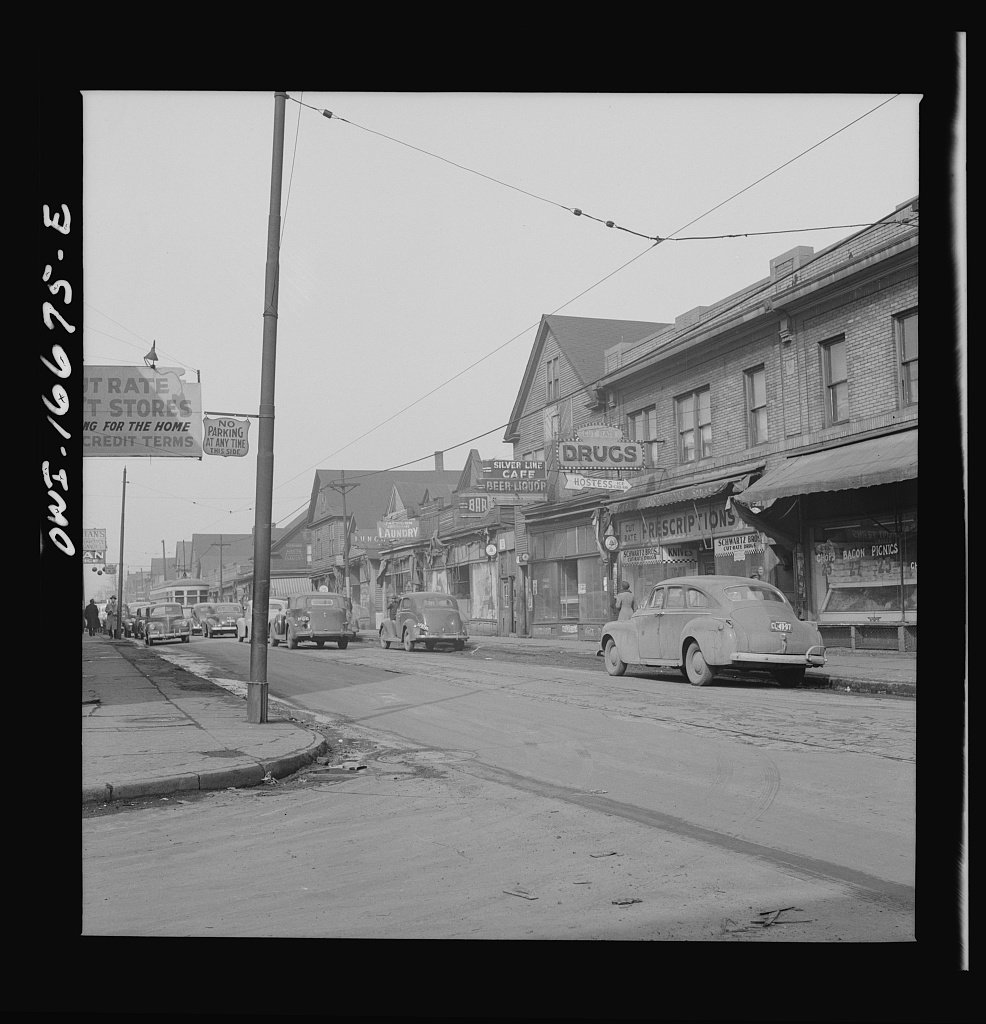
Arthur S. Siegel photographed Black Detroit for the federal government in 1942. His images show businesses, people, houses, alleys, signs, and streets at the height of wartime migration.
The photographs document commercial life and neighborhood density. They also record deteriorated buildings, muddy streets, overcrowding, and inadequate infrastructure. Both realities belonged to the same place.
Official reports used physical deterioration to label Black Bottom a slum. Yet those reports often treated the buildings as if their condition developed independently from policy. Property owners in redlined districts struggled to obtain conventional financing for repairs. Tenants had little control over maintenance. Municipal services and code enforcement operated unevenly. Overcrowding increased wear while discriminatory housing markets prevented families from moving.
A photograph of a damaged porch can be evidence of poor housing. It can also be evidence of a financial and political system that withheld the tools needed to improve it.

Clearance began before the freeway
It is common to say that I-375 destroyed Black Bottom. The freeway was a major instrument of destruction, especially along the Hastings Street corridor, but the full process began earlier and involved several overlapping projects.
In 1946, Mayor Edward Jeffries asked Detroit's Common Council for authority to begin clearing the area. The federal Housing Act of 1949 provided money for cities to acquire and clear districts officially classified as blighted. Detroit used urban-renewal programs to remove houses and businesses for redevelopment.
By the time major freeway construction began, large parts of Black Bottom had already been condemned or demolished. Residents sometimes received only brief notice, and relocation assistance was limited. Tenants—who made up much of the population—had even fewer protections than property owners.
Officials described clearance as an effort to eliminate unsafe housing and modernize the city. But redevelopment did not guarantee that displaced families would receive better housing they could afford. The same discrimination that had confined Black residents to Black Bottom restricted their choices when they were forced to leave.
Many moved into public housing or into other Black neighborhoods already facing housing pressure. Removal redistributed overcrowding and hardship across Detroit instead of solving the unequal housing system that created them.
Lafayette Park replaced homes with celebrated modernism
Part of the cleared land became Lafayette Park, designed with major contributions from architect Ludwig Mies van der Rohe, planner Ludwig Hilberseimer, and landscape architect Alfred Caldwell. Its glass residential towers, townhouses, green space, and modernist planning earned international architectural recognition.
Lafayette Park is now a National Historic Landmark and one of Detroit's most significant modern residential districts. Its architectural value is real.
So is the displacement that preceded it.
Good history does not require choosing between admiring Lafayette Park and remembering Black Bottom. It requires holding both truths at once. A celebrated design can occupy land cleared through an unjust process. Preserving the newer landmark should include honest interpretation of the community it replaced.
The contrast also exposes a central failure of urban renewal: the new housing largely served a different and more affluent population. According to federal historical research summarized by the National Endowment for the Humanities, three-quarters of Lafayette Park's residents were white by the 1970 census.
The Chrysler Freeway followed Hastings Street
Federal highway funding accelerated after World War II. Construction of the Chrysler Freeway and I-375 began through the area in 1959. The route followed the Hastings Street corridor that had connected Black Bottom and Paradise Valley.
A depressed freeway was presented as modern infrastructure: a fast connection between downtown, the riverfront, and the expanding regional highway network. It also created a physical divide and consumed land that had contained businesses, homes, and institutions.
By 1964, I-375 ran through the former community. Drivers could pass the site quickly without knowing what had been there.
The loss of Detroit's streetcar network and the construction of urban freeways were separate decisions, but together they changed the city's operating system. Transportation investment shifted toward moving automobiles across and out of the city. Dense neighborhoods built around walking, transit, and local commerce absorbed many of the costs.
Watch: Black Bottom was one part of a larger collapse
Detroit's decline cannot be explained by one neighborhood, one mayor, one riot, or one industry. This History Loves Company film connects deindustrialization, segregation, suburbanization, infrastructure, tax-base loss, and policy decisions across the wider city.
Watch The Real Reason Detroit Collapsed on YouTube.
Poletown repeated a familiar argument
Two decades later, Detroit again argued that demolishing an established community was necessary to protect the city's economic future. In Poletown, the promised public benefit was a new General Motors assembly plant rather than a freeway and modernist redevelopment.
The projects were not identical. Their legal structures, periods, populations, and goals differed. But both treated an inhabited neighborhood as a site to be assembled for a larger plan. Both concentrated the cost of progress on residents with limited control over the decision. Both left Detroit debating whether projected regional benefits justified permanent local loss.
Black Bottom reminds us that demolition is not only about structures. When businesses depend on nearby residents, churches depend on congregations, clubs depend on cultural networks, and families depend on neighbors, relocation damages relationships that compensation cannot purchase.
The debate over I-375 is a debate over repair
Michigan transportation officials have acknowledged that the original freeway construction disproportionately harmed Black, low-income, and minority residents. Plans for the corridor's future have created new questions about land, design, development, and who should benefit from the next transformation.
Removing or redesigning a freeway cannot recreate Black Bottom. Former residents were scattered, businesses closed, and generations have passed. The original parcels cannot simply be returned to a complete community waiting nearby.
But future decisions can still recognize history through meaningful participation, Black ownership, affordable housing, public space, business opportunity, interpretation, and investment that reaches descendants and the wider Black community.
A project becomes reparative through who holds power and receives value—not by attaching historic photographs to another development that excludes the people whose history it uses.
Memory survives in people, archives, and surviving institutions
Black Bottom's buildings largely disappeared, but its history survives through oral accounts, family albums, business directories, church records, photographs, maps, music, and institutions that relocated.
Orchestra Hall survived and again houses the Detroit Symphony Orchestra. Its years as the Paradise Theatre remain part of the building's story. The Blue Bird Inn, located farther west but connected to the same Black musical world, reminds us that cultural networks extended beyond official neighborhood boundaries.
Black Bottom Archives and other community historians have worked to gather memories that conventional planning records missed. Their work changes the archive from a catalog of buildings condemned by officials into a record of people who defined their own community.
If your family lived or worked in Black Bottom or Paradise Valley, record the street address, nearby businesses, church, school, and names of neighbors. Ask what relocation changed. Scan photographs with their captions and backs. Preserve menus, advertisements, programs, union cards, and property documents. Small records can restore human detail to land later described only in acres.
Explore more Detroit history, civil-rights history, historic neighborhoods, and the places remembered through Buildings We've Lost. You can also share your Black Bottom or Paradise Valley story with History Loves Company.
For a deeper examination of how segregation, industry, transportation, and policy remade Detroit, discover Christopher Hubel's book They Lied to Us About Detroit. Visit The Foundry by History Loves Company in downtown Pontiac, and subscribe to Stories We Keep.
The streets were erased, but the community was never empty—and its history must never be treated as vacant land.
Sources and further reading
- Detroit Historical Society: Black Bottom Neighborhood — boundaries, migration, housing, business life, clearance, and displacement.
- Detroit Historical Society: Paradise Valley — Black-owned businesses, entertainment, musicians, and urban renewal.
- National Endowment for the Humanities: The People and Places of Black Bottom, Detroit — community history, Black Bottom Archives, demolition, and Lafayette Park.
- Michigan Department of Transportation: I-375 Finding of No Significant Impact — official acknowledgement of displacement and the disproportionate effects of freeway construction.
- Rise Up Detroit: Black Bottom — oral histories, historic photographs, directories, and primary sources.
- Library of Congress: Detroit Black Business District, 1942 and Detroit Black Neighborhood, 1942 — Arthur S. Siegel photographs and reproduction information.