Players are hosted by YouTube. Playback does not start automatically; if an embed is unavailable, use its YouTube link.
The history research workshop
Turn curiosity into a story you can support.
Eight practical guides for homeowners, students, families, and curious neighbors. Each one includes an approach, a small task, and a route to further evidence.
8 research guides
01BuildingsHow to research a historic house or buildingBegin with an address. Finish with a timeline you can defend.
Make sure you have the right place.
Write down the current address, municipality, and parcel number. Record former street names or numbering changes as leads, not conclusions. Separate the history of the land from the history of the building standing on it.
Build a dated chain of evidence.
Compare deeds, city directories, permits, maps, photographs, and local newspaper coverage. A directory can connect an occupant with an address; it does not automatically prove ownership or a construction date. Record contradictions instead of smoothing them away.
Read the designation file.
A National Register nomination can supply descriptions, a significance narrative, maps, and a bibliography. Local designation is a separate question. Use the adopted local boundary before describing a property as protected.
Write a careful first account.
Create a short timeline with a source beside each claim. Label approximate dates and unresolved names. A useful first result is a clear account of what is known, what is likely, and what you still need to investigate.
02Images & mapsHow to read a historic photographA photograph is evidence—and a point of view.
Separate seeing from interpreting.
First describe what is visible: signs, clothing, vehicles, shadows, windows, and the edges of the frame. Then list what those details might suggest. “A crowd is outside” is an observation; why the crowd gathered needs evidence.
Keep the photograph with its record.
Save the creator, catalog title, repository, item identifier, and any supplied date range. Distinguish the exposure date from the date a print, scan, or postcard was made. An online caption may be newer than the image.
Ask what the frame leaves out.
Consider who made the picture, its likely audience, and what cannot be seen. Compare another view or a written source before treating one scene as typical of an entire neighborhood.
Explain changes to the image.
A cropped, restored, or colorized version is not the untouched original. Keep an original reference, describe meaningful alterations, and check the item’s rights statement before republication.
03Images & mapsHow to compare old maps with today’s streetsFollow a block through change without treating a map as a photograph.
Read the map before reading the city.
Check the title, publisher, date, scale, orientation, and key. Was it made for navigation, insurance, promotion, property boundaries, or something else? Its purpose shapes the information it includes.
Choose a stable reference.
Start with a street intersection, river bend, or enduring public building. Follow street renamings and boundary changes. A demolished landmark is a clue to investigate, not a reliable present-day coordinate.
Compare like with like.
Record when two maps use different scales or categories. A bird’s-eye illustration may compress space or emphasize selected buildings. Do not measure a legal property boundary from a promotional view.
Make change visible and qualified.
Note what appears, disappears, or changes use between dated sources. Missing information on a map is not necessarily proof that a building did not exist. Check a directory, photograph, or permit before stating a demolition date.
04People & memoryHow to record a family or neighborhood memoryMake room for the person, not just the fact you hope to find.
Agree on the purpose before recording.
Explain who you are, why you are asking, where the recording may appear, and how it will be kept. Discuss consent, privacy, access, and review expectations before turning a conversation into a public resource.
Ask open questions.
Try “What do you remember about that street?” before asking someone to confirm your theory. Invite descriptions of routines, sounds, work, and relationships. Allow pauses and avoid pressing someone to revisit a distressing experience.
Distinguish memory from a verified date.
Personal recollection is valuable evidence of experience. It may also contain uncertain chronology. Preserve the speaker’s meaning and compare dates or names with other records without presenting a disagreement as a reason to dismiss the person.
Keep context with the recording.
Record the interview date, participants, place, permissions, and a brief topic index. Preserve an original recording and identify edited excerpts. Ask before publishing private addresses, contact details, or information about other living people.
05BuildingsHow to read a historic districtLook at the relationships between buildings—not only the showpiece.
Look at the whole streetscape.
Notice setbacks, lot widths, building heights, porches, alleys, trees, and the relationship between shops and homes. Ordinary buildings can explain a neighborhood’s daily life as clearly as a landmark.
Compare style, date, and designation.
These are different facts. A style can span decades; an old building is not automatically designated; and a district can contain buildings from more than one period. Use the relevant nomination and local ordinance.
Ask who the neighborhood served.
Bring housing, employment, institutions, migration, and access into the story. Seek sources from residents as well as developers, architects, and officials. Architectural beauty is one part of the account, not the whole account.
Observe respectfully.
Research from public places, follow posted access rules, and ask permission before entering or filming on private property. A designation or a listing in this guide is not an invitation to enter a building.
06People & memoryHow to connect industry, migration, and everyday lifeA factory story becomes a human story when you follow people beyond the gate.
Start with a specific question.
Choose a place and a period: a hiring boom, a strike, a neighborhood’s growth, or a plant closure. A narrower question makes it easier to test an explanation and find voices missing from a broad overview.
Compare different kinds of records.
Business publicity, union records, government documents, newspapers, photographs, and family accounts were made for different purposes. Ask what each source can explain and where its perspective is limited.
Connect work with the neighborhood.
Look for routes to work, housing, schools, religious institutions, shops, and recreation. Migration is not simply a line between two cities; it involves relationships, choices, restrictions, and the building of communities.
Resist a single-cause ending.
Industrial change can involve technology, investment, policy, labor relations, and wider markets. Identify the evidence for your explanation and distinguish a local case from a claim about every American city.
07BuildingsHow to prepare for a preservation conversationDocument the place before deciding what should change.
Describe the building you actually have.
Make a dated photographic record of the overall building and relevant details. Note visible alterations and questions about earlier conditions. Research is not a substitute for a professional condition assessment.
Find character-defining features.
Study form, materials, openings, spaces, and the setting together. A replacement chosen from a style label alone can miss what is distinctive about the actual building.
Bring evidence to the right people.
Ask the municipality which reviews apply to the proposed work. Bring the relevant boundary, photographs, records, and a written scope to preservation staff and appropriately qualified specialists.
Compare care options before committing.
Ask what can be retained, repaired, or documented. Use the NPS Preservation Briefs as background reading for a qualified assessment, not as a diagnosis of an unseen building or a substitute for permits.
08StorytellingHow to turn research into a story people rememberLead with a human question. Let the evidence earn the answer.
Choose a place where something changed.
A doorway, street corner, boat, shop, or factory can give a large historical question a tangible starting point. Explain why the question matters before introducing every date you found.
Keep an evidence ledger.
Put the claim beside the source that supports it. Separate observation, remembered experience, documented fact, and your interpretation. If a dramatic detail cannot be supported, leave it out or clearly describe the uncertainty.
Match the picture to the claim.
Check the location, date, and source of each image. Do not present an unrelated street as the actual scene or an AI-generated reconstruction as an archival photograph. Label illustrative material and meaningful edits.
Leave a trail for the next researcher.
Link the records, credit images, include the source date, and invite documented corrections. A strong ending can offer a new question rather than pretending that a complicated past has one final explanation.
No guides match yet. Try a broader word or clear the subject filter.
Keep the question honest.
A source can be valuable without being complete or neutral. Say what it establishes, what it suggests, and what remains unknown. These guides offer research methods, not property-specific legal or conservation advice.
A visual field study · Michigan’s Copper Country
Three photographs. A bigger story.
A place can be read at the scale of a doorway, a machine, or an entire landscape. These National Park Service photographs make a practical exercise in looking—not a substitute for the people and records behind the view.
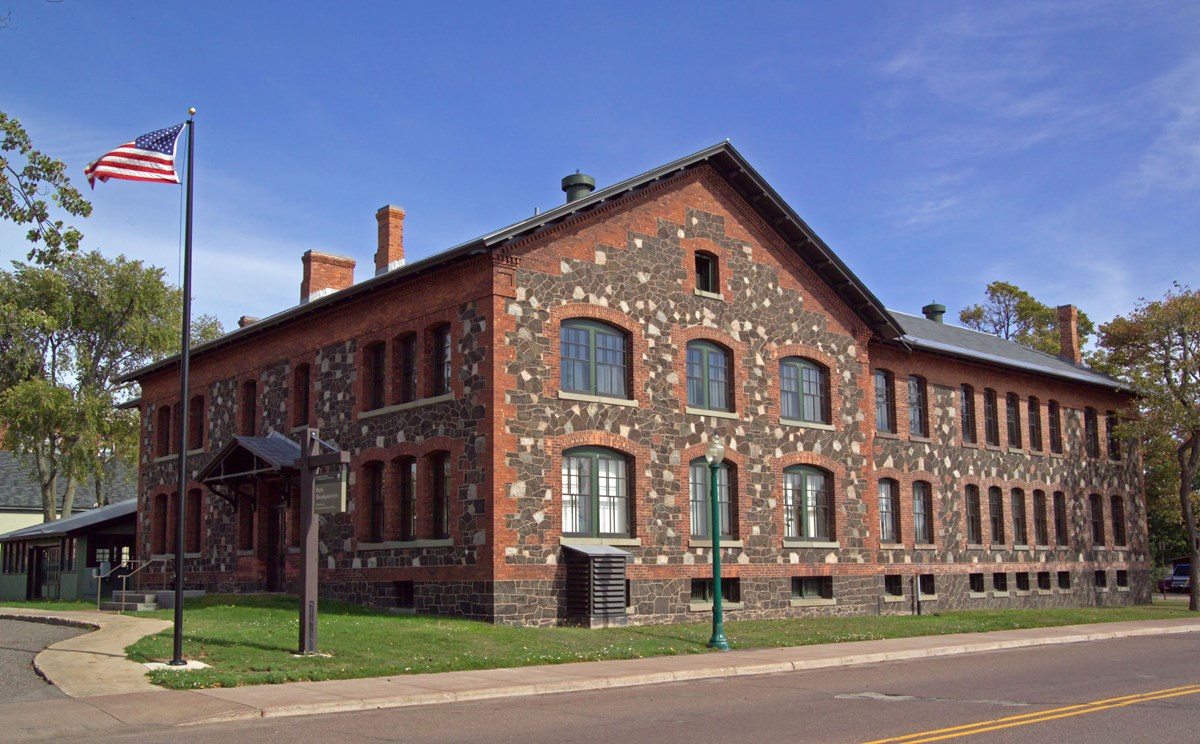
Former Calumet & Hecla Mining Company General Office, now park headquarters. NPS photograph. Source
The office: read the architecture of authority.
Compare the entrance, masonry, and formal arrangement of windows. What questions does an administrative building raise about the relationship between a company, its workers, and the surrounding town?
Quincy Mining Company No. 2 shaft-rockhouse and hoist house in winter. NPS photograph. Source
The mine: read the shape of work.
Notice the contrast between a purpose-built industrial structure and a conventional house or office. Before naming a feature’s function, compare the photograph with a plan or the site’s interpretation.
Quincy Smelter on the waterfront. NPS photograph. Source
The waterfront: read the connected landscape.
Look beyond one building to the relationship between structures, water, and land. What would you need to learn about transport, processing, waste, and nearby neighborhoods to tell this landscape’s story?
Photographs: National Park Service, Keweenaw National Historical Park. Modern views of historic places; capture dates are not supplied here. No claim to original U.S. Government works. Images link to larger versions; no institutional endorsement is implied.
Detroit roots. A wider horizon.
Build connections without flattening the differences.
Follow a subject across borders: a port, a railway, migration, industrial work, or the care of an old building. Compare places in their own context. Our original film collection begins close to home; these independent institutions open useful research routes beyond it.
01 / Images & everyday life
Library of Congress
Explore architecture, main streets, maps, and other thematic image sets. Read the item’s catalog and rights information before reusing it.
Start with shape, materials, openings, and the way a building meets the street. These common styles provide a vocabulary for looking. Buildings often mix styles, and renovations can change the clues.
Dates are broad regional guides, not a dating service. A style does not establish age, condition, or historic designation. Community links below are starting points for research, not a claim that every building there has the named style.
Early to mid-1800s
Greek Revival
Look for: Temple-like fronts, columns, and balanced façades.
Look a little closer
Look at the entry, corner boards, and gable rather than relying on paint color.
Compare the building’s overall form, significant details, materials, and interior spaces. Use specialist resources to turn a style label into informed questions about care.
Choose a scale, then an era. Each reading path offers a question to pursue and a place to begin. The date ranges overlap because migration, industry, culture, and political change do not fit neatly into separate chapters.
These are editorial reading paths, not exhaustive timelines. Regional chronologies differ, especially in world history. Indigenous histories continue throughout all the periods below.
01DetroitStart with the river. Follow the people.
A local story becomes richer when a building is connected to work, migration, power, and everyday life. These reading paths pair HLC stories with museum research resources.
Before 1701—and continuing
Indigenous homelands
Begin with Native communities as living peoples with continuing histories. Ask whose names, relationships, and accounts appear in the sources.
Move between the lakes, forests, farms, mines, and industrial centers. Statehood is one milestone in a much longer history; it is not the beginning of the story.
Before European arrival—and continuing
Indigenous nations and homelands
Start with Native-authored perspectives on place, governance, sovereignty, and community. Carry these histories through every later period.
03The MidwestFollow the connections across state lines.
A regional lens reveals shared transportation systems, labor markets, migration routes, and environmental histories. Begin with HLC films, then compare them with archival evidence.
Before state borders—and continuing
Indigenous places and networks
Explore Native histories across modern boundaries. Use community perspectives to avoid treating today’s state map as an ancient division.
04The United StatesPut local stories into a national conversation.
Use primary documents to compare regions and perspectives. These are research starting points; our original U.S. story collection will grow from specific places and people.
Before colonization—and continuing
Native nations
Study Indigenous histories and sovereignty across time, using sources that include Native voices and contemporary communities.
05World historyA wider horizon, with a place to start now.
Our long-term direction is stories without borders. For now, these curated museum and heritage resources offer substantial reading across regions and periods. They are external collections, not a claim that HLC has already covered every era.
Deep history–c. 500 CE
Early societies and ancient worlds
Explore objects, settlements, technologies, and exchange in multiple regions. Avoid measuring every society against one civilization’s chronology.
Follow the next film, bring a source we have not seen, or share the memory only you can tell. Stories We Keep brings HLC’s history, films, and discoveries to your inbox.
Share a place, a family memory, an architectural question, or a source we should follow. Tell us where it came from so the story can grow with evidence.
Resource links reviewed September 21, 2026. This guide offers original reading prompts and links to the institutions named above; it does not imply institutional endorsement.
Choose what draws you in
Detroit before the automobile
River trade, stoves, foundries, and the industries that came before the Motor City.
One interest. Three clues. A story worth following.
Choose a topic, open a related story, and find the answer. Each clue leads to another page or film. Your progress stays in this browser—no account required.
Keep Detroit at the center, then move through Southeast Michigan, the rest of Michigan, and across state lines. The county explorer opens every county and the communities named in our source inventory.