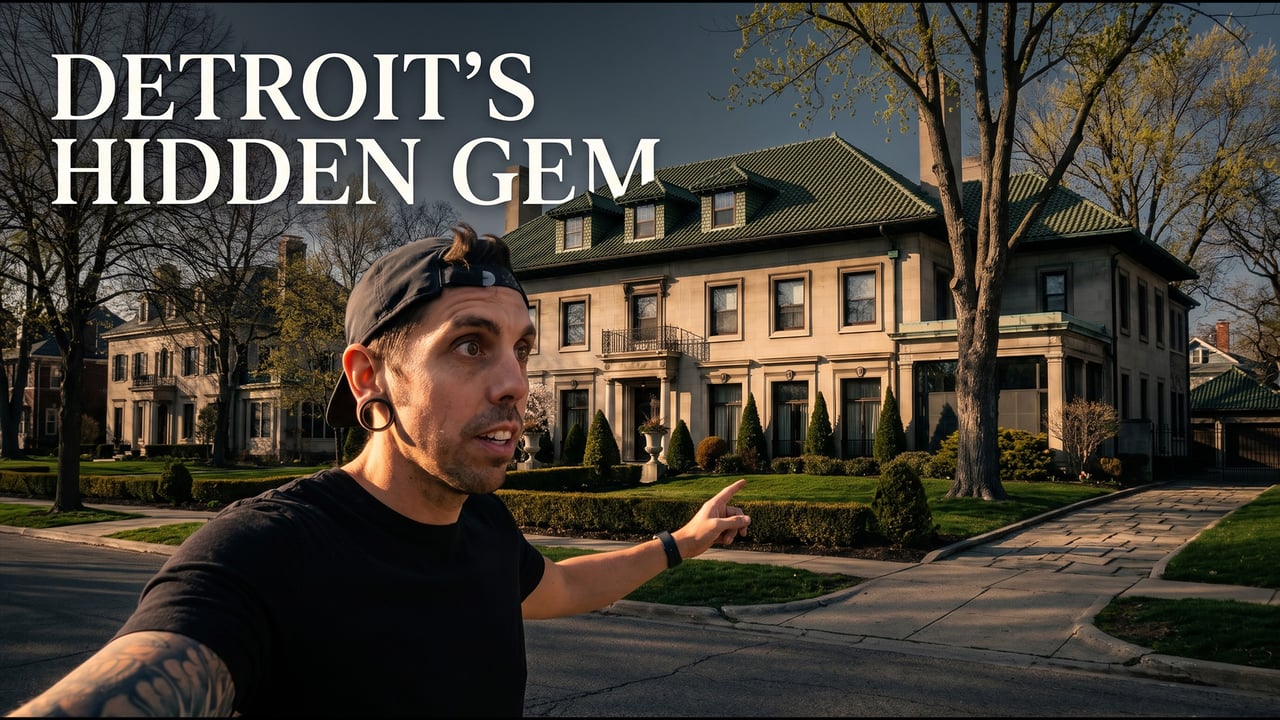
Boston-Edison: Inside Detroit’s Historic Mansion District
There are neighborhoods where you can see history in individual buildings.
Then there is Boston-Edison, where almost the entire story of modern Detroit can be read one house at a time.
Henry Ford lived here while the Model T was changing America. James Couzens lived here. Sebastian Kresge built a mansion here. Joe Louis called these streets home. So did Berry Gordy and Walter Reuther.
Across 36 blocks and more than 900 single-family homes, Boston-Edison became one of Detroit’s most extraordinary residential neighborhoods.
But calling Boston-Edison simply “Detroit’s mansion district” misses the most interesting part of its story.
These streets witnessed Detroit’s explosive industrial growth, enormous fortunes, architectural ambition, racial and cultural change, population loss, disinvestment—and ultimately preservation.
Boston-Edison wasn't simply built.
It survived.
Watch: Inside Boston-Edison
In this episode of Streets of History, we walk Boston-Edison and explore the houses, people and events that transformed these streets into one of Detroit's most important historic neighborhoods.
Watch the full episode on History Loves Company:
https://youtu.be/U4TrsJw88ls
Before the Mansions
Long before Boston Boulevard and Edison Avenue were lined with enormous houses, this area sat near the northern edge of Detroit's development.
One of the people who recognized its potential was Edward Voigt.
Voigt began acquiring land in the area as early as 1884 and, in 1891, platted the area between Woodward and Hamilton as the Voigt Park subdivision.
He wasn't developing for the Detroit that already existed.
He was anticipating the Detroit that was coming.
The first homes within today's Boston-Edison Historic District were built and occupied in 1905. Wide streets, landscaped boulevards, substantial homes, large setbacks and spacious lots established the residential character that still defines the neighborhood.
Development continued west.
In 1913, Truman and John Newberry developed the Boston Boulevard subdivision. Two years later, Henry B. Joy developed the Joy Farm subdivision farther west.
Their connection to Detroit's emerging automobile industry was no coincidence.
Automobile wealth wasn't merely supplying Boston-Edison with residents.
It was physically building the neighborhood.
The Neighborhood That Automobile Money Built
Detroit's growth during the early twentieth century is difficult to comprehend today.
In 1900, Detroit was America's thirteenth-largest city.
By 1920, it was the fourth largest.
Factories opened. Workers poured into the region. Streetcar lines stretched outward. New neighborhoods appeared almost overnight.
The automobile industry created hundreds of thousands of jobs.
For a smaller group at the top, it created enormous fortunes.
Boston-Edison became one of the places where that wealth took physical form.
And perhaps no resident better symbolizes that transformation than Henry Ford.
Henry Ford Lived Here While the World Changed
Henry and Clara Ford moved into their Edison Avenue home in 1908.
That was also the year the Model T entered production.
During the seven years the Fords lived in Boston-Edison, the Model T became a mass-market success, Ford Motor Company refined its mass-production techniques, the moving assembly line transformed manufacturing, and Ford's five-dollar day changed the national conversation surrounding industrial wages.
The Fords remained here until 1915, when they moved to Fair Lane in Dearborn.
Henry Ford wasn't alone.
James Couzens built a Tudor mansion on Longfellow Avenue in 1910.
Horace Rackham lived in the neighborhood.
Four of the Fisher brothers moved here.
Walter O. Briggs lived on Boston Boulevard.
Executives associated with Packard, Cadillac, Hupp, Studebaker, Regal, Paige-Detroit and numerous automotive suppliers filled these streets.
Boston-Edison became an address book for the people designing, financing, manufacturing and selling the machines transforming America.
More Than Automobile Royalty
The neighborhood's influence stretched far beyond automobiles.
Sebastian S. Kresge, whose company would eventually become Kmart, built his home here in 1914.
Benjamin Siegel, founder of an important early Detroit clothing store, constructed an imposing limestone mansion.
Wolf Himelhoch lived here.
So did Fred Sanders, whose candy, ice cream and soda fountains became part of Detroit culture.
Bankers, attorneys, judges, physicians, engineers, religious leaders, artists, athletes and musicians followed.
The opening of Henry Ford Hospital nearby in 1915 attracted another generation of doctors and medical professionals.
Boston-Edison became more than a wealthy enclave.
It became a place where Detroit's major institutions intersected.
900+ Houses — And Almost No Two Alike
The architectural variety is one of the things that makes walking Boston-Edison remarkable.
You encounter:
- Tudor Revival mansions
- Colonial Revival houses
- Italian Renaissance-inspired villas
- Prairie-style homes
- French-inspired residences
- English cottages
- Substantial brick houses filled with craftsmanship rarely found in ordinary modern construction
Despite that variety, the neighborhood feels remarkably cohesive.
Similar setbacks, scale, rooflines, masonry, mature trees, broad streets and landscaped boulevards connect hundreds of individually designed homes into a recognizable whole.
Then there are the materials.
Slate roofs.
Clay tile.
Leaded glass.
Copper.
Cut stone.
Carved entrances.
Decorative brickwork.
Heavy wood windows.
These were houses constructed during an era when Detroit wanted its buildings to communicate permanence.
Then Boston-Edison Changed
Boston-Edison's story didn't end when Detroit's first generation of industrial fortunes moved in.
Beginning in the 1940s, prominent Black Detroiters and Black professionals increasingly made the neighborhood home.
Among the most famous was heavyweight boxing champion Joe Louis, who lived on Edison Avenue.
Edward Davis, who became the first African American in the United States to own a new-car dealership, lived here.
Sidney Barthwell, creator of one of Detroit's best-known Black-owned drugstore chains, lived here.
Congressman Charles Diggs Jr. lived here.
Black judges, attorneys, doctors, educators, ministers, entrepreneurs, athletes and artists followed.
Then came another resident whose story represented an entirely different Detroit industry.
Berry Gordy and the Motown Mansion
In the late 1960s, Berry Gordy moved into a grand 1917 mansion on Boston Boulevard.
By then, Motown Records had become one of the most influential music companies in the world.
Gordy had started with a relatively modest house on West Grand Boulevard transformed into Hitsville U.S.A.
As Motown grew, he eventually moved into one of Boston-Edison's great houses—the property many came to know as the Motown Mansion.
Think about what that means.
Henry Ford and Berry Gordy lived in the same Detroit neighborhood during different generations.
One helped transform the world through automobiles.
The other helped transform it through music.
Walter Reuther—the labor leader who fought to reshape the relationship between those automobile companies and their workers—also lived here.
Joe Louis lived here.
Sebastian Kresge lived here.
Different generations.
Different backgrounds.
Different visions of Detroit.
The same streets.
Detroit's Decline Put These Houses at Risk
Boston-Edison was created during Detroit's rise.
Then it had to survive everything that followed.
Suburbanization.
The movement of wealth and investment outside the city.
Decentralization of automobile employment.
Population loss.
Changing housing markets.
Disinvestment.
And the enormous cost of maintaining aging houses.
A century-old mansion can be breathtaking.
It can also be extraordinarily demanding.
Slate roofs need repair. Masonry needs repointing. Boilers age. Electrical and plumbing systems require modernization. Historic wood windows need maintenance. Plaster cracks.
As the original script puts it, sometimes a historic house can be less expensive to purchase than it is to restore correctly.
Boston-Edison could easily have lost much more of its architectural fabric.
It didn't.
The People Who Kept Boston-Edison Alive
The Historic Boston-Edison Association was founded in 1926, making neighborhood organization part of Boston-Edison's story long before historic preservation became fashionable.
Boston-Edison received local historic-district designation in 1974 and was added to the National Register of Historic Places in 1975.
Those protections mattered.
But historic designation doesn't replace a leaking roof.
It doesn't repair masonry.
It doesn't restore a window.
And it doesn't make someone care about an old building.
People do that.
Generation after generation of residents maintained these houses, organized, advocated for preservation, repaired damage and continued buying into Boston-Edison during periods when much of the country had stopped believing in Detroit.
That may be the most important part of the entire story.
The industrialists had enough money to build Boston-Edison.
It took a community to keep it alive.
Boston-Edison Today
Boston-Edison isn't a museum.
People still live behind these historic doors.
Families gather here. Children grow up here. Dogs get walked. Contractors arrive. Roofs leak. Owners debate what project comes next.
Some houses remain astonishingly intact.
Others have been changed.
Some have already undergone extensive restorations.
Others still represent years of work for the people willing to take them on.
That's precisely what makes Boston-Edison fascinating.
It isn't frozen in 1915.
It's a living historic district.
Detroit's History Is Still Living Behind These Doors
Boston-Edison was built by people who believed Detroit's future had no limit.
It was preserved by people who understood that future was never guaranteed.
Today you can walk these streets and encounter the history of the automobile industry, organized labor, retail, medicine, politics, Black entrepreneurship, Motown, architecture and preservation within a few blocks.
That's why Boston-Edison matters.
Not simply because Henry Ford once lived here.
Not because the houses are enormous.
And not because famous names make for interesting stories.
Boston-Edison matters because more than a century of Detroit history has accumulated here without completely erasing what came before.
The houses are still standing.
The neighborhood is still evolving.
And history is still living behind these doors.
Watch the Full Boston-Edison Documentary
🎥 Boston-Edison: Inside Detroit's Mansion District
If you love Detroit history, historic homes, architecture and preservation, subscribe to History Loves Company and follow our Streets of History series as we explore the neighborhoods that built Detroit.
What is your favorite Boston-Edison house?
And which Detroit neighborhood should we explore next?
Every neighborhood has a story. Let's discover it.