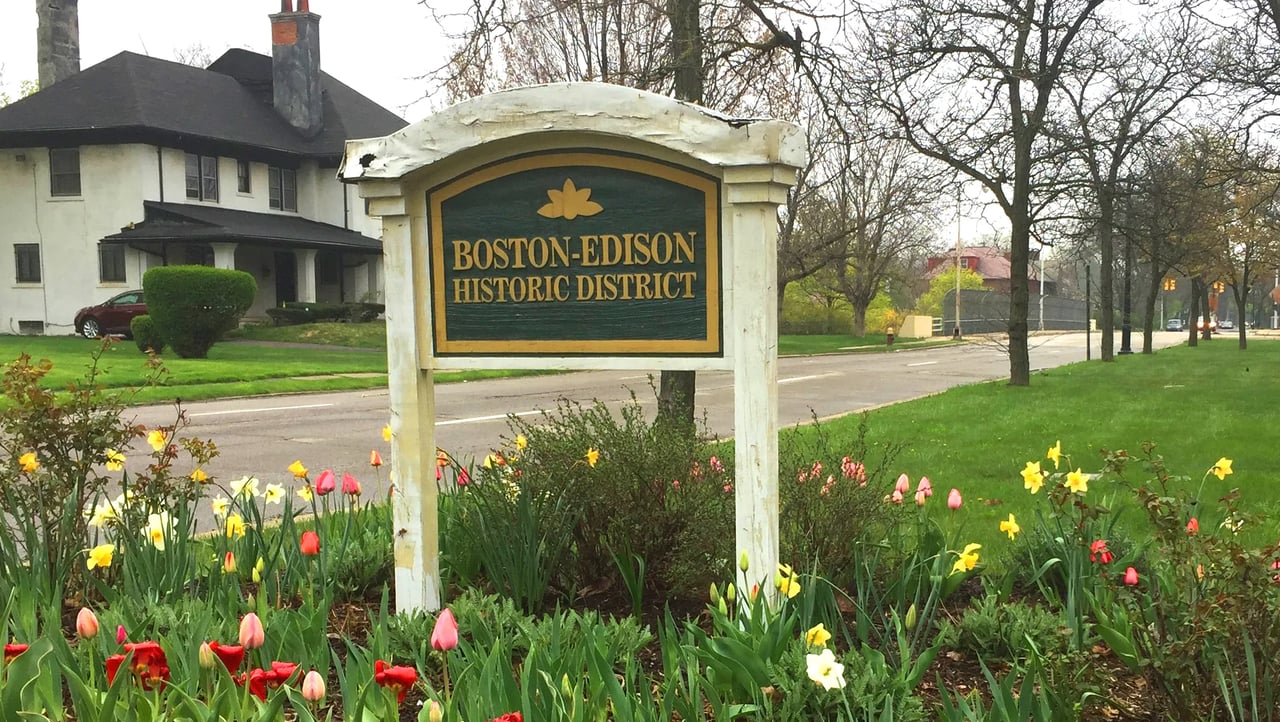
Why Boston-Edison Still Defines Detroit’s Mansion District
A walk through the homes, architecture and people behind one of Detroit’s most remarkable neighborhoods
This Wednesday, History Loves Company returns to Detroit for a new Streets of History episode — and this time we’re walking through a neighborhood that may tell the story of Detroit’s rise better than almost anywhere else:
Boston-Edison.
There are neighborhoods with beautiful old houses.
And then there are neighborhoods where the houses themselves feel like historical documents.
Boston-Edison is the latter.
Across roughly 36 blocks sit more than 900 homes, many constructed during the explosive growth of Detroit between 1905 and 1925. The district stretches from Woodward Avenue west to Linwood, between Boston Boulevard and Edison Street. (Detroit Historical Society)
Walking these streets today, it is difficult not to imagine what Detroit must have felt like when much of this neighborhood was being built.
The city wasn’t looking backward.
It believed the future was being invented here.
Detroit’s Success Was Written Into These Houses
Boston-Edison developed alongside the rise of the automobile industry.
As Ford Motor Company, Packard and Detroit’s countless manufacturers expanded, an extraordinary amount of wealth was being created — and some of the people building those companies began constructing their homes just north of the growing city center.
Henry Ford chose Edison Avenue for his home in 1908.
His early business partner James Couzens later built on Longfellow.
Members of the Fisher family, Packard figures, manufacturers, merchants, doctors and business leaders followed. Later residents included Joe Louis and Motown founder Berry Gordy Jr. (Detroit Historical Society)
That history gives Boston-Edison something that can’t be recreated by simply building expensive houses.
Context.
These weren’t homes designed to imitate an earlier period.
They are the period.
There Is No Single “Boston-Edison Style”
One of my favorite things about walking Boston-Edison is how quickly the architecture changes.
You can pass a commanding Tudor and moments later find an Italian Renaissance-inspired residence, Colonial Revival home or something with Prairie influences.
Brick, stone and stucco dominate the streetscape. Original homes frequently incorporate leaded glass, elaborate woodwork, slate roofs, substantial fireplaces, decorative masonry and details that would be prohibitively expensive to reproduce at the same level today. (Detroit Historical Society)
Yet despite that variety, the neighborhood still feels cohesive.
The scale of the houses, setbacks from the street, mature lots and consistent use of substantial materials create a streetscape that feels deliberate.
That’s part of what makes Boston-Edison so good to explore on foot.
You’re not simply looking at individual houses.
You’re seeing an entire architectural environment.
More Than the Famous Names
The celebrity history gets most of the attention.
Henry Ford.
Joe Louis.
Berry Gordy.
James Couzens.
Ty Cobb.
S.S. Kresge.
But focusing exclusively on famous former residents misses something bigger.
Boston-Edison represents a period when Detroit was attracting people, businesses, architects, craftspeople and investment at an extraordinary rate.
The homes document that confidence.
And unlike many of Detroit’s great early residential streets, much of Boston-Edison survived.
That’s incredibly important.
Detroit once had enormous houses and estates throughout areas that have since been transformed completely. Boston-Edison gives us a rare opportunity to experience an early-20th-century Detroit residential district at neighborhood scale rather than through one isolated surviving mansion.
The Boston-Edison Historic District received local historic designation in 1974 and was added to the National Register of Historic Places in 1975. Its neighborhood association traces its continuous operation to 1926. (Detroit Historical Society)
What It Means to Buy a House Here
For someone interested in historic homes, Boston-Edison can offer something very difficult to duplicate elsewhere in Michigan.
But buying one requires looking beyond the staircase and stained glass.
When I tour historic houses with buyers, some of the things I’m paying attention to include:
- Masonry and foundation condition
- Slate and specialty roofing
- Original windows
- Electrical service and wiring
- Plumbing and supply lines
- Heating systems
- Water intrusion
- Previous renovation quality
- Historic exterior alterations
- Original millwork, plaster and architectural details
- What has been preserved versus what would be expensive to reconstruct
Historic-district requirements also matter.
Exterior work isn’t always approached the same way it would be on a house outside a designated district. Recent Historic District Commission cases in Boston-Edison continue to involve everything from windows and porches to garages, decks and landscaping. (Detroit City Government)
That isn’t necessarily a negative.
Those protections are one of the reasons neighborhoods like Boston-Edison can retain their architectural identity.
But you should understand them before planning a major renovation.
Boston-Edison Homes Currently for Sale
The range of houses currently available also demonstrates how varied Boston-Edison really is.
Inventory checked August 24, 2026. Prices and availability can change at any time.
610 W Boston Boulevard — $1,250,000
6 bedrooms | 4 bathrooms | approximately 7,291 square feet | 1.29 acres
One of the largest current offerings in the district.
841 W Boston Boulevard — $899,900
6 bedrooms | 5 bathrooms | approximately 5,839 square feet
A substantial Boston Boulevard residence illustrating the scale available within the district.
658 Longfellow Street — $815,000
4 bedrooms | 5 bathrooms | approximately 4,440 square feet
90 Edison Street — $649,900
7 bedrooms | 5 bathrooms | approximately 4,808 square feet
1530 Longfellow Street — $623,000
5 bedrooms | 5 bathrooms | approximately 3,008 square feet
1168 W Boston Boulevard — $445,000
5 bedrooms | 4 bathrooms | approximately 4,124 square feet
899 Edison Street — $325,000
5 bedrooms | 3 bathrooms | approximately 2,098 square feet
You can also explore the neighborhood, learn more about its architecture and search for homes through the History Loves Company Boston-Edison page.
Why I Keep Coming Back to Boston-Edison
I’ve toured a lot of historic neighborhoods.
What keeps Boston-Edison interesting isn’t simply that the houses are big.
It’s that almost every block gives you another thread to pull.
An architect.
An industrialist.
A business.
A family.
A piece of Detroit’s automotive story.
A restoration.
A house waiting for someone to bring it back.
That’s exactly what Streets of History is supposed to be about.
We’re not just looking at old buildings.
We’re trying to understand why they are there, who built them, what happened around them and why preserving them matters now.
Watch Boston-Edison on Streets of History
The new Boston-Edison episode of Streets of History premieres Wednesday, August 26 on the History Loves Company YouTube channel.
We’ll walk the neighborhood, look at its architecture and dig deeper into the people and events that helped turn these streets into one of Detroit’s defining historic residential districts.
If you love historic houses, architecture or Detroit history, this is one you’ll want to see.
And if you’re thinking about buying or selling a historic home in Boston-Edison — or anywhere else in Michigan — that’s where the real estate side of History Loves Company comes in.
I don’t just want to show you square footage.
I want to help you understand the house you’re buying and the story you’re becoming part of.
Search Historic Homes for Sale
Chris Hubel
REALTOR® | Historic & Luxury Homes
@properties Christie’s International Real Estate
History Loves Company
Every home has a story. Let’s discover yours.