STORIES WE KEEP · SEPTEMBER 16, 2026
Brush Park: Detroit's History Between the Mansions
Grand homes, rented rooms, and a pottery born in a carriage house reveal a neighborhood with more than one story worth keeping.
By Christopher Hubel | September 16, 2026

The rooflines ask you to look up. The history asks you to stay a little longer.
Brush Park is easy to introduce through its grand houses. Turrets, bay windows, and elaborate porches make a strong first impression. But a house can outlive the purpose it was built for. Follow what happened inside it, and the familiar mansion story becomes something larger.
Brush Park's history includes wealthy households, working-class residents, creative enterprise, loss, and reuse. Those chapters belong together. A neighborhood does not stop making history when its original owners move away.
Where is Brush Park, and how did it begin?
Brush Park lies north of downtown Detroit, between Woodward Avenue and Beaubien Street, with Mack Avenue to the north and the Fisher Freeway to the south. Edmund Askin Brush began developing his family's land in the 1850s as an upscale residential neighborhood. Its surviving houses reflect the architectural ambitions of nineteenth-century Detroit, before the automobile became the city's defining industry. Neighborhood overview and references.
That timing matters. Detroit already had people with the wealth to commission ambitious homes and architects able to translate that wealth into brick, stone, wood, and ornament. The city visible here cannot be explained by automobile manufacturing alone.
The Ransom Gillis House: one address, several lives
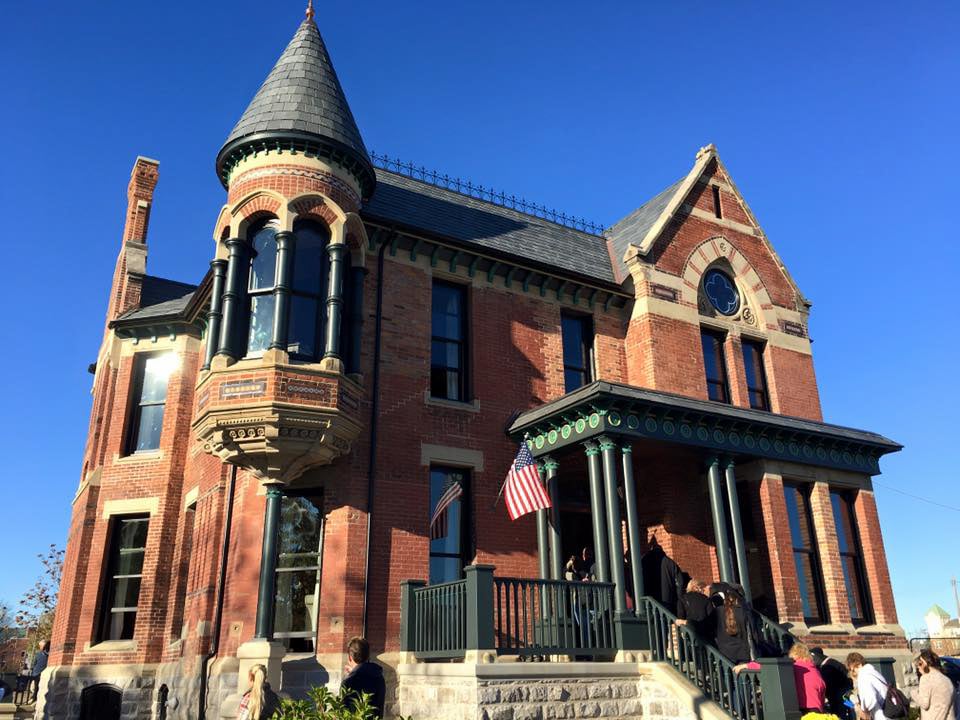
At 205 Alfred Street, the Ransom Gillis House offers a particularly clear example. Built between 1876 and 1878 for a wholesale dry-goods merchant, it was designed by Henry T. Brush and his young assistant George D. Mason. Its Venetian Gothic character includes the distinctive corner turret and decorative tilework. Source: John Kossik for Historic Detroit.
The original owner is only the beginning. After passing through several affluent households, the house became a rooming house after 1919. A storefront was added in the late 1930s. Decades later, unsuccessful rehabilitation efforts preceded the highly publicized 2015 renovation associated with Nicole Curtis. Historic Detroit documents those changes.

A photograph of the renewed exterior invites admiration. The building's full timeline invites another question: how much attention do we give the people who lived there between the celebrated first owner and the celebrated renovation?
A rented room was still someone's address. A storefront was still someone's working day. Those uses deserve to be recorded with the same care as an architect's name.
A carriage house helped launch Pewabic
One of Brush Park's most consequential creative beginnings happened in a much smaller space. Pewabic Pottery was founded in 1903 by artist and educator Mary Chase Perry, later Stratton, and kiln manufacturer Horace J. Caulkins. The pottery began in a Brush Park carriage house before moving production into its purpose-built East Jefferson studio in 1907. Source: Pewabic's own history.
Historic Detroit identifies the early location as the Gillis property's carriage house. It later served automotive businesses before being demolished. Read the property's history.
The pottery's legacy traveled far beyond that first workshop. Pewabic's architectural tile and ceramics became part of homes, schools, religious buildings, and public institutions in Michigan and elsewhere in the country. Explore Pewabic's history and continuing work.
That is a useful way to widen a Michigan story: follow a documented connection outward. Begin with an actual place and the people working there, then see where their work went.
Who gets remembered after a neighborhood changes?
As prosperous residents moved to other neighborhoods, many Brush Park homes became apartments and rooming houses. Black residents also became an important part of the neighborhood's twentieth-century life. Its history includes working households and community institutions alongside its famous early owners. Brush Park's history and further references.
Describing this entire transition as decline can hide more than it explains. A change in a building's social status is different from the disappearance of the people who use it. To understand a neighborhood, we need to ask who arrived, what they built together, and what choices were available to them.
Yesterday's subject, Black Bottom, raises related questions about neighborhood memory, although its geography and redevelopment history are distinct. This History Loves Company film continues that conversation.
Related film: remembering Black Bottom
Watch Detroit's Black Bottom: What They Destroyed to Build the Freeway.
Preservation needs a longer memory
Saving a historic house gives future generations something tangible to study. But the building and its interpretation need attention together. A carefully repaired facade can still carry an incomplete story.
When looking at Brush Park, try three questions: What was this building made for? How did people adapt it? Which parts of that history are visible, and which require research?
Historic Detroit's Brush Park house directory is a useful starting point for following individual addresses. Compare photographs from different years, and look for changes in entrances, additions, and surrounding buildings. Keep the date beside every image; it is part of the evidence.
For another HLC story about architecture, memory, and a building's changing place in Detroit, watch our Michigan Central film.
Related film: Michigan Central and Detroit's architectural ambition
Watch Grand Central Made New York Famous. Michigan Central Made Detroit Great.
Keep the story going
For more from History Loves Company, explore our neighborhood stories and Christopher Hubel's book, They Lied to Us About Detroit.
Pewabic's beginnings also leave a practical question for the present: where can someone with a skill find room to start? Discover The Foundry by HLC, our creator marketplace in downtown Pontiac, and the people building their own next chapters there.
Subscribe to Stories We Keep for more Michigan history, and share a neighborhood memory that deserves to be recorded.
Every home has a story. Keep looking beyond its first chapter.
Sources and further reading
- Historic Detroit: Ransom Gillis House — architecture, changing uses, and the 2015 renovation.
- Pewabic: Our History — founders, Brush Park origins, and the 1907 move.
- Brush Park overview and bibliography — boundaries, development, and residential change.
- Historic Detroit: Brush Park house directory — further research by address.