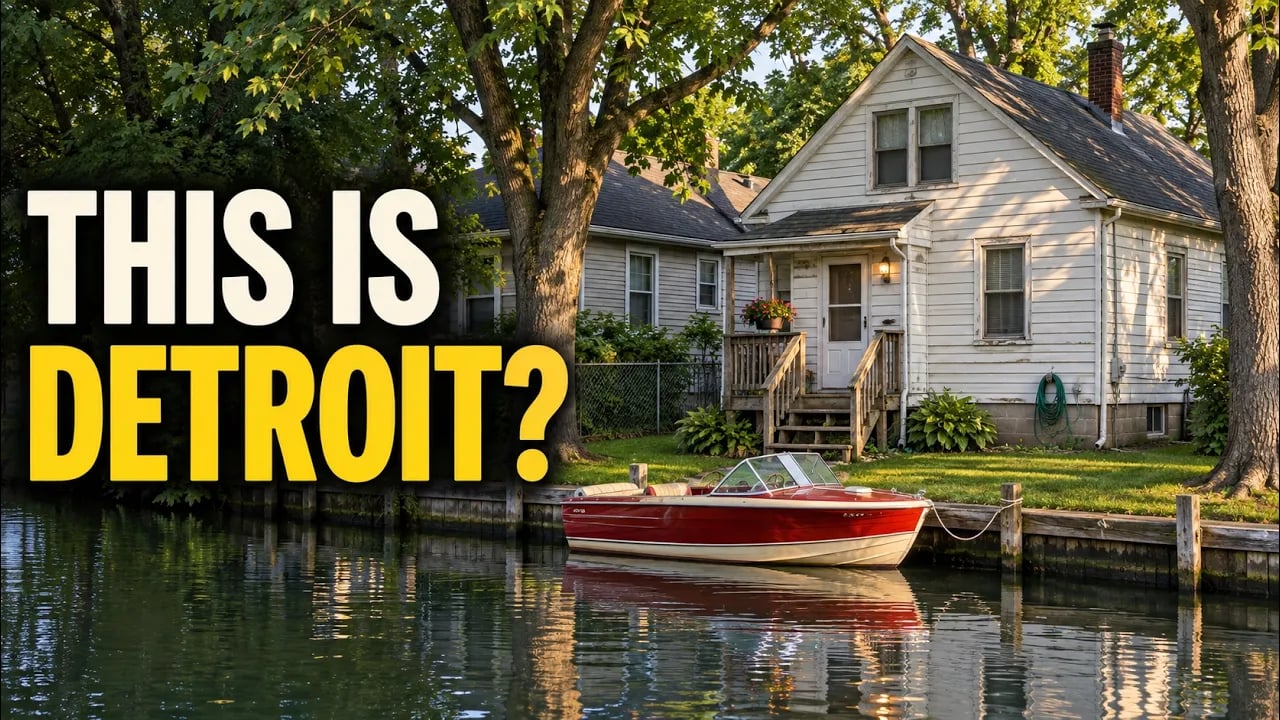
In one corner of Detroit, the car can be parked out front while the boat is tied up out back. Walk beyond the house, and the backyard meets a canal connected to the Detroit River.
This is the waterfront side of Jefferson-Chalmers, on Detroit’s far east side near Grosse Pointe Park. It’s often called the Venice of Detroit. The nickname catches the surprise of seeing boats between city houses. The history explains how they got there.
These waterways developed through drainage work, changes to existing creeks and the sale of land with boating access. Keeping that access open sometimes meant going to court. In one dispute, the obstacle was a barge deliberately sunk across the channel.
Where are Detroit’s canals?
The residential canals lie south of East Jefferson, close to the Detroit River and the Grosse Pointe Park border. Fox Creek is part of this network, which connects homes and backyards to the larger water system.
This waterfront landscape is one part of Jefferson-Chalmers. The Jefferson-Chalmers Historic Business District is a separate, defined district centered on the commercial corridor along East Jefferson. Its storefronts and ballrooms tell the main-street story; the canals tell another chapter.
Before the houses, there was a marsh
The wider area belonged to the wetland landscape known as the Grand Marais. Before a street grid organized the land, water shaped the possibilities for travel, farming and construction.
The City of Grosse Pointe Woods’ historical account describes William Moran securing government help to drain marshland south of Jefferson in 1874. Two years later, land donated by Charles and William Moran helped create the road now known as Alter. Excavated earth became dikes, and Fox Creek received a straighter channel.1
The neighborhood took shape on ground people were actively changing. Ditches, channels and embankments made development possible. Water remained part of the landscape people would live with.
Waterfront access became part of the sale
For a developer, a channel reaching inland could give more lots access to open water. For a buyer, that meant the possibility of keeping a boat beside the house.
Detroit’s historic district report describes William Klenk’s Motor Boat Subdivision and its lots beside the creek and connecting canals. Owners built docks and boathouses. The report dates three connecting canals to 1918; the wider network developed in stages, with waterways and disputes over their use already documented earlier.2
The appeal was practical. A boat needed a route out. What happened elsewhere along the channel could affect whether a waterfront owner could reach the river at all.
The sunken barge that brought a neighbor to court
That problem had already reached the Michigan Supreme Court by 1914.
John Lepire used a canal to travel by water between his home and Lake St. Clair and the Detroit River. Klenk blocked the channel by sinking a barge across it.
In Lepire v. Klenk, decided June 1, 1914, the court upheld a decree preventing the obstruction. The opinion described years of public use, improvements made at public expense and a substantial part of the waterway dedicated to public use when the surrounding subdivision was platted.3
A canal behind a house could look like a small piece of water. For Lepire, it was the way out to the lake and river. The court record makes that dependence tangible.
In 1924, residents dug their way back to the river
A later obstruction came from a storm. In 1922, sand and debris blocked Fox Creek’s mouth. Efforts to reopen it became entangled in a dispute involving Klenk’s estate.
On August 10, 1924, more than 200 residents gathered with a horse and a grading scoop. Detroit’s historic district report records that they cleared a channel roughly 15 feet wide and two feet deep over more than 300 feet in a day.2
It’s an extraordinary neighborhood workday to picture. It also shows how much depended on a relatively narrow passage. A dock in the backyard was useful only if boats could get through.
The river connection also brings flood risk
The same waterways that provide boating access can carry high water inland.
The U.S. Army Corps of Engineers’ July 2022 study of Jefferson-Chalmers described flooding associated with high lake levels and storm effects, including water overtopping canal walls. The study examined ways to reduce that coastal flood risk.4
That connection matters to the history as much as the boats and boathouses do. Drainage and construction changed the land, but the neighborhood remained linked to the river’s water levels. The view from a backyard dock and the work of protecting a home belong in the same account of life here.
A neighborhood built around a route to the water
Detroit has a canal neighborhood because people reshaped a wet landscape and built homes around access to the river. Residents then worked to preserve those routes, through lawsuits and, on one documented summer day, a horse and a grading scoop.
The next time you see a boat behind a Jefferson-Chalmers house, consider the passage between that dock and the river. More than a century of decisions, disputes and neighborhood work runs through it.
Did your family live along the canals? Share your memory in the film’s comments. The records explain how this place developed. The people who lived here can tell us what it felt like to call it home.
Watch next:Continue with Streets of History →
Explore HLC:Historic neighborhood guides · Films and stories · Detroit history guide
Sources and further reading
- City of Grosse Pointe Woods, “Challenging the Marshes.” Moran drainage work and the development of Alter Road and Fox Creek’s channel.
- City of Detroit, Jefferson-Chalmers Historic Business District report, included as Exhibit L in city materials. Canal development and the August 10, 1924 reopening account; the latter appears on report page 16.
- Michigan Supreme Court, Lepire v. Klenk, 180 Mich. 481, June 1, 1914. Opinion describing the barge obstruction and affirming relief.
- U.S. Army Corps of Engineers, Jefferson-Chalmers flood-risk study, July 2022. Coastal flooding pathways and risk-reduction alternatives.
