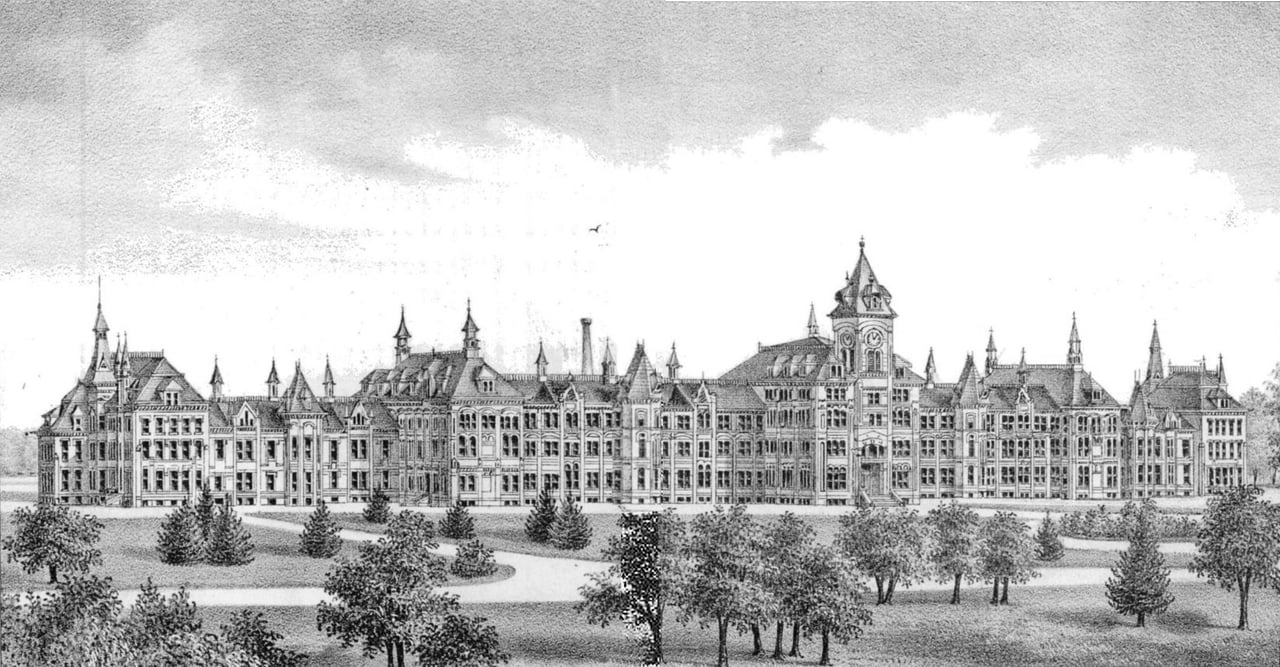
Michigan History / Forgotten Places
Eloise Asylum: The Forgotten History of Michigan's Lost City of the Sick
Before the ghost stories, abandoned buildings, and paranormal investigations, Eloise was one of the largest public healthcare and welfare institutions in Michigan. Its history reveals a world of poverty, illness, medical innovation, and thousands of lives that deserve to be remembered.
Along Michigan Avenue in Westland, just west of Detroit, stands one of the most recognizable surviving landmarks of Michigan's institutional history.
For generations, the name Eloise has carried an unusual reputation.
Some know it as an abandoned asylum. Others recognize it from ghost tours, paranormal investigations, and stories of unexplained activity.
But long before Eloise became associated with the supernatural, it was a place where thousands of people lived, worked, received medical treatment, and sometimes spent the remainder of their lives.
Its history is far more complicated, and far more important, than the legends suggest.
The Beginning: Wayne County's Poorhouse
The story begins in 1839, when Wayne County established a poorhouse in Nankin Township, in the area now known as Westland.
At the time, organized public assistance was very different from what exists today.
People experiencing poverty, disability, chronic illness, or other hardships often had few places to turn.
County poorhouses were intended to provide basic shelter and support to residents who could not support themselves.
These institutions frequently housed people with very different needs under the same roof.
The early Wayne County facility was known as the County Poorhouse. Over time, the institution expanded, and its role changed dramatically.
What Did Michigan's Early Institutions Look Like?

Michigan's nineteenth-century poorhouses were part of a much larger national system of institutional care.
Many were established on large tracts of rural land.
Residents might participate in farming, food preparation, laundry, maintenance, and other work that helped support the institution.
These arrangements were often presented as practical and self-sustaining.
But they also reflected an era when poverty, disability, and mental illness were frequently treated as problems to be managed through institutionalization.
How Eloise Got Its Name
The institution eventually became known as Eloise, a name traditionally associated with Eloise Dickerson, the daughter of a local postmaster.
The name was adopted in the nineteenth century and became closely identified with the surrounding community and institutional complex.
What had begun as a county poorhouse was growing into something far larger.
A Hospital Complex That Became a Small City
As Wayne County's population grew, so did the demand for public healthcare and institutional care.
Eloise expanded into a sprawling campus with separate facilities for different populations.
Its operations eventually included psychiatric care, general medical treatment, residential care, and extensive support services.
At its height, Eloise occupied hundreds of acres and included dozens of buildings.
The grounds contained far more than hospital wards.
There were agricultural operations, maintenance buildings, kitchens, laundry facilities, employee housing, and infrastructure necessary to support a large institutional population.
The scale was so substantial that Eloise functioned in many ways like a small town.
A Community Within a Community
Eloise was not simply one asylum building. It was an extensive network of hospitals, residential facilities, farms, service buildings, and grounds that changed repeatedly over more than a century.
The institution's enormous physical footprint reflected both the scale of public need and the institutional approach to healthcare and welfare during that period.
Psychiatric Care in an Earlier Era

To understand Eloise, it is important to understand how psychiatric care changed over time.
During the nineteenth and early twentieth centuries, large institutions became a common approach to caring for people with serious mental illnesses.
Some patients entered these facilities voluntarily, while others were committed through legal or administrative processes.
Treatment methods evolved as medical knowledge changed.
In different periods, psychiatric institutions used approaches that included structured routines, occupational activities, medications, and treatments that would later become controversial or obsolete.
It would be inaccurate to describe every patient experience at Eloise in the same way.
For some people, the institution provided care and shelter that were otherwise unavailable.
For others, institutional life could involve separation from family, restricted freedom, and prolonged confinement.
The history deserves to be examined with compassion rather than reduced to horror.
The People Who Lived at Eloise
Behind the institution's enormous buildings were individual lives.
Patients and residents came from many different backgrounds.
Some needed short-term medical treatment. Others lived at Eloise for years.
The workforce included nurses, physicians, attendants, cooks, maintenance workers, agricultural employees, and administrators.
Many employees devoted significant portions of their careers to the institution.
The people who lived and worked there formed a community shaped by routines, relationships, medical care, and the changing conditions of institutional life.
Explore Authentic Eloise Photographs
The Real Eloise, Preserved in Photographs
Historic photographs document the actual hospital buildings, grounds, farm operations, and people associated with Eloise.
These collections are valuable primary sources. Because their reuse permissions have not been established as public domain, the original archive pages are linked here instead of copying the photographs into this article.
Explore the Tales of Eloise Photo Galleries
Eloise's Farms and Daily Operations
One of the most fascinating aspects of Eloise was the institution's agricultural system.
The property included farmland and livestock operations that helped supply food to the institution.
Farming was both an economic activity and, during certain periods, part of the institution's approach to daily routines and occupational work.
The farm also reflected the location of Eloise, which began as a rural institution before the surrounding region became more heavily developed.
As suburban Wayne County grew, the landscape surrounding Eloise changed dramatically.
What had once been isolated farmland eventually became part of a major suburban commercial corridor.
The Cemetery and the Forgotten Residents
One of the most solemn reminders of Eloise's history is the cemetery associated with the institution.
Thousands of people who died while connected to the facility were buried in institutional cemetery grounds.
Many graves were identified with numbers rather than elaborate individual markers.
These burial practices reflected the economic and social conditions of the period, as well as the administrative systems used by public institutions.
For modern researchers and families, identifying individuals buried at Eloise can require careful archival investigation.
The cemetery is an important reminder that the institution's history is not simply a story of buildings.
It is also a story of people whose lives deserve recognition.
Medical Advances and Changing Ideas
The twentieth century brought major changes to both general medicine and psychiatric care.
New medications, changing treatment philosophies, and the expansion of community-based services challenged the model of large residential institutions.
Across the United States