A useful meeting place needs more than an address. It needs something people can recognize: a curve in the street, a tower above the trees, a place to wait without disappearing into a doorway. Grand Circus Park brings those things together along Woodward Avenue.
That helps explain its appeal as a downtown landmark. The park gives the surrounding buildings room to be seen. In return, the buildings give the park a recognizable edge. Its history is a conversation between open ground and the city growing around it.
The circle that became a half-circle
Grand Circus Park grew from the plan for rebuilding Detroit after the fire of 1805. The Detroit Historical Society dates the park’s establishment to 1850. The original street plan envisioned a complete circle, but the northern half was never built. What survives is a semicircle divided by Woodward, with Adams Street along its straight northern edge. Read the Historical Society’s overview.
The National Register nomination describes streets converging on the park, including Madison, Broadway, Washington Boulevard and Bagley. That geometry matters at walking speed. An ordinary corner usually asks you to turn. Here, several approaches draw your attention toward a shared space. The park becomes a reference point for understanding where you are. See the district’s National Register documentation.
A skyline built around a pause
Central United Methodist Church anchors the northeast corner of Woodward and Adams. Built in 1867 to Gordon W. Lloyd’s design, its Gothic Revival tower belongs to an earlier chapter than much of the commercial architecture around the park. The National Register documentation identifies the church as the district’s oldest building and records a major concentration of construction between 1915 and 1928. The nomination records these different building eras.
Those dates change the way the view reads. The park was already there while the surrounding city grew taller. A church spire and later commercial buildings share the same frame, although they arrived in different generations. You can see that layering without entering a lobby or knowing every architect’s name.
The district includes landmarks such as the David Whitney Building and Broderick Tower. Their relationship to the open space is part of the experience: step back into the park and a building becomes easier to take in as a whole. Architecture has a different presence when there is room to look up.
An old view, an everyday place
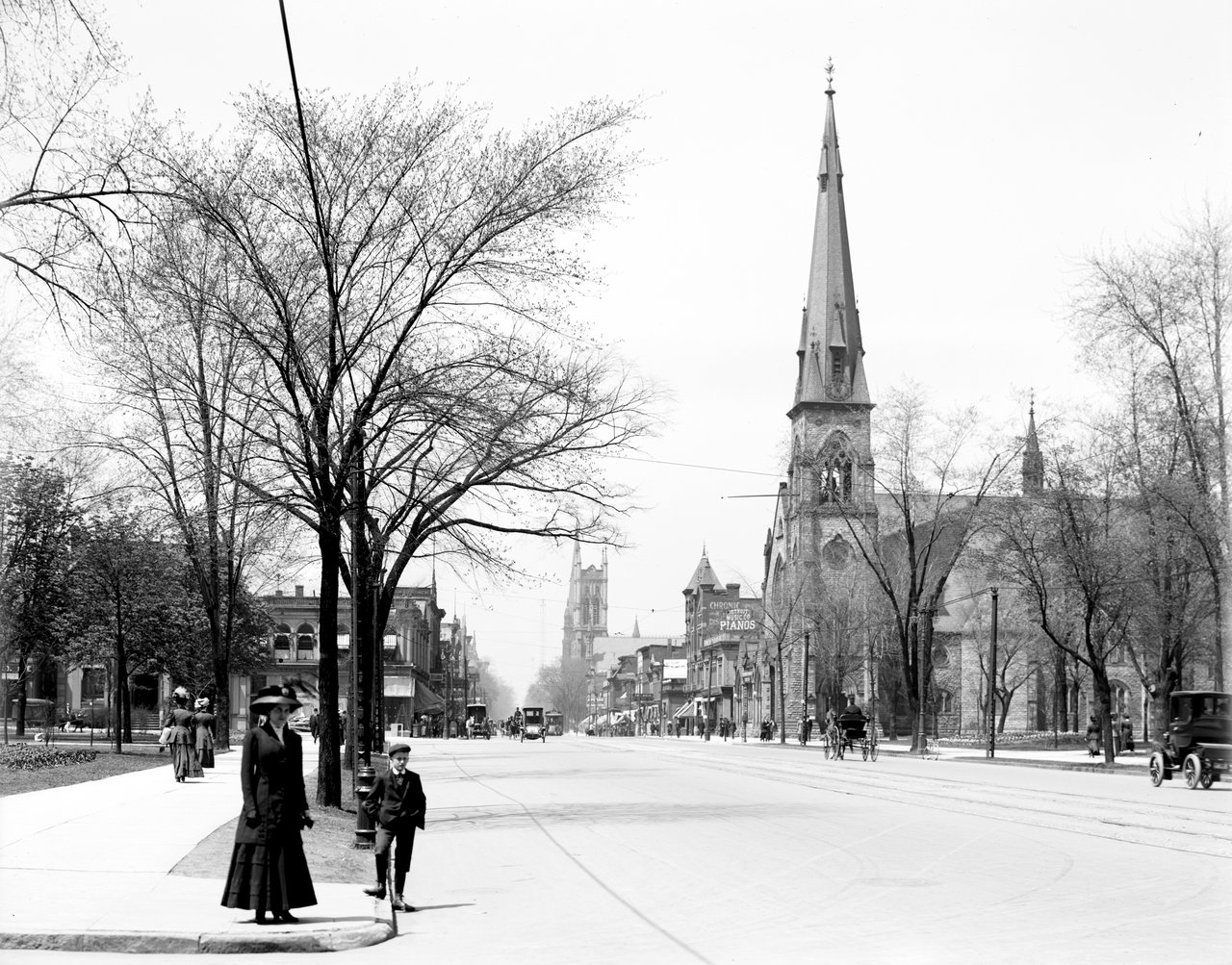
The Detroit Publishing Company photograph accompanying this story dates from between 1905 and 1915. Pedestrians stand near the curb, trees line the park, and Central Methodist’s spire rises beside Woodward. It preserves a busy street with people moving through it, rather than an empty architectural portrait. The photograph is held in the Library of Congress collection. View the image’s source and rights record.
Today, the Downtown Detroit Partnership identifies seating, gardens and two historic fountains among the park’s features. Those everyday provisions matter alongside the landmarks. A place to sit gives someone a reason to stay; a visible landmark gives someone else a way to find them. Check the current park information.
Make it a starting point
On your next downtown walk, choose one building facing the park and notice how your view changes as you move along the public sidewalk. Look at the roofline, then the entrance, then the space between you and the building. That simple change of distance can make a familiar landmark feel newly legible.
Continue exploring the city through History Loves Company’s Detroit and Michigan films. Which Detroit landmark has been your easiest place to tell someone, “Meet me there”?
Woodward Avenue at Grand Circus Park, between 1905 and 1915. Detroit Publishing Company / Library of Congress, digital ID det.4a18915. No known restrictions on publication.