STORIES WE KEEP · SEPTEMBER 12, 2026
Highland Park Ford Plant: Where Work Changed Forever
The moving assembly line made the Model T faster to build. It also changed what a day's work demanded from the people building it.
By Christopher Hubel | September 12, 2026

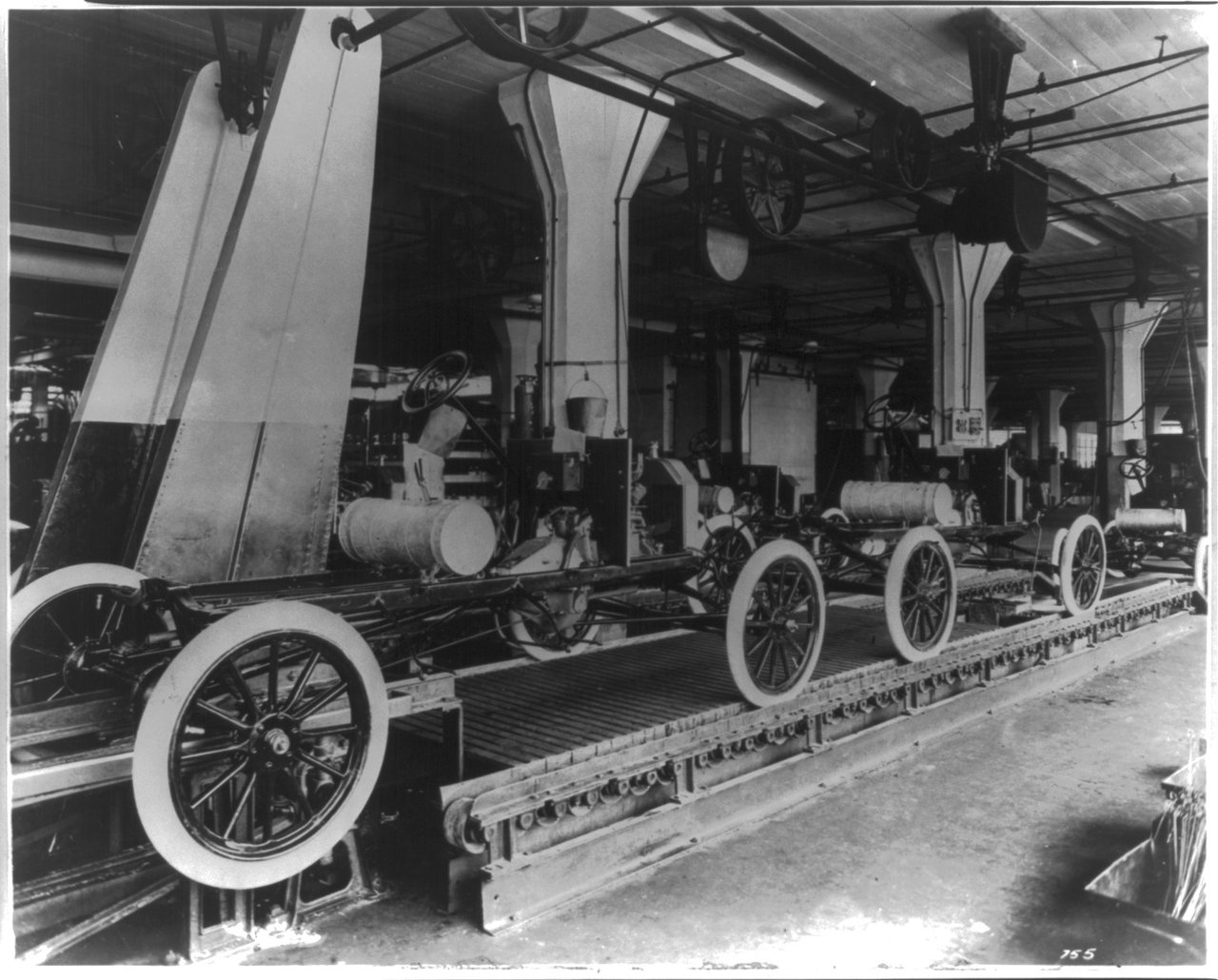
The cars in this photograph are not finished. They are waiting for the next operation.
That is what makes the picture worth studying. It shows an automobile becoming a sequence: a chassis here, another behind it, the same task repeated as each one moves forward.
We often remember Henry Ford's Highland Park plant as the place that made cars faster. But speed was only part of the change. The moving assembly line reorganized the relationship between a product, a worker, and the clock.
This is a Michigan history story with consequences far beyond Michigan. It deserves more than a quick sentence about an invention.
Before the Assembly Line: A New Factory in Highland Park
Ford's Highland Park plant opened in 1910 at Woodward Avenue and Manchester Street. Albert Kahn designed the complex, including a long, four-story factory whose extensive glazing helped earn it the nickname “Crystal Palace.” Concrete columns and large windows supported a brighter, more open industrial interior. Source: Detroit Historical Society.
The Model T did not originate here. It first emerged from Ford's Piquette Avenue plant in Detroit in 1908; production moved to Highland Park in January 1910. Keeping those places distinct matters. One belongs to the car's beginnings, the other to the transformation of how it was produced. Source: Detroit Historical Society's Piquette history.
1913: Bring the Work to the Worker
The change developed through experiments, not one fully formed idea dropped onto a factory floor. In an early 1913 magneto assembly arrangement, workers added components to Model T flywheels and passed them along to the next person. Source: The Henry Ford, magneto assembly collection entry.
That simple arrangement helps explain the larger system. Divide a job into operations. Position the necessary parts and tools. Move the product between stations. Reduce the time spent carrying, searching, and waiting.
The Henry Ford reports that experiments during 1913 and into 1914 reduced Model T assembly time from roughly twelve and a half hours to 93 minutes. That comparison describes assembly time—not the time needed to turn raw materials into every component of a finished car. Source: The Henry Ford.
Calling this simply “Ford invented the assembly line” hides the most interesting part: the process of arranging people, equipment, and materials into a system that could keep moving.
Watch: Inside the Highland Park Ford Plant
My History Loves Company walkthrough brings this story back to the physical place. Watch the building, then return to the archival photograph. Compare the scale of the rooms, the columns, and the machinery-filled space with what the camera records today.
Watch the full Highland Park Ford Plant walkthrough on YouTube.
The film is not an announcement of public access. Do not enter the property or buildings without authorization; an open doorway or window is not permission.
The Line Worked. Keeping Workers Was Harder.
Ford's productivity gains came with repetitive work and serious employee turnover. Workers left, and replacing them cost money. A production system built around a dependable sequence still needed people willing to return for another shift. Source: The Henry Ford.
Look again at the photograph and imagine a person occupying one station for an entire workday. The finished car would travel somewhere new. The worker would perform the next repetition.
That does not erase the achievement. It tells us whose experience we need to include when we describe it.
1914: The Five-Dollar Day Had Conditions
On January 5, 1914, Ford announced its famous five-dollar day. The offer included profit sharing, not simply an unconditional wage increase for everyone. Eligibility came with requirements, and the company's Sociological Department investigated employees' lives beyond work. Higher income and employer intrusion were part of the same arrangement. Source: The Henry Ford.
The announcement also paired the higher daily payment with an eight-hour day, compared with the earlier nine-hour schedule. The Henry Ford's collection documents the crowds of applicants drawn to Highland Park by the offer. Source: The Henry Ford's Five Dollar Day collection.
It is tempting to reduce this to generosity or control. The better questions are more specific: who qualified, what changed in a household budget, and what did the company demand in return?
A factory can expand what people can afford while narrowing how much control they have over their working day.

The Model T Era Ended. The Site's Story Continued.
Model T assembly at Highland Park continued until 1927. Ford's next passenger-car chapter centered on the Rouge, while Highland Park served other manufacturing purposes, including wartime production. Parts of the complex were later demolished; the Crystal Palace and powerhouse came down in 1960. The site became a National Historic Landmark in 1978. Source: Detroit Historical Society.
That history makes precision important when looking at the buildings that remain. A surviving part of a complex is not the entire original factory. A present-day room should not automatically be labeled the exact location of a photographed 1913 operation.
Preservation begins with noticing what is there. Historical research helps us understand what is missing.
Beyond the Factory Gates
A car leaving an assembly line is not the end of a transportation story. It is the beginning of questions about roads, parking, commuting, and where people live.
But an affordable automobile does not, by itself, explain every later change in an American city. The choices made outside the factory deserve their own investigation. That is where our They Lied to Us streetcar episode picks up the conversation.
Watch What Really Killed America's Streetcars?
The Stories Worth Keeping Include the Workers
A factory history usually starts with a company name. It should not stop there.
Employment records, family photographs, and recollections of a department or shift can bring people back into a story dominated by products. If your family has a Ford connection, write down which plant, which years, and what work the person actually did. Do not assume every Ford story belongs to Highland Park.
This is the approach behind Stories We Keep: start with a place, check the details, and follow the people. It also informs the conversations we want to make room for at The Foundry in downtown Pontiac.
For a broader Detroit narrative, explore They Lied to Us About Detroit. The factory belongs in that story alongside the neighborhoods and transportation systems beyond its gates.
Have a factory photograph or family work story? Share it with History Loves Company, with names, dates, and permission to use the material where available.
Keep exploring our Detroit-area history stories and Pontiac collection, or subscribe to Stories We Keep.
Every home has a story. Every city carries memory.
Sources and Further Reading
- Detroit Historical Society: Ford Highland Park Plant — architecture, production, demolition, and landmark designation.
- Detroit Historical Society: Ford Piquette Avenue Plant — the Model T's earlier production home.
- The Henry Ford: America's Industrial Revolution — early magneto assembly.
- The Henry Ford: Ford's Five Dollar Day Revolution — assembly time, turnover, profit sharing, and its conditions.
- The Henry Ford: Five Dollar Day collection — working hours and contemporary applicant photographs.
- Image credits and reuse terms appear beneath each photograph. Both videos are from History Loves Company.