STORIES WE KEEP · SEPTEMBER 21, 2026
Before suburban malls and online shopping, Hudson's turned Woodward Avenue into Michigan's gathering place—and its loss became a symbol of downtown Detroit's decline.
By Christopher Hubel | September 21, 2026

For generations of Detroiters, going downtown often meant going to Hudson's.
The trip might begin on a streetcar, a bus, or in a family automobile. It might include lunch beneath the store's roof, a visit to Toyland, a careful search for school clothes, or a December crowd gathered around holiday windows. The building was enormous, but its place in memory was built from small moments.
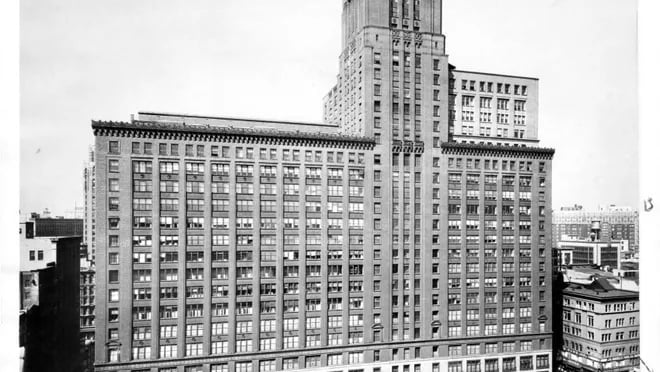
J.L. Hudson's did not simply sell merchandise. It helped make downtown Detroit a destination. Its growth reflected the rise of the industrial city. Its expansion into the suburbs reflected a changing metropolitan region. Its 1983 closure and 1998 demolition became symbols of downtown's long decline. The history is not a single story about one store failing. It is a story about how Americans changed where they lived, traveled, shopped, and gathered.
The story began smaller than the building Detroit remembers
Joseph Lowthian Hudson was born in England in 1846 and came to North America as a child. Before building his name in Detroit, he worked for retailer C.R. Mabley in Pontiac—a connection that places the Hudson story inside the wider history of Southeast Michigan.
In 1881, at age 35, Hudson established a men's and boys' clothing shop inside Detroit's old Opera House. The business moved and expanded before settling at Gratiot Avenue and Farmer Street in 1891. From there, additions gradually consumed the block bounded by Woodward, Farmer, Gratiot, and Grand River.
The familiar Hudson's building was therefore not one structure completed in a single moment. It was a retail complex assembled across decades as Detroit's population, industry, and purchasing power grew. The building's complicated interior—and the way longtime shoppers learned to navigate it—was part of its character.
Hudson's became a city inside the city
At its height, the downtown store contained more than two million square feet. It rose 25 stories and was described as the world's tallest department store until 1961. The Detroit Historical Society's collection documents hundreds of fitting rooms, dozens of elevators, multiple restaurants, an auditorium, a circulating library, a writing lounge, dry cleaning, and an enormous delivery operation.
Those numbers explain the scale, but not the attachment. Hudson's brought many parts of urban life under one roof. People could shop, eat, meet, work, attend an event, or simply experience the spectacle of a modern department store.
That distinction matters. A downtown department store depended on more than shelves of products. It depended on transit, nearby offices, theaters, restaurants, sidewalks, and the habit of making downtown the center of metropolitan life. Hudson's helped generate that habit while also benefiting from it.

The windows helped turn shopping into public theater
Department-store windows transformed the edge between private business and public sidewalk. A passerby did not need to buy anything to experience the display. The glass offered fashion, technology, fantasy, and civic messaging to everyone moving along the street.
The photograph above shows Hudson's participating in a U.S. Food Administration campaign during World War I. The display reminds us that major retailers did more than advertise goods. Their windows became prominent public communication spaces during national events.
Holiday traditions deepened the relationship. Hudson's hosted Detroit's first Thanksgiving parade in 1924, with Santa's arrival marking the beginning of the Christmas season. Toyland, elaborate decorations, and animated windows became part of family ritual. The store sold products, but it also sold anticipation—the sense that a visit downtown was an occasion.
Watch: drive the Woodward Avenue that connected Detroit
Woodward was the spine of the downtown shopping district and the route that connected the city center to neighborhoods farther north. This History Loves Company drive places the Hudson's site inside that larger urban corridor.
Watch A Drive Through Detroit's History on Woodward Avenue on YouTube.
Hudson's helped invent the suburban future that challenged downtown
As metropolitan Detroit spread outward, Hudson's followed its customers. Northland Center opened in Southfield in 1954 with Hudson's as its anchor. Designed by Victor Gruen, Northland offered a carefully planned shopping environment with abundant parking and easy access for suburban households.
The move made business sense. It also revealed a larger transformation. Federal mortgage policy, highway construction, new subdivisions, racial exclusion, population movement, and automobile ownership were changing the region's geography. Retail did not cause all of those changes, but it adapted to them—and reinforced them.
By 1978, Hudson's operated nine satellite locations around metropolitan Detroit in addition to stores elsewhere. The downtown flagship now competed with branches carrying the same trusted name closer to suburban homes.
This is one reason the decline of downtown shopping cannot be reduced to a simple claim that people stopped caring about the city. The systems surrounding daily life had changed. Jobs dispersed. Roads made some destinations easier to reach than others. Free parking became an expectation. Shopping centers concentrated stores in climate-controlled environments. Families had new options, although access to suburban housing and those options was never distributed equally.
Watch: why the suburbs grew so quickly
Our documentary Why America Really Built the Suburbs examines the policies, financing, roads, builders, and racial barriers behind the metropolitan shift that changed downtown retail.
Watch Why America Really Built the Suburbs on YouTube.
Closure was the end of an era—not the result of one decision
The Dayton Company purchased Hudson's in 1969, creating Dayton-Hudson. During the 1970s and early 1980s, Detroit faced population loss, economic instability, employment changes, and declining downtown retail activity. Hudson's reduced the flagship's operations before closing the store in 1983.
That date matters because the building remained after the store was gone. The structure remained for another fifteen years, but it was not empty throughout that period. Historic Detroit documents continued office use by about 1,200 employees after retail closed, with workers remaining until 1990. The building was imploded on October 24, 1998. Retail closure, the end of office use, and demolition were three separate stages.
Demolition footage can make the loss look instantaneous: a countdown, an explosion, a cloud of dust. Historically, the disappearance took much longer. The building's usefulness had been weakened by decades of metropolitan change before explosives brought it down.
The same caution applies when Hudson's is used as a symbol for Detroit. A symbol can focus attention, but it can also flatten a complicated history. The department store did not rise because of one person or fall because of one event. It existed inside a network of workers, shoppers, transportation systems, public policy, corporate decisions, and changing expectations about urban life.
Remember the workers as well as the shoppers
Nostalgia usually remembers the decorated windows and special purchases. A fuller history also asks who made those experiences possible.
Thousands of people worked inside the downtown store and across its delivery system. They staffed counters, prepared food, operated elevators, maintained displays, handled alterations, cleaned the building, managed stock, and delivered purchases across the region. According to the Detroit Historical Society, Hudson's employed approximately 12,000 people by 1953.
The employment story also reveals barriers. The downtown store hired its first African American bus girl in 1960: high school student Diana Ross, who would soon become famous as a member of the Supremes. That surprisingly late milestone should sit beside the more celebratory statistics. A place can be beloved and still reflect the exclusions of its time.
A new Hudson's now occupies the old site
For years after the implosion, the former Hudson's block was defined by absence. Today, a new mixed-use development bearing the Hudson's name occupies the site, bringing offices, residences, retail, hospitality, events, and public space back to the block. Explore the current Hudson's Detroit development.
The new project does not recreate the old department store, and it should not be asked to. Cities cannot rebuild memory exactly as it was. The more useful question is whether a new place can understand the history beneath it while creating reasons for people to gather again.
That question reaches beyond one block. What makes a downtown worth visiting? What makes it useful to residents rather than only attractive to visitors? How do transit, housing, public space, small businesses, major employers, and cultural institutions work together? Hudson's history reminds us that a destination is never just a building.
Keep your Hudson's story
If your family has a Hudson's box, employee badge, receipt, catalog, parade photograph, or shopping memory, record the details now. Ask which location the story belongs to. Write down the approximate year, the department, the people present, and what made the occasion memorable. A simple shopping bag can become evidence of work, fashion, family tradition, or a changing city.
Share your Hudson's memory with History Loves Company. Continue exploring Detroit history, then read our companion story, Why America Really Built the Suburbs.
For the larger story of the forces that reshaped the city, discover Christopher Hubel's book They Lied to Us About Detroit. You can also visit The Foundry by History Loves Company in downtown Pontiac and subscribe to Stories We Keep.
A building can disappear. The stories people carried through its doors do not have to.
Sources and further reading
- Detroit Historical Society: Hudson's — store growth, traditions, suburban expansion, closure, and demolition.
- Detroit Historical Society: J.L. Hudson — Joseph Lowthian Hudson's life, Pontiac connection, business career, and civic legacy.
- Detroit Historical Society: The J.L. Hudson Department Store Collection — artifacts and interior details preserved from the downtown store.
- Detroit Public Library, Burton Historical Collection: Hudson's in 1929 — featured-image record and public-domain status.
- U.S. National Archives: J.L. Hudson Company window display — archival record for the World War I-era photograph.
- Hudson's Detroit — official information about the current development on the historic site.