STORIES WE KEEP · SEPTEMBER 14, 2026
Michigan Central Station: Ruin, Memory, and Return
Before it became Detroit's most familiar image of abandonment, it was a place of arrival. Its restoration gives us a reason to tell the whole story.
By Christopher Hubel | September 14, 2026

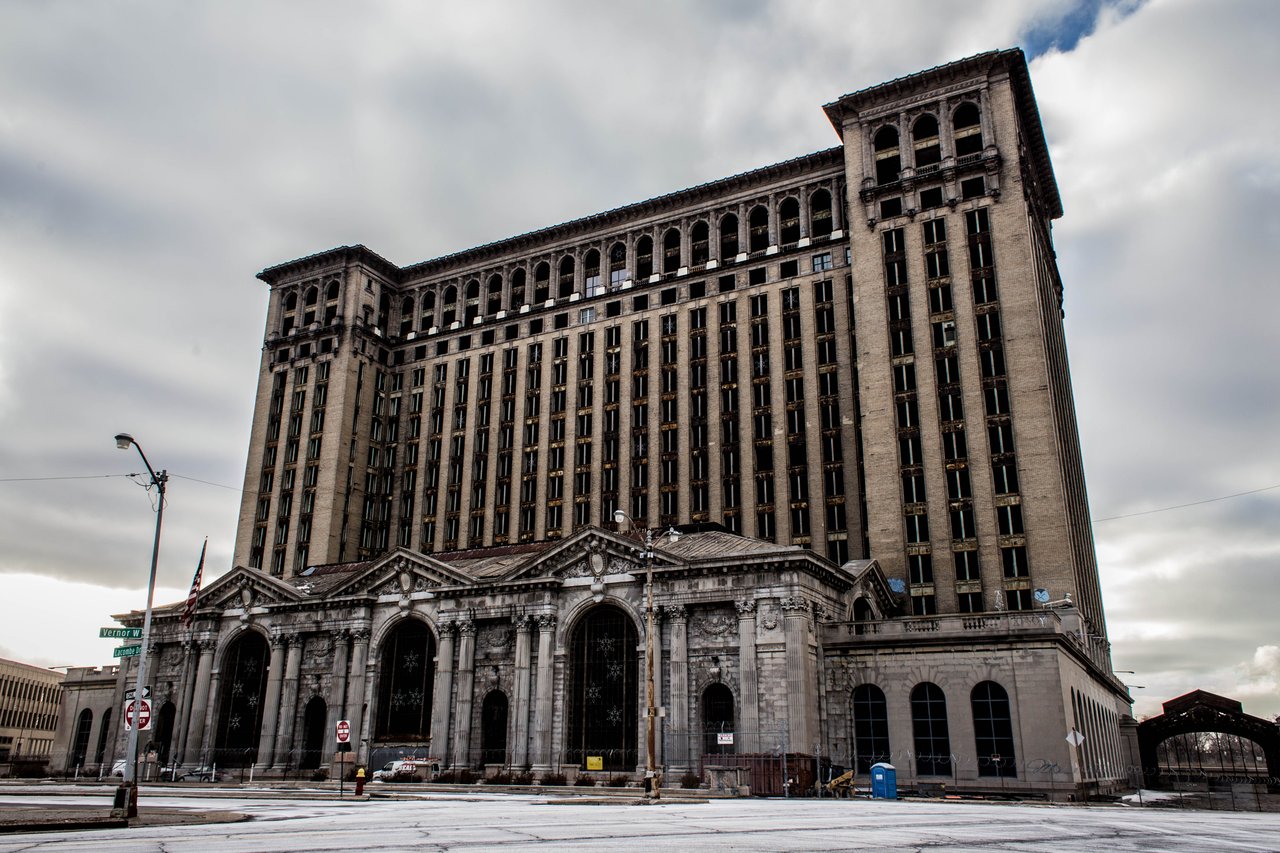
For years, a photograph of Michigan Central Station could stand in for an entire argument about Detroit.
The empty windows did the talking. The camera looked up at the tower, and the viewer was expected to understand the city from what was missing.
But the building had a life before that photograph. It has a life after it, too.
Michigan Central Station's history runs from a working passenger depot to decades of vacancy and a new use following its 2024 reopening. Understanding that whole arc means looking at transportation, architecture, the labor of restoration, and the limits of asking one landmark to explain a city.
1913: A Place Built for Arrivals
The station opened in December 1913 in Detroit's Corktown neighborhood. A fire at the older depot forced it into service before its formal dedication. Its construction responded to growing passenger business and the Detroit–Windsor rail tunnel, which had opened in 1910. Source: Detroit Historical Society.
That puts the building in a different frame. It was infrastructure for movement, built with the expectation that people would keep coming.
Imagine reading an arrival photograph instead of an abandonment photograph. You would ask different questions: Where had the passengers traveled from? Who was waiting for them? What work kept the station running?
Tickets, luggage, meals, cleaning, maintenance—those ordinary needs belong in the history as much as the tower does.
The Grand Central Connection
Reed & Stem and Warren & Wetmore, the architectural firms behind New York's Grand Central Terminal, also designed Michigan Central. Both opened in 1913. The connection is a useful way to understand Detroit's architectural ambition without treating its station as a copy of another city's landmark. Read our Grand Central and Michigan Central architectural companion.
Look at the lower entrance hall and the much taller office block behind it. The building combined a ceremonial public arrival space with the daily business of a railroad. Its dramatic silhouette came from more than a desire to impress travelers.
The original waiting room featured marble, bronze chandeliers, and high vaulted ceilings. Those materials made an everyday activity—waiting for a train—part of a grand public interior. Source: Detroit Historical Society.
Watch: The Architects Who Connected Detroit and New York
This History Loves Company film follows that architectural connection. It is also a way for Stories We Keep to travel outward from Michigan through a specific, documented relationship.
Watch the Grand Central and Michigan Central documentary on YouTube.
1988: The Last Departure Was Not the Beginning of the Decline
Passenger rail use fell as highway and air travel expanded. Michigan Central lost facilities and saw portions close over time. Its final train departed for Chicago on January 5, 1988. The shutdown followed a longer contraction; it was not a sudden event that explains everything before or after it. Source: Detroit Historical Society.
That distinction matters when we tell Detroit's transportation story. A departure board can stop changing on one date. The decisions and habits that brought it to that point develop over years.

What the Ruin Photograph Could Not Tell Us
The damage was real. So was the photograph's power. But a photograph of an empty building cannot tell us everything about the people living around it.
It cannot explain a household's daily life, identify every attempt to save a property, or measure the worth of a neighborhood. It captures what the photographer placed inside the frame.
There is a difference between documenting loss and allowing loss to become the only story a place is permitted to have.
Michigan Central was a building in Detroit. It was never all of Detroit.
2018–2024: Giving the Building Work to Do Again
Ford acquired Michigan Central in 2018. The restored station reopened in June 2024. Source: Detroit Historical Society.
Restoration architect Quinn Evans describes a team of architects, engineers, historians, and conservation specialists working together on the rehabilitation. The work included masonry repairs and the integration of modern building systems into historic spaces. Source: Quinn Evans, Michigan Central Station project.
Those tasks are less easy to summarize than a before-and-after image. Stone needs repair. A historic room needs heating, ventilation, and wiring. The design has to accommodate present-day use without stripping away the details that make the building worth keeping.
Quinn Evans also describes preserving graffiti along the concourse ramp as part of the station's interpretation. That is a significant choice: the building's vacant years became a layer to explain, rather than something to erase completely. Source: Quinn Evans.
What Did Michigan Central Reopen As?
The restoration created a mix of offices, retail, and public space. The waiting room, ticket lobby, and concourse were adapted for public activity and events. It was a new use for an old station, not a resumption of its former passenger-train timetable. Source: Quinn Evans.
Michigan Central now presents the wider district as a technology and cultural hub. For visitors, the practical step is to check the official Michigan Central website for current access, events, and visitor information before heading over.
A reopening is an important milestone. What happens afterward—how a place is used, maintained, and connected to its neighbors—is the next part of the story.
Watch: The Rise, Fall, and Return of Michigan Central Station
Continue with our full station film, then compare the two dated photographs above. Look for what survived across both views, as well as what changed.
Watch The Rise, Fall, and Return of Michigan Central Station.
The Next Story Is About Use
Michigan Central shows what can happen when a historic building receives investment, skilled work, and a purpose. It also leaves a question for less famous places: which buildings deserve that attention before they become landmarks of neglect?
At The Foundry in downtown Pontiac, our scale is much smaller. But putting an existing building to work through local businesses and gathering spaces makes that question immediate. Keeping a place means finding reasons for people to use it.
For the wider Detroit narrative, explore They Lied to Us About Detroit. Michigan Central belongs in that history alongside the homes, workplaces, and neighborhoods that never became famous photographs.
Did someone in your family arrive at, depart from, or work at Michigan Central? Share the story with History Loves Company. Names, dates, tickets, and photographs can help connect the building to the people who used it. Please share only material you have permission to use.
Explore more Detroit history, browse our films and stories, or subscribe to Stories We Keep.
Every home has a story. Every city carries memory.
Sources and Further Reading
- Detroit Historical Society: Michigan Central Station — working history, closure, acquisition, and reopening.
- Quinn Evans: Michigan Central Station — the rehabilitation team's account of conservation and new uses.
- Michigan Central — current district information and visitor planning.
- History Loves Company / The Foundry: Grand Central and Michigan Central — related architectural reading.
- Photograph credits and licenses appear beneath each image. Both embedded films are from History Loves Company.