Streets of History | Detroit, Michigan
The Hidden History of Detroit's Palmer Park: A Senator's Estate, a Forgotten Cabin & Architectural Treasures
Before Palmer Park became one of Detroit's most beloved green spaces, it was a private country estate belonging to a United States senator. Its story includes a remarkable log cabin, a miniature lighthouse, and one of Michigan's finest collections of historic apartment architecture.

There are places in Detroit where the history is hiding in plain sight.
You might drive past them every day without realizing what once stood there, who lived there, or why the surrounding neighborhood looks the way it does.
Palmer Park is one of those places.
Today, visitors know it for its wooded trails, recreation spaces, historic apartment buildings, and extraordinary collection of architecture.
But more than a century ago, this was the private retreat of one of Michigan's most influential political figures.
And the story of how that private estate became a public park is one of the most fascinating chapters in Detroit's history.
The Man Behind Palmer Park
Thomas Witherell Palmer was born in Detroit in 1830, long before the city became the automotive capital of the world.
His family had deep roots in Michigan's early political and business history. His grandfather, James Witherell, served as a judge in the Michigan Territory.
Palmer became a successful businessman, particularly in the lumber industry, before entering politics.
He served in the Michigan State Senate, and from 1883 until 1889 represented Michigan in the United States Senate.
He later served as United States minister to Spain and became president of the World's Columbian Exposition Commission in Chicago.
Palmer was also an advocate of women's suffrage and animal welfare.
But one of his most enduring contributions to Detroit would come from the land he owned north of the growing city.
When Palmer Park Was the Countryside
During the nineteenth century, the area around present-day Palmer Park was far removed from downtown Detroit.
The land was largely rural, with forests, farmland, and open fields.
Palmer used his property for agriculture and to raise Percheron horses.
What we now recognize as a densely developed urban neighborhood was once part of a sprawling country estate.
The surrounding landscape would change dramatically over the next several decades.
The Remarkable Log Cabin

In 1885, Thomas Palmer commissioned architects George D. Mason and Zachariah Rice to design a rustic summer retreat for his wife, Elizabeth Merrill Palmer.
Completed in 1887, the two-story cabin was much more sophisticated than its rough exterior suggested.
Although built using logs from the surrounding property, the interior included finished walls, fine wood flooring, fireplaces, and carefully selected furnishings.
The approximately 2,400-square-foot building became a gathering place for family, friends, politicians, and other guests.
The Palmers filled the home with family heirlooms, historical objects, and furnishings that reflected their interest in the past.
The cabin still stands in Palmer Park, making it one of the most important surviving connections to the property's nineteenth-century history.
Inside the Palmer Family Retreat

The cabin was designed to evoke an earlier period of American life, but it was also a comfortable retreat for a prominent Victorian family.
Its rooms held valuable heirlooms, including objects associated with the Witherell family.
Visitors could admire the collections, enjoy meals outdoors, and gather around bonfires on the grounds.
The property was a deliberate escape from the growing noise and activity of Detroit.
A Lake, a Lighthouse, and a Country Estate

The Palmers' property was not simply a cabin surrounded by trees.
It was a carefully developed landscape with lakes, pathways, and decorative features.
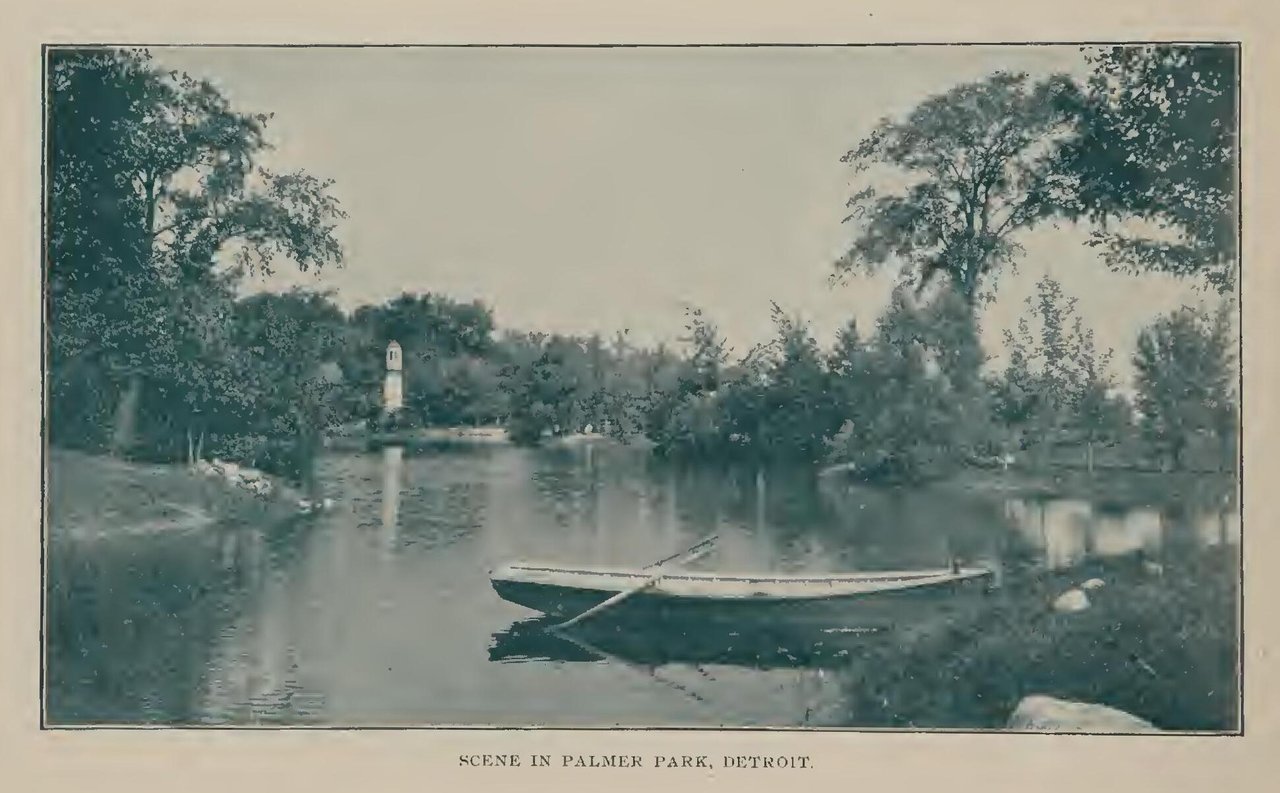
Lake Frances, located near the cabin, became one of the estate's most recognizable attractions.
A small lighthouse was constructed near the water before 1900.
Visitors could also enjoy boating, and the grounds became a destination for recreation and social gatherings.
It was a remarkable landscape for what was then the outskirts of Detroit.
The Gift That Changed Detroit
In 1893, Palmer donated approximately 140 acres to the City of Detroit for use as a public park.
The donation helped preserve an important natural landscape at a time when the city was expanding rapidly.
Palmer wanted the property to remain available for public enjoyment.
His gift included protections for the historic log cabin and forest.
The park was originally known as Log Cabin Park before being renamed Palmer Park in 1897.
Over time, additional land was added, and the park became one of Detroit's most significant recreational spaces.
The Merrill Fountain
Another important connection to the Palmer family is the Merrill Fountain.
Elizabeth Merrill Palmer commissioned the monument in honor of her father, Charles Merrill.
Designed by the architectural firm Carrère and Hastings, the fountain was originally installed in downtown Detroit in 1901.
It was later relocated to Palmer Park in 1925.
The fountain represents another surviving connection between the Palmer family and Detroit's architectural history.
The Extraordinary Apartments of Palmer Park
Across from the park stands one of the most architecturally diverse collections of historic apartment buildings in Michigan.
The Palmer Park Apartment Buildings Historic District began developing during the 1920s.
After Thomas Palmer died in 1913, portions of the family's remaining property were developed for residential use.
The result was a remarkable collection of apartment buildings designed for Detroit's growing middle and upper-middle classes.
Architects experimented with an extraordinary variety of styles: Art Deco, Tudor Revival, Spanish Colonial Revival, Mediterranean, Moorish, and modernist designs.
Between 1925 and 1965, more than forty buildings were constructed within the district.
Albert Kahn and the Palmer Park Apartments
Among the prominent architects associated with the neighborhood was Albert Kahn, whose influence extended far beyond Detroit's factories and industrial buildings.
In 1925, Walter O. Briggs Sr., who would later own the Detroit Tigers, commissioned Kahn to design an apartment building at 1001 Covington.
Other notable architects working in the district included Charles Agree, William Kapp, Robert West, and Weidmaier and Gay.
Together, their work created an architectural landscape unlike almost anywhere else in the city.
The Palmer Park Apartment Buildings Historic District was added to the National Register of Historic Places in 1983.
A Neighborhood Worth Preserving
Palmer Park's architecture reflects a period when Detroit was experimenting with new ideas about urban living, apartment design, and neighborhood planning.
These buildings are more than beautiful facades. They document the ambitions, wealth, cultural influences, and changing lifestyles of twentieth-century Detroit.
Palmer Park Through the Years
1830
Thomas Witherell Palmer is born in Detroit.
1885
Construction begins on the Palmer family log cabin.
1887
The cabin is completed.
1893
Palmer donates land to Detroit for a public park.
1897
The park is renamed Palmer Park.