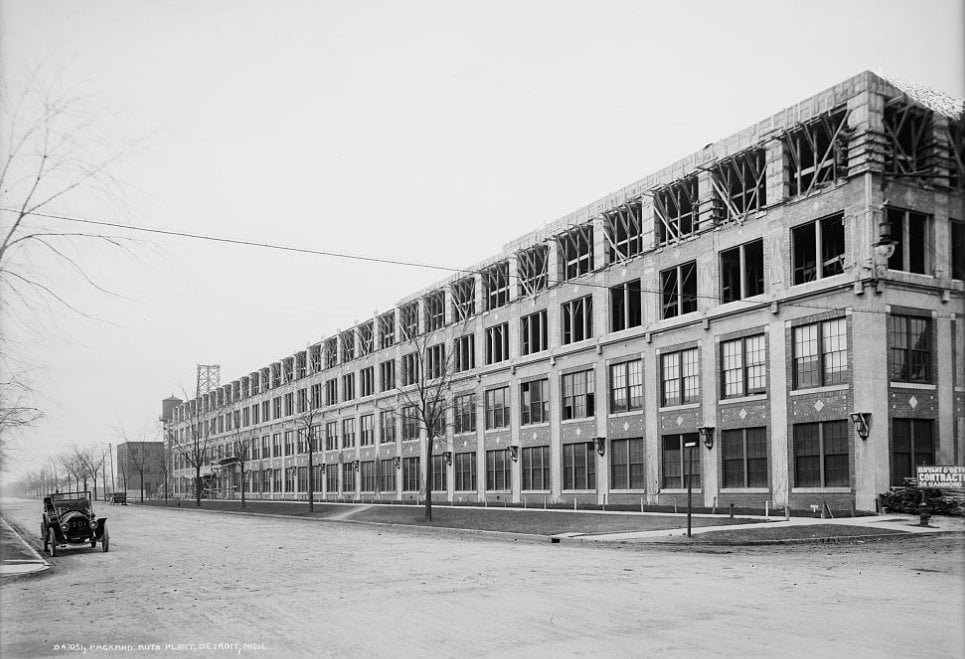

Few places summarize Detroit’s industrial rise and painful decline as powerfully as the Packard Plant.
Stretching along East Grand Boulevard, the complex once produced some of America’s finest automobiles. It employed thousands, advanced factory design and helped establish Detroit as the center of the automotive world. Decades later, its collapsing floors and broken windows became an international symbol of abandonment.
History Loves Company at the Packard Plant
A new History Loves Company film exploring the Packard Plant premieres Saturday on our YouTube channel.
Watch the Packard Plant premiere on History Loves Company →
Packard and the luxury automobile
Packard built its reputation on engineering, craftsmanship and prestige. Long before luxury became a marketing label attached to nearly every product, a Packard automobile represented status and technical excellence.
Detroit’s growing complex gave that reputation a physical form. Factory buildings multiplied as production expanded, creating an industrial city within the city.
Albert Kahn and a new kind of factory
Parts of the Packard complex helped demonstrate the possibilities of reinforced-concrete factory construction associated with Detroit architect Albert Kahn and engineer Julius Kahn. Wide bays, strong floors and large windows created flexible interiors filled with natural light.
That design influenced industrial architecture far beyond Detroit. The factory was not just where Packards were assembled—it was part of a revolution in how factories themselves were built.
The Packard Plant did not begin as a ruin. It began as an argument for the future.
War production and industrial power
Like many Detroit manufacturers, Packard contributed to wartime production. The complex’s workers and machinery became part of the vast industrial effort that earned Detroit its Arsenal of Democracy identity.
The factory’s importance therefore reaches beyond automobiles. It belongs to the history of labor, migration, engineering and America’s twentieth-century military production.
How a landmark became a ruin
Packard automobile production in Detroit ended in the late 1950s. Portions of the enormous complex continued to house smaller businesses, but fragmented ownership, unpaid taxes, neglect, scrapping and vandalism accelerated its decline.
As years became decades, deterioration made reuse more expensive and demolition more likely. The abandoned factory became famous around the world, but notoriety was not the same thing as preservation.
What Detroit should remember
Much of the complex has now been demolished or destabilized beyond practical reuse. The Packard story reminds us that waiting is also a decision. Every season without a secure roof or workable plan narrows the future.
Whatever comes next on East Grand Boulevard should acknowledge the workers, designers and automobiles that made this ground internationally important.
