They Lied to Us | American History
Urban Renewal: The Government Program That Destroyed American Neighborhoods
They called it progress. Across America, entire neighborhoods were demolished, families were displaced, and communities built over generations disappeared. Detroit was one of the clearest examples.

Imagine waking up one morning and discovering that your neighborhood had been marked for destruction.
Not because a disaster had struck. Not because the buildings were all beyond repair. But because city planners had decided that the land beneath your home could serve a different purpose.
Across the United States, that scenario became reality for hundreds of thousands of families during the twentieth century.
Entire blocks of houses disappeared. Churches were demolished. Businesses closed. Streets that had connected neighbors for generations were erased from maps.
The government had a name for this transformation.
It called it urban renewal.
America's Promise of a Better City
After World War II, American cities faced genuine challenges. Housing shortages, overcrowding, deteriorating buildings, and inadequate infrastructure affected millions of residents.
Many urban neighborhoods had suffered decades of underinvestment. Discriminatory lending practices made it especially difficult for Black families and other marginalized communities to obtain mortgages, repair their properties, or move into better housing.
Federal leaders believed a large-scale rebuilding program could help address these problems.
In 1949, President Harry Truman signed the Housing Act of 1949. Its stated goal was to provide decent homes and suitable living environments for American families.
Title I of the law supplied federal assistance for acquiring and clearing areas designated for redevelopment.
Local governments could use eminent domain to acquire property, remove existing buildings, and transfer cleared land for new development.
The program was presented as a way to improve American cities.
But there was a fundamental problem.
When planners looked at neighborhoods, they often saw land values, building conditions, and redevelopment potential. Residents saw their homes, businesses, neighbors, and communities.
What Was Urban Renewal?
Urban renewal was a federally supported approach to rebuilding areas that local governments considered deteriorated or blighted.
The concept involved clearing or rehabilitating existing development and replacing it with new housing, commercial buildings, institutional campuses, public facilities, or other uses.
Supporters argued that these projects would remove unsafe buildings, stimulate investment, modernize infrastructure, and strengthen cities facing economic decline.
Some projects did improve housing and public facilities.
But the policy also gave governments extraordinary power to reshape neighborhoods, often without meaningful participation from the people most directly affected.
The 1954 Housing Act expanded the program and placed greater emphasis on the broader concept of urban renewal.
In practice, clearance frequently moved faster than the creation of affordable replacement housing.
The Scale of America's Urban Renewal Program
Research summarized by the New York State Museum identifies more than 1,200 cities and communities involved in urban renewal, with over 330,000 households displaced.
Other historical estimates count more than one million individuals affected by displacement. These figures measure different things: households versus individual residents.
Behind every number was a family, a business, or a community forced to adapt to a decision made about its future.
Why Black Neighborhoods Were Especially Vulnerable
Urban renewal did not affect every American neighborhood equally.
Black communities were particularly vulnerable because of discriminatory housing policies, restrictive covenants, mortgage redlining, unequal public investment, and political exclusion.
In many cities, Black residents had been confined to particular neighborhoods by law, custom, and discriminatory real estate practices.
Those same neighborhoods were then classified as deteriorated or blighted.
Officials could condemn the properties and clear the land, even when the surrounding community contained thriving churches, businesses, cultural institutions, and social networks.
Residents who lost their homes frequently encountered the same discriminatory housing market when searching for somewhere else to live.
The result was not simply the loss of buildings. It was the destruction of community networks that could not easily be recreated.
Detroit: The Destruction of Black Bottom
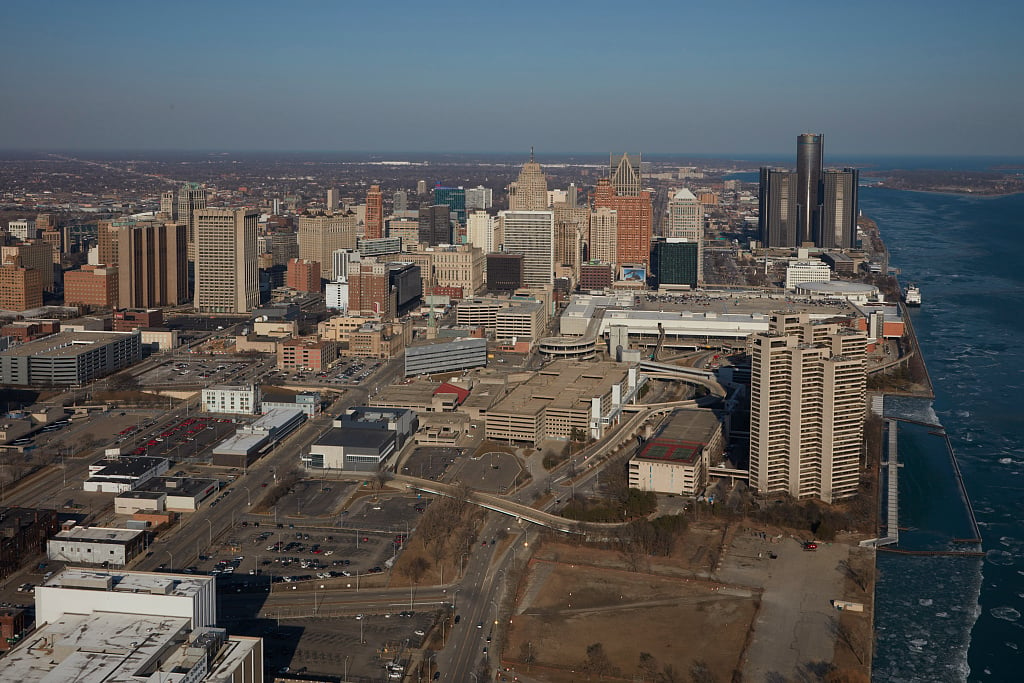
Few American cities illustrate the consequences of urban renewal more clearly than Detroit.
East of downtown stood Black Bottom, a neighborhood that became one of the centers of Detroit's African American community during the first half of the twentieth century.
The neighborhood's name came from the dark, fertile soil associated with the area's earlier landscape, not from the race of its residents.
Over time, Black Bottom developed into a dense community of houses, shops, restaurants, churches, and social institutions.
Nearby Paradise Valley became famous for its nightlife, jazz clubs, entertainment venues, and Black-owned businesses.
These communities were not without hardship. Overcrowding, aging housing, and poverty were real challenges.
But they were also places where residents established businesses, raised families, worshipped, and built cultural institutions.
Beginning in the late 1940s and continuing through the following decades, urban redevelopment and highway construction transformed these neighborhoods.
Much of Black Bottom was cleared for projects that included Lafayette Park and the Chrysler Freeway. Other clearances reshaped Paradise Valley and areas associated with the expanding Detroit Medical Center.
The loss extended far beyond the physical structures.
See Black Bottom Before Demolition
The Detroit Public Library preserves thousands of photographs taken in 1949 and 1950 documenting streets, homes, and businesses before clearance.
The Black Bottom Street View project reconstructs those streets using original photographs, allowing visitors to see the neighborhood that once existed.
Explore the Black Bottom Street View archive
Archival photographs are linked rather than republished because their public-domain status has not been established.
The Neighborhoods Were More Than Their Buildings
One of the greatest misunderstandings about urban renewal is the idea that demolition only removed deteriorating structures.
A neighborhood is more than a collection of houses.
It is the grocery store where families shop, the church where generations worship, the restaurant where people gather, and the neighbors who look after one another.
When an entire community is cleared, those relationships can disappear with it.
For residents who owned property, compensation did not necessarily cover the full economic and personal cost of relocation.
Renters often had even fewer resources.
Business owners lost established customer bases and locations that had taken years to develop.
The Highway System Changed Everything
Urban renewal was not the only force transforming American neighborhoods.
The Federal-Aid Highway Act of 1956 accelerated the construction of the Interstate Highway System.
Urban expressways frequently cut through established neighborhoods, dividing communities and removing homes and businesses.
Although highway construction and urban renewal were separate programs, their consequences often overlapped.
In Detroit, freeways permanently altered the street grid and severed connections between neighborhoods.
The same pattern appeared in cities across the country.
What Happened Across America?
Detroit was part of a national transformation.
New York City
Large-scale redevelopment projects and highway construction displaced residents and transformed communities. The Lincoln Square redevelopment on Manhattan's Upper West Side became one of the best-known examples of midcentury clearance.
Boston, Massachusetts
The West End was largely demolished during the late 1950s. Thousands of residents were displaced from a neighborhood known for its closely connected immigrant communities.
San Francisco, California
Urban renewal in the Fillmore District displaced thousands of residents and businesses, damaging a historically important center of Black culture and music.
St. Louis, Missouri
Redevelopment and clearance reshaped major portions of the city. The Pruitt-Igoe housing complex became a symbol of the era's ambitious planning and its failures, although its history involved many additional economic and policy factors.
Each city had its own circumstances, but the recurring pattern was striking: neighborhoods identified as obstacles to progress were cleared for projects intended to create a modern urban future.
What Was Left Behind?

Urban renewal did not create every problem that affected American cities.
Deindustrialization, suburbanization, discriminatory lending, population loss, municipal policy, and changing transportation patterns also contributed to urban decline.
But clearance programs often intensified existing problems by destroying affordable housing, disrupting local economies, and removing the institutions that helped neighborhoods remain stable.
Some cleared areas were successfully redeveloped.
Others remained vacant for years or failed to deliver the promised benefits to the people who had lived there.
And in many places, the buildings that replaced historic neighborhoods were designed with little connection to the original community.
Urban Renewal: A Timeline
1930s
Federal housing and clearance programs expand during the New Deal.
1949
The