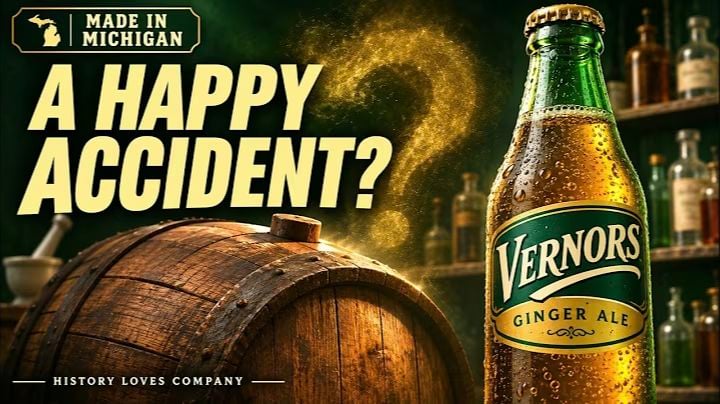
You probably know the story. A Detroit pharmacist leaves an experiment in a barrel, goes off to the Civil War, and comes home to find that time has done something remarkable.
It is a great origin story. It also deserves a closer look.
Vernors belongs to Detroit’s history. But the version that fits neatly on a label is not the whole story, and the surviving accounts do not agree on every detail.
Watch the film: Vernors: The Detroit Legend That Might Not Be True
Start with the pharmacist.
James Vernor was born in Albany, New York, in 1843 and moved to Detroit with his family as a child. He worked at Higby and Stearns’ drugstore before serving in the 4th Michigan Cavalry during the Civil War. The Detroit Historical Society dates the opening of his own pharmacy at Woodward and Clifford to 1866. [1]
That drugstore is the place to begin. Before Vernors became a familiar name far beyond the city, its story was tied to one businessman and one Detroit street corner.
What about the barrel?
The familiar account says Vernor left an experimental mixture behind when he entered military service and discovered an improved drink when he returned. The Detroit Historical Society identifies that account as a company legend. Its encyclopedia also records a competing family account: that the formula was developed after the war. [2]
The dates are not completely settled across the society’s own publications, either. A 2013 article says later records place the start of ginger-ale production and sales around 1880, while its encyclopedia gives 1866 as the first public serving. [3] [2]
That does not give us a reason to throw out the whole history. It gives us a reason to be precise: 1866 is the conventional founding date associated with Vernor’s pharmacy, while the accidental wartime discovery should be told as a legend, not an established fact.
A Detroit business you could see.
The story gets bigger than a pharmacy. In 1896, Vernor closed the drugstore and focused on the beverage business. The company’s riverfront operation and illuminated sign became part of the city’s landscape. In 1954, the plant moved to Woodward and Canfield, where visitors could watch production while enjoying a drink. [4]
Think about that for a moment. This was a brand people could associate with an actual place: a street, a building, a sign, a counter. The factory was part of the experience.
That is a useful way to look at Detroit’s business history. A product can survive long after the place that made it familiar has changed. Photographs, advertisements, and people’s memories help put that place back into the story.
And the Boston Cooler?
The Detroit Historical Society describes the familiar combination of Vernors and vanilla ice cream, but challenges another often-repeated explanation: that its name came from Detroit’s Boston Boulevard. Its account traces “Boston Cooler” to a broader early-twentieth-century term for ice-cream-and-soda drinks. [2]
Even the dessert has a story behind the story.
What do you remember?
A trip to the fountain? Watching the bottles go by? A family photograph with the old sign in the background? Those details can help us see the business as people experienced it.
Share a memory or historical lead →
Keep exploring Detroit.
Watch more History Loves Company films, explore the Detroit history collection, or read about They Lied to Us About Detroit.
For books and history-inspired finds, visit The Foundry’s Shop the Stories collection. You can also join the free Sunday newsletter for the next story.
Sources and a note on dates
Sources reviewed November 16, 2026. The accounts below disagree on the earliest production date; that disagreement is retained rather than presented as resolved.