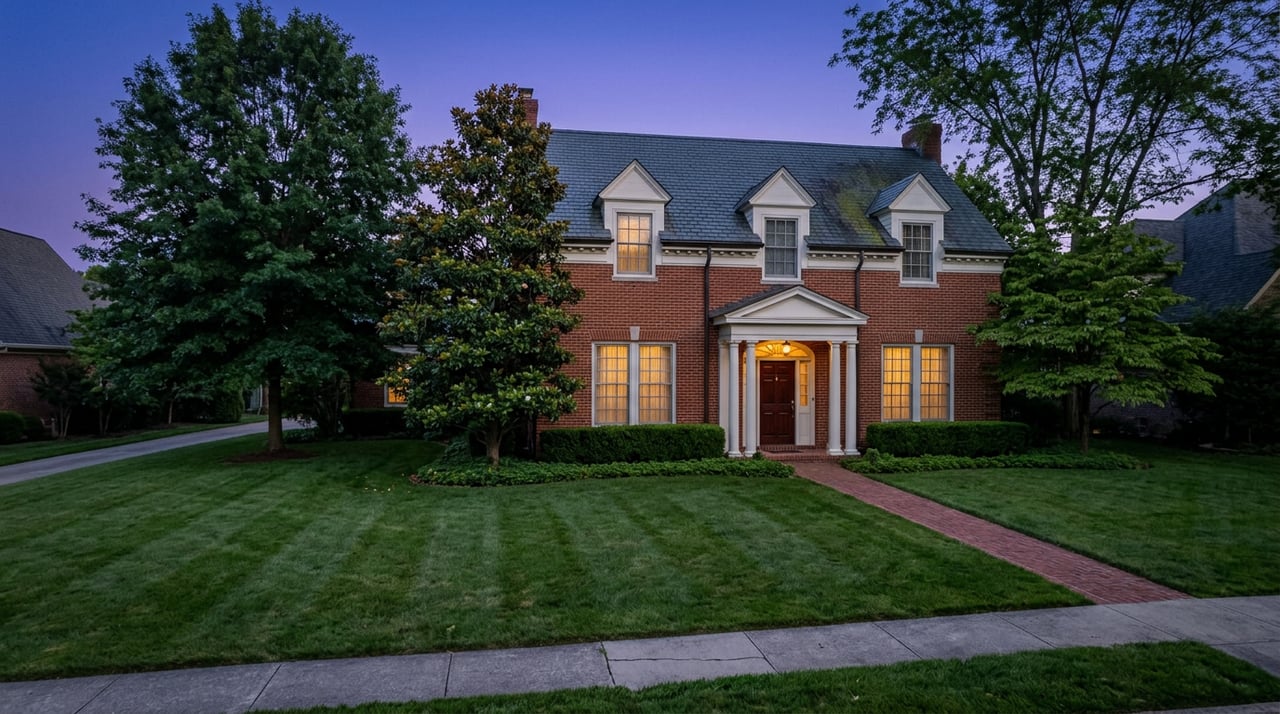
This fall, the Detroit Parks and Recreation Department is finally installing paved concrete paths and a handful of benches in Voigt Park, the seven-acre green space that Edward Voigt deeded to the city in 1908 as the ornamental centerpiece of Boston-Edison. The project has been years in the making, funded through the Wayne County park millage, and it has split a neighborhood that usually agrees on almost everything else.
Two blocks away, on Atkinson Street, a group of neighbors spent roughly two million dollars converting a vacant, century-old rectory into a full-service pizza restaurant with a three-season deck. Nobody organized a block club meeting about it. Nobody called it an affront to the district's character. It just opened.
Same neighborhood, same historic district, same set of unwritten rules about what belongs here. One project needed years of public process to add a bench. The other needed a contractor and a liquor license. If you live here, that gap is worth understanding, because it tells you more about how Boston-Edison actually protects itself than any plaque on a Tudor Revival facade.
The Park That Isn't Allowed to Change Quietly
Voigt Park has almost nothing in it. Historic District Commission filings describe roughly 6.8 acres of open lawn, mature hardwoods, and four period light fixtures along Edison and Longfellow. That bareness is the point. It has been deed and name restricted since 1908, which means the city cannot sell it, rename it, or alter it without review by the Historic District Commission, and the Voigt Park Block Club, which has about 120 members, has spent the last couple of years in that review process.
Ann Marie D'Anna has lived in Boston-Edison for more than 40 years and is a founding member of the block club. She wants gravel, not concrete, and she is not alone. The city's position, laid out by Deputy Chief Parks Planner Juliana Fulton, is that the paths and benches make the park usable for families and for residents who cannot comfortably sit or walk on open grass. Detroit invited all 12 of the district's block clubs to a 2025 meeting on the plan, and the Voigt Park Block Club, sitting closest to the actual grass in question, has been the loudest voice pushing back.
"That included the Voigt Park Block Club that is immediately around the park and very vocal," Fulton said of the outreach.
Neither side is wrong, exactly. A public park that has stayed almost untouched since the Model T era is a genuine asset, and asking whether a concrete path erodes that is a fair question to ask in public, which is exactly what a park deeded to the city in 1908 requires. The fight is not really about benches. It is about who gets to decide what "historic" means when the thing in question belongs to everyone.
What Happened Next Door, With No Public Comment Period
The Rectory sits at 1920 Atkinson Street, inside a building that served as the rectory for St. James A.M.E. Church starting in 1929 and had sat vacant for more than 50 years before anyone touched it. Betsy Murdoch, who co-founded The Congregation, the converted-church cafe and bar next door at 9321 Rosa Parks Boulevard, partnered with fellow Boston-Edison residents Antonio Luck, Mark Mondary, and Amy Peterson to restore it. Crain's Detroit Business reported the group put roughly $2 million into the project. It soft-launched in June 2025 and held its ribbon cutting that September 30, with music from DJ Radical Me and a full menu of hand-tossed pizzas, salads, and drinks running out of a building that had been an eyesore for half a century.
Nobody in the neighborhood organized against it. There was no equivalent of the Voigt Park Block Club weighing gravel against concrete for a private commercial renovation. The building is inside the same historic district boundary that governs Voigt Park, subject to the same Historic District Commission, but a private owner restoring a vacant structure into a going business does not trigger the kind of multi-year public engagement that a change to a deed-restricted public park does. The rules are the same. The stakes, as the neighborhood experiences them, are not.
That distinction matters if you are trying to understand what Boston-Edison actually protects. The district's historic designation, granted by the city in 1974 and added to the National Register of Historic Places in 1975, exists to preserve building fabric and public space, not to referee taste. A private owner can gut a vacant building and reopen it as a restaurant with comparatively little friction, because the commission's review is about exterior character, not about whether the neighborhood wanted a pizzeria there. A public park, by contrast, belongs to every household in the district at once, so any change to it becomes everyone's business, and the review process reflects that.
The Calendar That Doesn't Care Either Way
While the park debate plays out in commission filings and block club meetings, the neighborhood's actual social rhythm has kept running on its own schedule, largely independent of who wins the Voigt Park argument. Anyone living here right now has a few things worth putting on the fridge calendar:
- Wednesday Night Markets at The Congregation, hosted by Ryan Brown & Co., run every Wednesday in August, September, and October from 5 to 9 p.m., with local vendors set up alongside the cafe's regular trivia night.
- House Night, an outdoor dance party on The Congregation's lawn with music, food, and drinks, happens every other Thursday from 5 to 9 p.m. and is free and open to all ages.
- The Historic Boston-Edison Association's House Concert Series brings live acts into neighbors' homes throughout the year, including Florella Strings, a cello and violin duo, and LL7, a seven-piece jazz ensemble made up largely of Detroit players.
- The annual Attic Sale turns the district into a neighborhood-wide yard sale, organized through the same association that runs the concerts.
- The 2026 Holiday Home Tour is set for Saturday, December 12, and Sunday, December 13, when five decorated homes open their doors as the association's biggest annual fundraiser.
None of that changes whether Voigt Park gets a concrete path or stays gravel. The Congregation's lawn will still host a dance floor every other Thursday, The Rectory will still be slinging pizza by the slice, and five homeowners will still open their front doors in December regardless of how the park vote lands. The neighborhood's identity was never resting entirely on one seven-acre lawn. It is also resting on a converted church that turned into a cafe, then a pizzeria, then a Wednesday market, without anyone needing to hold a hearing first.
If you have ever wondered why Boston-Edison can absorb a $2 million restaurant renovation without controversy while a bench debate drags on for years, the answer is not that residents care less about the park. It is that public land invites public argument, and private restoration, done inside a historic district's rules, mostly just gets to happen. Both are forms of preservation. Only one of them asks permission first.
If you are watching this neighborhood, whether you already live three doors from Voigt Park or you are simply paying attention to how a historic district negotiates change in real time, that tension is worth understanding before you buy, sell, or renovate anything inside these boundaries. Christopher Hubel has spent years documenting how Metro Detroit's historic districts actually work, not just how they photograph. Let's tell your home's story.