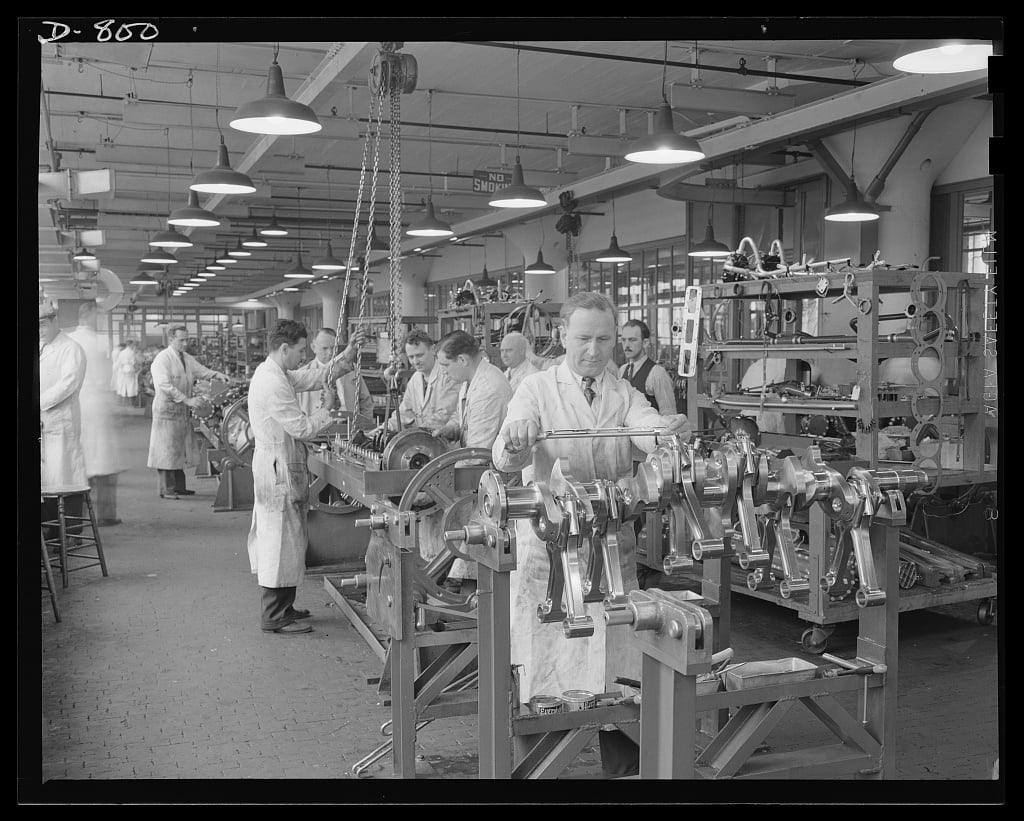
Header photograph: Marine-engine assembly at Packard, Detroit, May 1941. Alfred T. Palmer / Library of Congress, Prints & Photographs Division, FSA/OWI Collection. Public-domain source and image details.
Stand outside an old factory in Detroit and the question feels immediate: where did the work go?
The answer changes depending on the factory, the industry, and the decade. Some production moved. Some companies failed. Some plants became more productive with fewer workers. Imports, recessions, investment decisions, and changing demand all belong in the discussion. A single explanation cannot carry the whole history.
Start by separating jobs from production
A factory’s employment, its output, and its address measure different things. A business can make more goods with fewer workers. A company can close one plant while expanding another. A country can remain a major manufacturer while particular communities lose the employers around which daily life was organized.
The Bureau of Labor Statistics places the U.S. manufacturing employment peak at approximately 19.6 million in June 1979. Its historical review of manufacturing jobs shows a long decline punctuated by especially severe losses during recessions. That timeline matters. The story did not start with one trade agreement or one recent generation of machinery.
Technology changed the work, but does not explain everything
Higher productivity means more output for a given amount of input. New machinery and production methods can change how many people are needed for a task, and what skills the remaining jobs require. But employment also depends on how much a business sells and where it chooses to produce it.
A Federal Reserve research paper on manufacturing employment examines the relationship among production, productivity, and employment and the difficulty of separating competing explanations. Treating every missing job as proof that a robot replaced a person skips those distinctions.
Trade shocks had lasting local consequences
Trade also mattered. Research by David Autor, David Dorn, and Gordon Hanson found that U.S. communities more exposed to rising Chinese import competition experienced persistent damage to employment and incomes. Their study following local outcomes through 2019 shows why an economy-wide description of adjustment can miss what happens in a particular place.
A new job elsewhere does not automatically replace a lost job here. The worker may not be able to move. The new position may require different training. A family’s house, caregiving responsibilities, and community ties do not disappear when a plant closes.
Detroit’s factory stories need their own timelines
Packard is a useful reminder. Its corporate troubles and the end of Detroit automobile production in the 1950s belong to a different chapter from the manufacturing losses of the 2000s. The later businesses that occupied parts of its plant belong to the history, too.
That is why this series starts with individual places. Ask what the plant made, who owned it, when production changed, where the work went, and what happened to the property afterward. Those questions are more useful than making every empty building stand for the same national argument.
What a closure takes away
A factory can support more than the people on its payroll. Suppliers, lunch counters, nearby stores, and local services can depend on the activity it brings. Understanding a closure means following those connections without assuming every city experienced the same outcome.
For this installment of They Lied To Us, History Loves Company looks past the easy version of industrial decline. The goal is to understand the decisions and changes behind the buildings, and the lives still connected to them.