HISTORY LOVES COMPANY / THEY LIED TO US
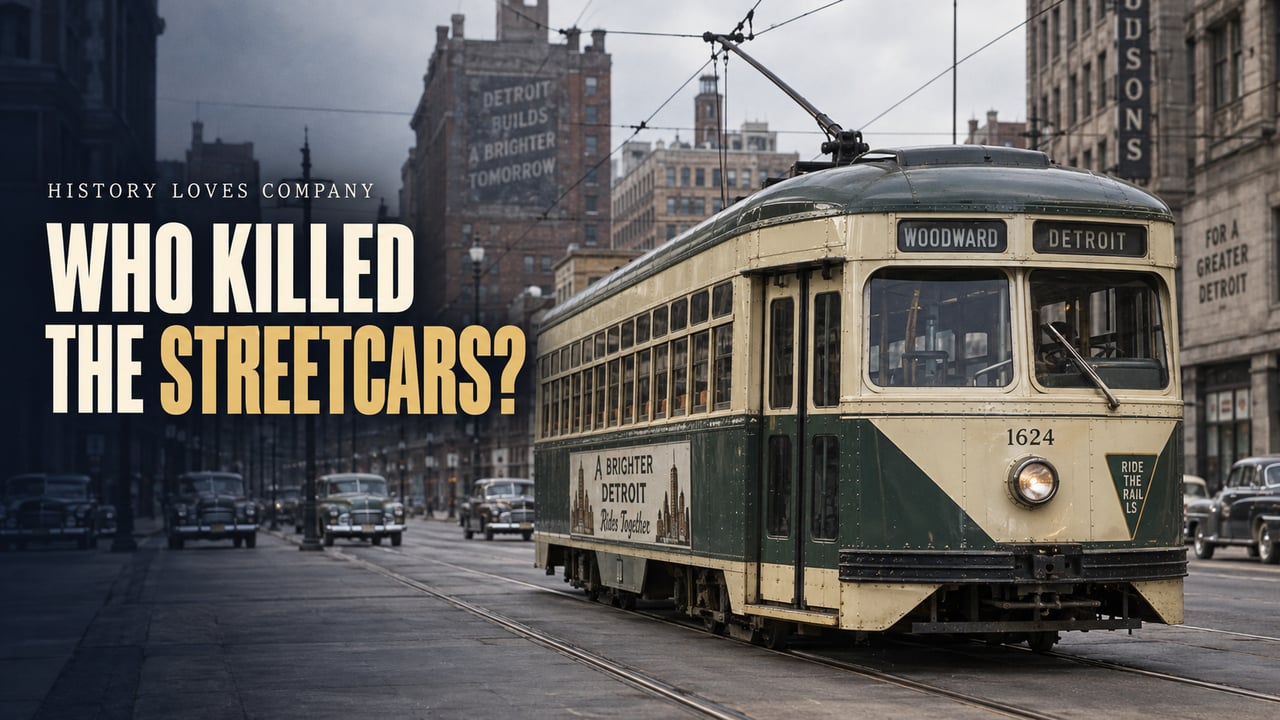
Detroit put signs on its last streetcars advertising the buses that would replace them.
That detail tells you something about the city in 1956. The end of the streetcar was being sold as the beginning of something better.
Look at an old photograph of Woodward Avenue. Before you look up at the buildings, look down at the street.
Rails run through the pavement. Wires stretch overhead. A streetcar carries people past storefronts, offices, and intersections you might still recognize.
This was ordinary life. Getting to work. Going shopping. Visiting family. Moving through Detroit without needing to own a car.
Today, those photographs raise a question that is harder to answer than it first appears: Why did we get rid of it?
THE DOCUMENTARY / EPISODE 2
What Really Killed America’s Streetcars?
The last ride was also a sales pitch
On April 8, 1956, Detroit held a farewell parade along Woodward Avenue. Streetcars, buses, and vintage vehicles traveled toward the State Fairgrounds. Signs on the departing streetcars promoted the new Woodward bus line.
The Detroit Historical Society documents that final-day celebration. It is a striking image: the old system carrying advertisements for its own replacement.
From our side of history, it can look like an obvious mistake. From the sidewalk in 1956, a new bus could look like progress.
Understanding that difference matters. People made these decisions with expectations about cost, convenience, technology, and what Detroit would become. We have the advantage of seeing what followed.
What the GM case actually means
The familiar explanation has a powerful villain: General Motors. It also has a foundation in real events.
GM and other automotive suppliers invested in National City Lines, which acquired local transit operations and was associated with converting streetcar routes to buses.
In the 1949 criminal case, GM and other defendants were convicted of conspiring to monopolize sales of buses and related supplies to transit companies controlled by National City Lines. They were acquitted on the separate charge concerning a conspiracy to monopolize local transportation operations.
That distinction changes what we can honestly say. The conviction establishes anticompetitive conduct involving transit supplies. It does not establish that GM alone destroyed every streetcar system in America.
Nor does it make the corporate role harmless. There was money to be made selling buses, fuel, and tires. Those interests belong in the story. So do the decisions of transit operators and public officials.
For further reading, the Justice Department preserves the final judgment in the related civil action. That civil judgment is separate from the criminal verdict.
Detroit’s timeline complicates the story
Detroit’s Department of Street Railways was already pursuing bus conversion in the 1930s. MotorCities National Heritage Area records that the department began buying hundreds of small Ford buses in 1936 as streetcar routes started changing over.
World War II interrupted that direction. Rationing and wartime employment increased the importance of the existing streetcar system. Afterward, conversion continued.
1936
Detroit begins purchasing hundreds of small Ford buses as routes start converting.
World War II
Rationing and wartime travel demand interrupt the transition.
April 8, 1956
Detroit’s original streetcar era ends on Woodward Avenue.
This was a transition carried out over years. Reducing it to one dramatic corporate act leaves out the local choices that made Detroit’s experience its own.
A new vehicle was not the same as a better system
Buses offered practical advantages. They did not need tracks or overhead wires. Routes could change. Drivers could maneuver around some obstructions that would stop a streetcar.
But buying a different vehicle does not answer the questions that matter most to a rider.
How often does it come? Where does it go? Can I get to work on time? Can I get home after my shift ends?
A bus network can answer those questions well. A rail network can answer them poorly. Either one needs useful routes, reliable service, and sustained investment.
The deeper question is what Detroit and its region were prepared to build around the replacement.
Opportunity moved. Could everyone follow?
Streetcar conversion unfolded as metropolitan Detroit was changing. Homes, jobs, and investment increasingly spread beyond the city’s boundaries. Automobile access became central to the region’s development.
Segregation by Design’s account of Detroit transit connects the loss of the streetcar system with suburbanization, segregation, and weakening transit support.
For someone with a reliable car, a job farther away might remain accessible. For someone dependent on transit, the same move could mean additional transfers, a much longer commute, or an opportunity that was no longer practical to reach.
The question reaches beyond what happened to the streetcars. What happened to the people who depended on them?
That is why these old transportation photographs deserve more than nostalgia. They show us a different set of possibilities for moving through a city.
We do not have to pretend the old system was perfect to examine what was lost, what improved, and what the replacement failed to provide.
Follow the decisions
Corporate interests matter. So do public ownership, purchasing decisions, operating costs, development patterns, and the level of service a community is willing to fund.
The mix differs from city to city. That is why the local record matters more than a national story compressed into a sentence.
When I look at Detroit’s final streetcar parade, I keep coming back to those signs advertising the buses. They remind me that the future was being presented as a promise.
History gives us the chance to ask who that promise worked for.
GO DEEPER WITH HISTORY LOVES COMPANY
They Lied to Us About Detroit
The streetcar story is one part of a much larger question: how did Detroit become the city we inherited?
Our companion book continues that exploration on the page. If this series has made you look at Detroit differently, I would love for you to be part of its next chapter.
KEEP EXPLORING
Two more chapters of the Detroit story

THEY LIED TO US · EPISODE 1
What Really Destroyed Detroit?
Start with the episode that questions the familiar explanation for Detroit’s decline.

INSIDE THE MOTOR CITY
Ford’s Highland Park Plant
Come inside the historic factory with me for another look at Detroit’s automotive story.
Did your family ride Detroit’s streetcars?
I want to hear about the route, the destination, the person who took you along. If you have a photograph or a memory passed down through your family, help us keep it connected to the place.
Share your story → Or leave a comment on the documentary.
— Chris Hubel
History Loves Company
Every home has a story. Let’s discover yours.
Visit The Foundry by History Loves Company at 35 W Huron Street, Suite 101, in downtown Pontiac’s historic Riker Building. Explore local makers, vintage finds, and the community growing around these stories.
