Dayton · Ohio · Beyond Michigan
Dayton, where workshops and words traveled far.
A bicycle shop, a short-lived newspaper, a poet’s home, and a flying field connect Dayton to stories larger than any one invention. Follow the city through the work of Wilbur and Orville Wright and Paul Laurence Dunbar, then look toward the river to see how a regional catastrophe changed its landscape.
The story of the place
Follow the places. Meet the people.
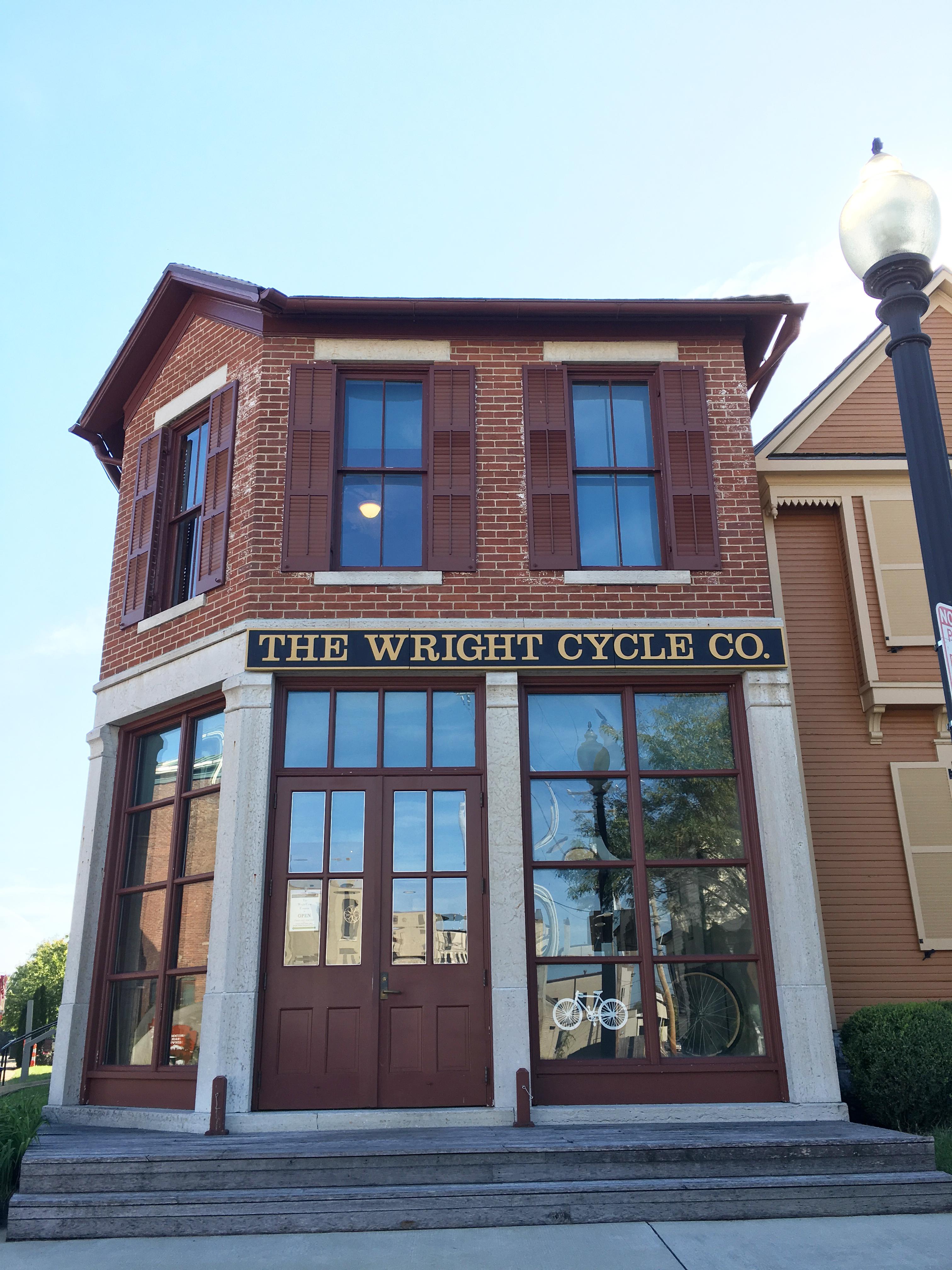
The surviving cycle shop belongs to an earlier stage.
The Wright Cycle Company building interpreted by the National Park Service was the brothers’ fourth bicycle-shop location, used from 1895 to 1897. Nearby, the Hoover Block housed their printing business from 1890 to 1895. These dates place the buildings within a developing working life, before the celebrated flights.
The cycle shop provides a setting for asking how repair, tools, and small-business experience contributed to later experimentation. It should not be treated as a generic backdrop for every Wright achievement. The visitor center distinguishes a recreation of the printing shop from the surviving historic buildings, and cycle-shop tours begin there. Pay attention to that distinction between an original place and an interpretive reconstruction. Both can be useful, provided the visitor understands what each preserves and what has been assembled to explain the work.
Sources: National Park Service: historic buildings and landmarks; National Park Service: cycle-shop interpretation and dates
A printing press connects Dunbar and the Wrights.
Paul Laurence Dunbar and Orville Wright attended Dayton’s Central High School together. In December 1890, Wright printed the Dayton Tattler, a newspaper Dunbar published and edited for west Dayton’s African American community. The National Park Service records only three issues. Its short life does not make it a minor connection: it joins literary ambition, Black community life, and the practical business of producing a newspaper.
Dunbar’s prospects after school were constrained by both money and racial discrimination. Working as an elevator operator, he continued writing; his first poetry collection, Oak and Ivy, appeared in 1893. The printing story is a useful corrective to a city history organized entirely around machines. Words also required labor, equipment, distribution, and readers. A surviving page can reveal those networks through its advertisements, local notices, and editorial choices as well as its most memorable lines.
Sources: National Park Service: Dunbar’s education, newspaper, and early writing
Matilda Dunbar helped make a home into a lasting record.
In 1904, Matilda Dunbar purchased the house now preserved at 219 North Paul Laurence Dunbar Street. Paul lived there with her until his death in February 1906. Matilda kept the property as a memorial to her son, and it later entered public ownership. The house opened to visitors in 1938 and became a National Historic Landmark in 1962.
Including Matilda changes the preservation story. The house survived as a place associated with a writer because someone cared for its rooms, objects, and memory after his death. During a visit, consider the building as both a domestic space and an evolving museum. Dunbar’s career extended across poetry, fiction, and other forms; a room arrangement cannot represent that full range on its own. Pair the house with his writing and the visitor-center interpretation, allowing the literary work to remain central to the experience.
Sources: National Park Service: the house, Matilda Dunbar, and preservation
Huffman Prairie explains what happened after 1903.
The Wrights’ first powered flights took place in North Carolina on December 17, 1903. Back near Dayton, banker Torrence Huffman allowed them to use his pasture for experiments. During 1904 and 1905, the brothers worked toward sustained, controllable flight at what is now Huffman Prairie Flying Field.
Their 1905 Flyer III could turn circles and figure-eights. On October 5 of that year, Wilbur flew more than 24 miles in 39 minutes. This is the achievement behind the description “first practical airplane”: the aircraft could do much more than briefly leave the ground. The field later served the Wright Company for testing and flight instruction, beginning in 1910. Visit with the sequence in mind—first flights, repeated experiments, practical control, and training—so that one famous moment does not obscure the years of work that followed it.
Sources: National Park Service: the 1904–1905 experiments and later flying school
The aircraft and its flying field are separate destinations.
The 1905 Wright Flyer III is preserved at Dayton History’s Carillon Historical Park. It is the aircraft associated with the practical-flight breakthroughs at Huffman Prairie, and it received National Historic Landmark designation in 1990. Seeing the machine and visiting the field answer different questions: one concentrates attention on construction; the other restores a sense of distance, terrain, and repeated movement.
A useful visit pairs these two kinds of evidence instead of expecting either to tell the whole story. Read the aircraft labels for the condition and interpretation of the object on display, then use the National Park Service’s account to understand its historical flights. Carillon Historical Park also places aviation among other local technologies and businesses. That wider setting helps explain Dayton as a working city, while keeping the particular accomplishments of the Wrights clear.
Sources: National Park Service: the 1905 Wright Flyer III; Dayton History: Carillon Historical Park collections and exhibits
The 1913 flood produced a regional engineering response.
In March 1913, sustained heavy rain fell on already saturated ground across the Great Miami River watershed. Floodwater overwhelmed river communities, including Dayton. The response extended beyond rebuilding individual streets. Residents raised funds, engineer Arthur Morgan developed a plan, Ohio enacted its Conservancy Act in 1914, and the Miami Conservancy District was established in June 1915.
Between 1918 and 1922, the district constructed five dry dams, levees, and channel improvements as an integrated flood-protection system. The scale is essential to the story: Dayton’s river landscape is connected to storage areas and structures elsewhere in the watershed. The district’s digitized historical newsletters provide contemporary accounts of construction and the workforce. Read them alongside photographs of the flood and the later works. The engineering story is also a history of institutions, financing, labor, and communities trying to reduce the chance of another catastrophe.
Sources: Miami Conservancy District: the Great Flood of 1913; Miami Conservancy District: creation, construction, and historical newsletters
Places and people
Three ways to begin.
Wright-Dunbar Interpretive Center
Start at 16 South Williams Street for the cycle-shop story and directions to other park units. Check the individual site schedule before arriving.
Paul Laurence Dunbar House
The house is at 219 North Paul Laurence Dunbar Street. Tours begin through the visitor-center entrance on Edison Street; consult the current tour schedule.
Field and aircraft
Plan separate stops for Huffman Prairie and Carillon Historical Park. Use NPS directions for public access near Wright-Patterson Air Force Base.
Plan your visit.
These sites are spread across Dayton and the surrounding area, so this is a set of starting points rather than a single walking loop. The NPS partnership park has different schedules for each unit. Carillon Historical Park has its own admission arrangements. For Huffman Prairie, consult the park’s directions and alerts before travel; GPS routes can lead toward restricted military roads. Ask the interpretive center for the current public route to the field.
Historical and visitor resources reviewed October 8, 2026.
Keep exploring
Follow the story outward.
Dayton’s print culture connects naturally with Frederick Douglass’s Rochester newspaper. Its regional waterways can be explored beside Cincinnati and Toledo, while Detroit’s industrial histories offer another perspective on workshops, skilled labor, and the institutions that preserve them.
Sources and local resources.
- National Park Service: historic buildings and landmarks
- National Park Service: cycle-shop interpretation and dates
- National Park Service: Dunbar’s education, newspaper, and early writing
- National Park Service: the house, Matilda Dunbar, and preservation
- National Park Service: the 1904–1905 experiments and later flying school
- National Park Service: the 1905 Wright Flyer III
- Dayton History: Carillon Historical Park collections and exhibits
- Miami Conservancy District: the Great Flood of 1913
- Miami Conservancy District: creation, construction, and historical newsletters