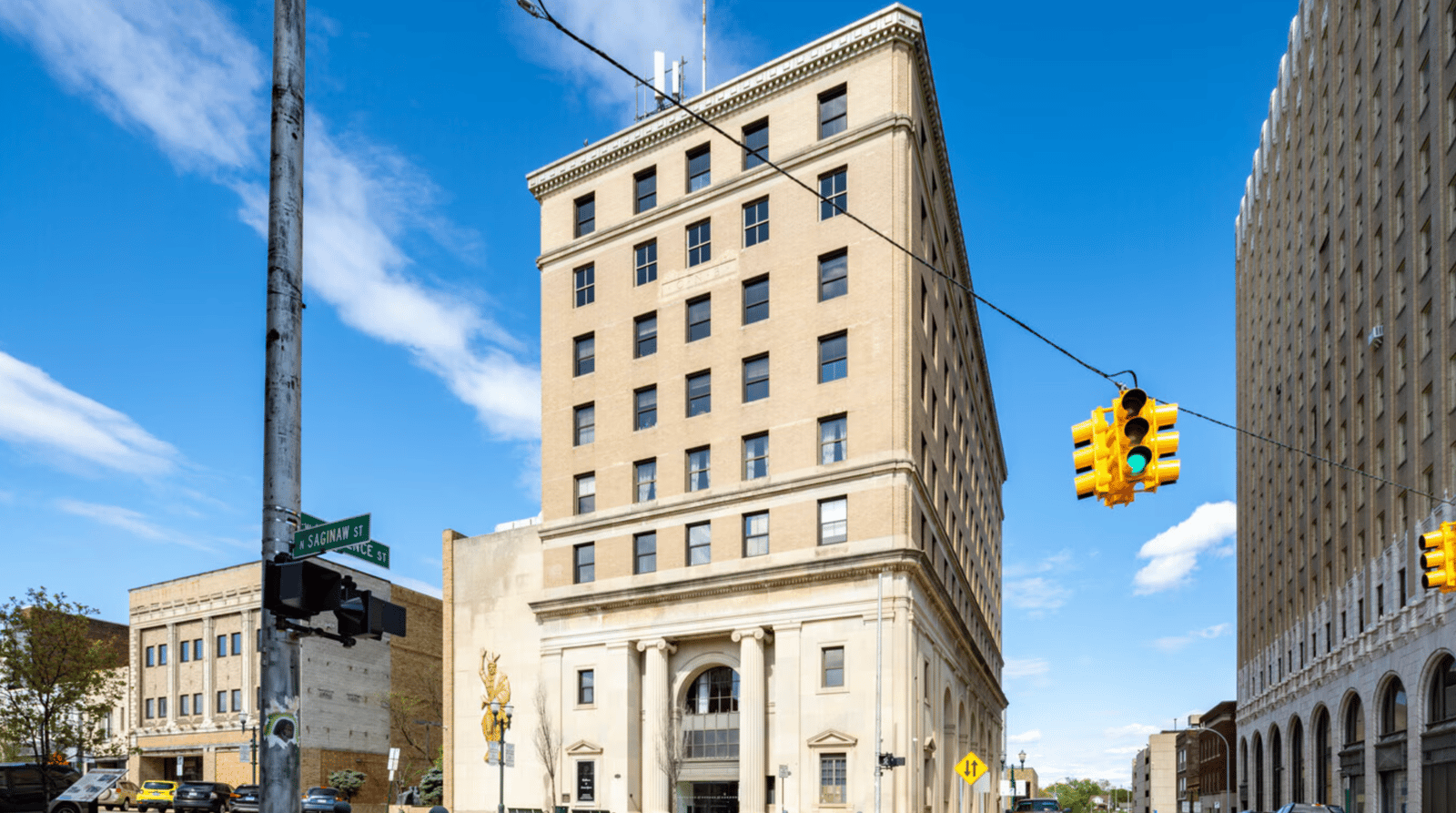
71–75 N Saginaw Street
Turk Building
1900
This broad Romanesque commercial building dates to 1900. Its decorative brick corbels help distinguish it from the narrower storefronts nearby.
History source → · Link to this building
The next chapter
A history profile does not mean this property is for sale or lease. Ask Chris about current options, or share an owner-authorized opportunity.
12–14 N Saginaw Street
Strand / Campus Theatre
Historic theater
The Strand’s facade uses delicate Adamesque ornament and fluted pilasters. Its architecture preserves a theater identity even as interiors and uses change.
History source → · Link to this building
The next chapter
A history profile does not mean this property is for sale or lease. Ask Chris about current options, or share an owner-authorized opportunity.
35 E Huron Street
Former Post Office / Furlong Building
1910
This limestone post office was built in 1910 from Treasury architect John Knox Taylor’s office plans. Ionic columns give its frontage a civic presence.
History source → · Link to this building
The next chapter
A history profile does not mean this property is for sale or lease. Ask Chris about current options, or share an owner-authorized opportunity.
1 Lafayette Street
Masonic Temple
1923
Built in 1923, the temple is distinguished by grouped arched windows recessed into larger arches. It represents downtown’s fraternal and civic life.
History source → · Link to this building
The next chapter
A history profile does not mean this property is for sale or lease. Ask Chris about current options, or share an owner-authorized opportunity.
27 S Saginaw Street
Grinnell Brothers Music House
1923 · Leo John Heenan
Music retail was part of Pontiac’s commercial life. Grinnell Brothers opened a local outlet in 1907; after fire destroyed its earlier premises, the company commissioned this replacement in 1923. Architect Leo John Heenan designed a narrow, three-story Gothic Revival building with a stone front. The name carved above the storefront keeps the original business visible in the architecture. Steel framing and concrete floors reflected the ambition to build a more fire-resistant store.
History source → · Link to this building
The next chapter
A history profile does not mean this property is for sale or lease. Ask Chris about current options, or share an owner-authorized opportunity.
11–15 S Saginaw Street
Eagle Theater
1927 · Moorish Revival
The site’s entertainment story began before the present building. A nineteenth-century hotel was converted to a movie house in 1910, and the current Eagle replaced it in 1927. The building’s Moorish vocabulary includes horseshoe arches and strong vertical towers. Its upper levels included a gathering room and apartments intended for traveling vaudeville performers. The theater is a reminder that downtown supported an entire evening economy, from performances to the people who stayed after the curtain fell.
History source → · Link to this building
The next chapter
A history profile does not mean this property is for sale or lease. Ask Chris about current options, or share an owner-authorized opportunity.
Crofoot complex · South Saginaw Street
Vernor’s Building
Victorian storefront · remodeled 1926
This narrow historic component of the Crofoot complex was remodeled for a Vernor’s soda fountain in 1926. The changing storefront shows how familiar downtown buildings were repeatedly adapted to new kinds of public life.
Historic component; separate current parcel and address require confirmation
History source → · Link to this building
The next chapter
A history profile does not mean this property is for sale or lease. Ask Chris about current options, or share an owner-authorized opportunity.
35 N Saginaw Street
35 North Saginaw Street
HLC film location
HLC’s on-location film makes this Saginaw Street building a starting point for exploring the commercial district. Watch Chris’s account of the building and its downtown setting. A documented construction date, architect, and ownership chronology will be added as the property record is assembled.
History source → · Link to this building
Watch this place with HLC
Continue the building’s story in Chris Hubel’s original film.
Watch on YouTube ↗The next chapter
A history profile does not mean this property is for sale or lease. Ask Chris about current options, or share an owner-authorized opportunity.
35 W Huron Street
Riker Building / The Foundry
Historic downtown building · HLC’s physical home
The Riker Building connects the downtown archive with a story still unfolding. The Foundry by History Loves Company occupies Suite 101, bringing makers, retail, media, and community programming into a historic commercial setting. Start with HLC’s film about the marketplace, then follow the building’s earlier chapters as archival research develops.
Downtown companion profile; exact National Register parcel coverage to confirm
History source → · Link to this building
Watch this place with HLC
Continue the building’s story in Chris Hubel’s original film.
Watch on YouTube ↗The next chapter
A history profile does not mean this property is for sale or lease. Ask Chris about current options, or share an owner-authorized opportunity.