Fayette · Delta County · Upper Peninsula
Fayette, an iron town with a life beyond the furnaces.
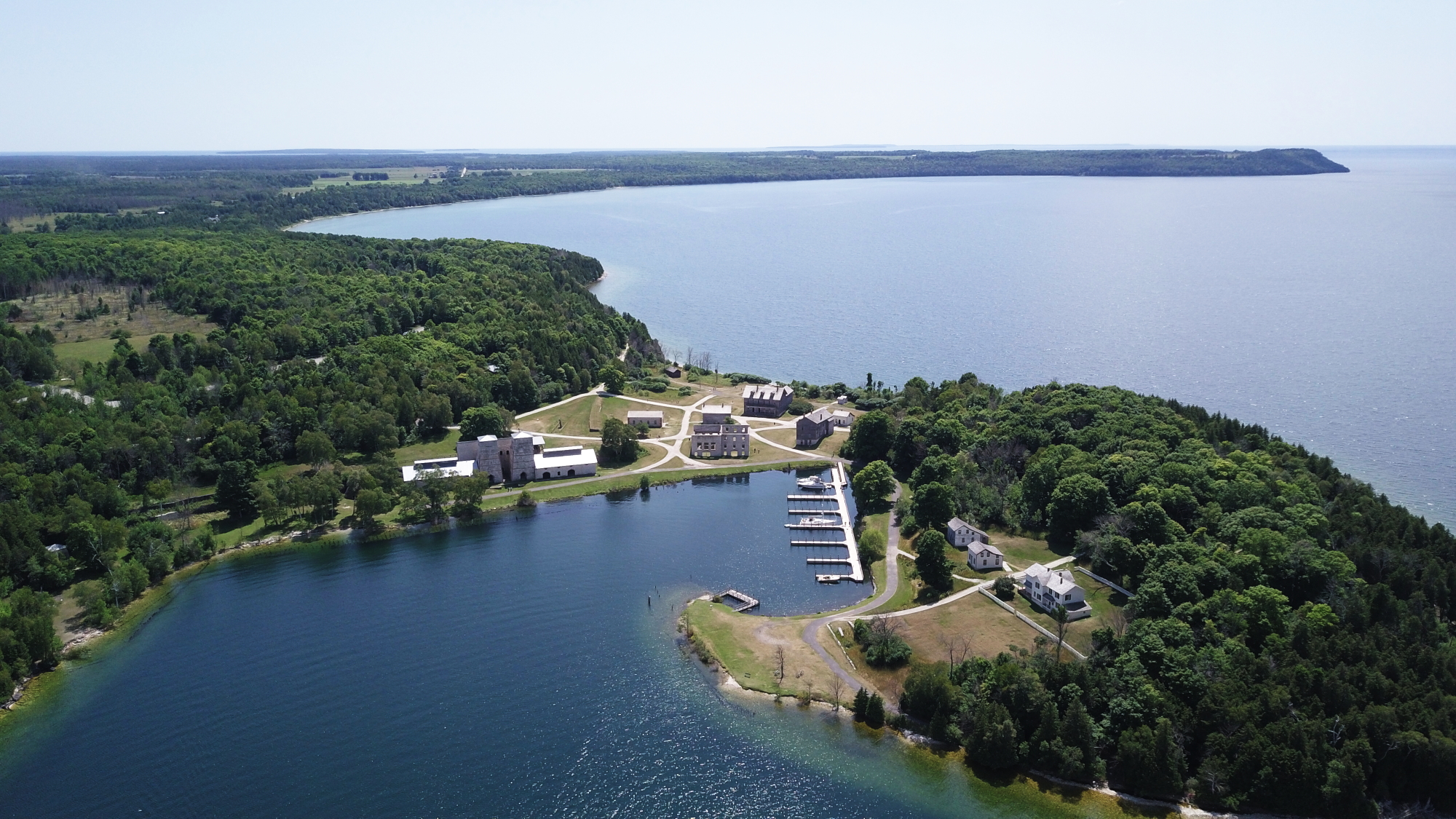
At Snail Shell Harbor, the furnace walls face the water that connected Fayette to the Great Lakes economy. Walk farther into the townsite and the story becomes domestic: houses, a hotel, schooldays and the work of keeping a family fed in an industrial community.
The story of the place
Iron, households and an altered landscape.
The Jackson Iron Company established its smelting community here in 1867. The harbor carried raw materials, supplies and finished iron; nearby limestone served the furnaces, while forests supplied wood for charcoal. Over the operating years, through 1891, Fayette produced nearly 230,000 tons of pig iron. Much of it traveled to lower Great Lakes steelworks and became material for railroad rails. The quiet shoreline was part of a noisy, interconnected production system.
Fayette’s workforce was largely immigrant, and the community included families as well as furnace crews. The Michigan History Center’s education program reports that children aged sixteen and younger made up 40 percent of the population in 1880. Housing expressed differences in status: the state’s management history contrasts workers’ simple dwellings with the doctor’s house. A school, company store, baseball team and horse-racing track made this a place of ordinary routines and recreation alongside heavy industry.
When smelting ended in 1891, many residents left, but Fayette’s history continued through fishing, farming and efforts to attract visitors. Michigan acquired the site in 1959, and Fayette entered the National Register of Historic Places in 1970. Its preserved buildings now require regular conservation work. The Michigan History Center’s account of its 2025 preparations describes cleaning rooms, inspecting objects and returning stored textiles to displays: the town visitors see is also the result of present-day care.
Places and people
Three places to begin.
The furnace complex and harbor
Start with the relationship between the furnaces and the landing places. Imagine the separate jobs involved in unloading ore, making charcoal, tending machinery and moving finished iron. From authorized paths, compare the industrial structures with the surrounding water and wooded slopes; those surroundings helped determine where the company operated.
Workers’ houses, the doctor’s house and hotel
Use the interpreted buildings to compare room sizes, household furnishings and distance from work. The Shelton House hotel adds the lives of travelers and service workers to the picture. Look for the labor behind a furnished room: meals prepared, floors cleaned, clothing maintained and goods brought into an isolated community.
The visitor center and town model
The A. Gene Gazlay Visitor Center includes a model of the nineteenth-century company town. Use it to locate structures that no longer stand before exploring the surviving buildings. The model makes the spaces between today’s landmarks meaningful and helps connect home, workplace and shoreline in one view.
Explore with context
Look for evidence of daily life.
Ask a household question
Choose one question to carry through the exhibits: how did children spend a day, how did goods arrive, or how did housing differ by occupation? Compare objects and interpretation across several buildings. A furnace’s output and a family’s experience describe different parts of the same history.
Keep the layers of time visible
Fayette’s industrial years, later tourism and state preservation are separate chapters. Pair an old photograph with its date and viewpoint, then record later changes. The National Register record identifies a historic district; the state park’s visitor information is the source for present access.
Plan through the site operator
Check the Michigan History Center and DNR pages for the current season, open buildings, tours and accessibility. Stay on authorized routes and leave artifacts in place. This is a preserved public townsite, so a visit centers on interpretation and stewardship rather than access to every structure.
Continue the story
Make time for a closer look.
Use the local resources to plan a visit, explore the records and follow the people behind the place.
Keep exploring Michigan.
Sources & local resources
- Michigan History Center: Fayette history and visitor information
- Michigan DNR: Fayette Historic State Park
- Michigan DNR: general management plan and historical analysis
- Michigan History Center: childhood and company-town education programs
- Michigan DNR: preparing Fayette’s exhibits, June 2025
- National Park Service: Fayette historic district record