St. Louis · Missouri · Beyond Michigan
St. Louis, where a riverfront landmark opens a harder history.
The Gateway Arch is a familiar outline. Nearby courtrooms, a bridge, and the records of vanished riverfront blocks tell more complicated stories about freedom, movement, and what a city chooses to preserve. Begin with the people who challenged injustice, then look again at the landscape around them.
The story of the place
Follow the places. Meet the people.
Dred and Harriet Scott began a family’s legal struggle.
On April 6, 1846, Dred and Harriet Scott filed suits in St. Louis seeking freedom from enslavement. Their claims drew on time spent in places where slavery was prohibited. The National Park Service’s account follows a family whose movements had been controlled by enslavers and whose effort to secure freedom required years of legal proceedings.
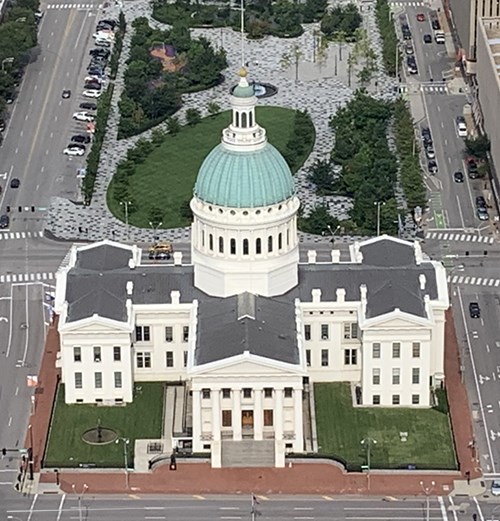
The Old Courthouse hosted the first two trials of the Dred Scott case, in 1847 and 1850. The infamous 1857 ruling came later from the United States Supreme Court. Keeping those stages separate prevents the St. Louis building from being mistaken for the place where the Supreme Court sat. The ruling denied the Scotts the result they sought and rejected Black citizenship. Start with their names, their children, and the long sequence of petitions and hearings: a constitutional landmark was also a family’s attempt to change its future.
Sources: National Park Service: Dred and Harriet Scott; National Park Service: Old Courthouse and trial dates
Harriet’s petition restores a voice to the record.
The National Park Service publishes a transcript of Harriet Scott’s petition. It describes her movement between Fort Snelling, Louisiana, and St. Louis, and asks permission to sue Irene Emerson to establish her right to freedom. The document bears Harriet’s mark and the date April 6, 1846.
Read the court’s accompanying order as well as the petition. It allowed her access to counsel and the court and directed that she not be removed from the court’s jurisdiction. Those procedural details show how a person’s ability to pursue a case depended on protection against being taken away. The document uses the legal language of its time; it should be read as evidence produced within an unjust system. Pair the transcript with the case chronology rather than assuming a single filing captures every motive, conversation, or experience behind it.
Sources: Primary document: Harriet Scott petition transcript
Virginia Minor tested the relationship between citizenship and voting.
Virginia Minor attempted to register to vote in St. Louis on October 15, 1872, and was refused because she was a woman. She and her husband Francis challenged the registrar, arguing that citizenship under the Fourteenth Amendment protected her claim to vote. Their case eventually reached the United States Supreme Court, which ruled that citizenship did not itself guarantee voting rights.
The National Park Service places Minor’s action within a longer organizing career, including her leadership in the Woman Suffrage Association of Missouri. Her case makes the courthouse a place to consider repeated challenges to the boundaries of political membership. The Scotts and Minor pursued different claims in different circumstances; visiting the same building should not flatten those differences. Look for the legal question in each case and for the organizing and personal persistence that surrounded the formal court record.
Sources: National Park Service: Virginia Minor and her voting-rights challenge
Eads Bridge changed the river’s role in transportation.
The Mississippi was a route along which people and goods traveled, but it also presented an obstacle to routes running across it. Eads Bridge, completed in 1874, brought railroad traffic across the river at St. Louis. The National Park Service’s landscape history places that crossing within the shift from river transport toward rail.
The bridge offers a useful counterpoint to the Arch. One is transportation infrastructure; the other is a memorial landscape. Both direct attention to movement, but at different scales and for different purposes. From public viewpoints, consider the relationship between river level, bridge deck, shore, and city streets. Do not assume that a surviving structure explains the whole network: terminals, warehouses, labor, and connections farther inland were also necessary. The crossing belongs in a regional history extending to the Illinois side of the river.
Sources: National Park Service: the riverfront and Eads Bridge
The Arch stands in a landscape that was deliberately remade.
The memorial’s creation required more than erecting a monument. The National Park Service’s newspaper-collection guide records demolition beginning on the riverfront on October 9, 1939, and finishing in May 1942. Eero Saarinen won the design competition in 1948; the Arch was completed on October 28, 1965.
That sequence leaves years between removal and construction. It is a reason to read the open grounds as a designed landscape with a history of its own. The archive’s clippings document proposals, acquisition, restoration, and construction, allowing researchers to follow decisions rather than treating the current view as inevitable. A preservation question emerges from the contrast: why did the Old Courthouse survive while surrounding buildings disappeared? Compare dated photographs and plans, and ask whose activities each source records. Admiring the engineering can coexist with investigating what the project removed.
Sources: National Park Service archives: creation of the memorial and riverfront demolition
A courthouse visit should include the wider freedom-suit history.
The Old Courthouse was a place where enslaved people pursued freedom through the courts, but also where people were sold at estate auctions. The National Park Service links the building to hundreds of freedom suits. These overlapping uses prevent the building from becoming a simple symbol of justice successfully delivered.
Four museum galleries opened in May 2025, and visitors can also explore historically furnished courtrooms. Start with the Scotts, then look for other lives and legal challenges in the exhibits. Keep the building’s architecture in the picture without letting its dome eclipse the people who entered under very different conditions. For further research, the park’s historical pages and archive guides provide a route into case documents and the later preservation story. Ask about research arrangements before arriving with a request for original records.
Sources: National Park Service: courthouse interpretation and visitor information
Places and people
Three ways to begin.
Old Courthouse
Begin at 11 North Fourth Street. The National Park Service lists free admission and current gallery and tour information. Verify the day’s arrangements before travel.
Gateway Arch riverfront
Use the park’s landscape history alongside present-day paths and viewpoints. Courthouse access, museum access, and an Arch tram ride are different activities.
Documents before departure
Read Harriet Scott’s petition and the memorial’s archive guide before visiting. Note the document date and the later date of interpretation in your research.
Plan your visit.
The courthouse and Arch grounds provide a downtown starting point. Check current park alerts, accessibility information, and the requirements for any ticketed activity; free courthouse admission does not imply a free tram ride. At this October 9, 2026 review, the courthouse’s post-renovation galleries were open. For archival work, arrange access through the park rather than assuming documents are available during a casual museum visit.
Historical and visitor resources reviewed October 9, 2026.
Keep exploring
Follow the story outward.
Compare St. Louis’s changing riverfront with Cleveland’s Cuyahoga and Pittsburgh’s industrial landscapes. Detroit’s civil-rights stories offer another way to follow people who challenged exclusion, while HLC’s American Ride places St. Louis within a wider journey west.
Sources and local resources.
- National Park Service: Dred and Harriet Scott
- National Park Service: Old Courthouse and trial dates
- Primary document: Harriet Scott petition transcript
- National Park Service: Virginia Minor and her voting-rights challenge
- National Park Service: the riverfront and Eads Bridge
- National Park Service archives: creation of the memorial and riverfront demolition
- National Park Service: courthouse interpretation and visitor information