Topeka · Kansas · Beyond Michigan
Topeka: the families behind a national turning point.
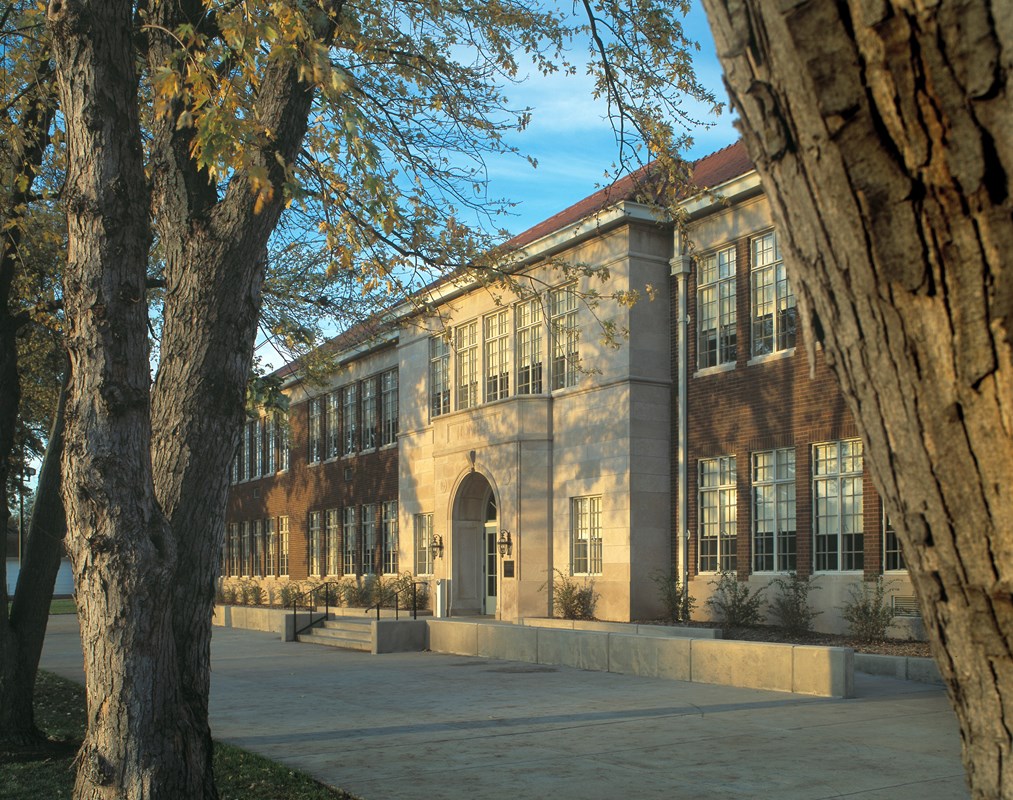
Monroe Elementary School makes a national court decision tangible. Its classrooms belonged to a community; its preservation required another generation of organizing. In this American Ride city, follow the people behind Brown v. Board of Education, then read the Capitol’s murals as a different kind of historical argument.
The story of the place
Follow the places. Meet the people.
Monroe School before it became a landmark
The present Monroe Elementary School building dates to 1927, replacing an earlier school on the site. It was one of four elementary schools designated for Black children in segregated Topeka. Linda Brown attended Monroe, but its history includes many other students, teachers and families. The National Park Service’s account of the school’s landscape places the building within an established neighborhood and a longer local history of education.
Do not assume that the constitutional challenge depended on Monroe being a ruin or its teachers being incapable. The park explains that Topeka’s Black schools could have capable staff and adequate facilities while operating within an unequal system of compulsory racial separation. That distinction matters inside the preserved school. Ask how a community made an institution serve its children, and why those same families challenged the rule that assigned them to it. The school can hold both histories: educational work worthy of respect and a public policy that denied equal treatment.
Sources: NPS: Monroe School and the park’s preservation; NPS: the school and the constitutional question
An organized campaign, not one family acting alone
In 1950, Topeka’s NAACP, led locally by McKinley Burnett, organized a challenge to elementary-school segregation. Thirteen parents participated on behalf of twenty children. Families tried to enroll their children in designated white schools and were refused; the resulting federal case was filed in 1951. Oliver Brown’s name became the case title, but he was one plaintiff among a larger group.
That sequence changes how the familiar story should be told. It was a planned campaign involving parents, organizers and attorneys, not a spontaneous lawsuit prompted by a single child’s experience. The National Park Service’s “Myth or Truth” resource also cautions against reducing the case to a simple tale about a long walk to school; transportation arrangements and the families’ objectives were more complicated. Read the plaintiffs’ names as a starting point for learning about households and choices. Collective action becomes easier to recognize when the people behind a legal caption are restored to the story.
Sources: NPS: the Topeka case; NPS: Myth or Truth
What the 1954 decision did—and why the distinctions matter
On May 17, 1954, the Supreme Court unanimously held racial segregation in public schools unconstitutional under the Fourteenth Amendment. The Brown decision brought together cases from Kansas, South Carolina, Virginia and Delaware. A related Washington, D.C., case, Bolling v. Sharpe, was decided the same day under the Fifth Amendment. The distinction helps explain why accounts often speak of five cases, even though the District of Columbia case received a separate ruling.
Topeka belongs within that national campaign, not above it. The places and circumstances varied, and each case depended on people who challenged local institutions. Nor did a Supreme Court decision instantly complete school integration. The park’s historical resources separate the ruling from the long work that followed. As you move through the exhibits, keep three questions distinct: what the law had permitted, what the Court rejected, and how communities responded afterward. This makes the school a place to understand a process of change rather than only commemorate a famous date.
Sources: NPS: distinctions among the Brown cases; NPS: the five cases; NPS: Topeka’s desegregation history
Saving Monroe required a second campaign
Monroe closed as a school in 1975 because of declining enrollment. The building subsequently passed through other uses and private ownership. When its future became uncertain, the Brown Foundation and supporters pursued preservation; the Trust for Public Land purchased it in 1991. Congress established the national historic site in 1992. The restored school opened to visitors on May 17, 2004, fifty years after the Supreme Court decision.
Cheryl Brown Henderson and the Brown Foundation were central to that work. The sequence is a reminder that places associated with major events do not preserve themselves. Buildings can be sold or altered while public recognition lags behind their significance. At Monroe, distinguish the school’s working life from its later museum life, and ask what had to be repaired, researched and interpreted to connect the two. The park’s current name, Brown v. Board of Education National Historical Park, dates to a 2022 redesignation that also broadened the preservation effort beyond Kansas.
Sources: NPS: preserving Monroe; NPS: the 2004 opening; NPS: establishment and redesignation
Archaeology recovers the surrounding neighborhood
Before the museum opened, National Park Service archaeologists investigated the Monroe grounds between 1999 and 2003. Their work identified evidence of earlier structures, including the nineteenth-century school, and recovered objects associated with the surrounding community. The NPS research describes a working-class neighborhood with residents of varied backgrounds and a substantial Black presence.
Everyday objects widen the story beyond the courtroom. Bottles, ceramics and other manufactured goods can illuminate household activity and commercial connections, although an object alone cannot identify its user or explain every decision behind its purchase. The park’s archaeological account traced goods to manufacturers and retailers in numerous states and several countries. Pair that material record with the park’s oral histories: one preserves things discarded or left behind, while the other preserves recollection and perspective. Together they encourage a fuller view of Monroe as part of a lived neighborhood, rather than a school building isolated from the people around it.
Sources: NPS Midwest Archeological Center: Monroe investigations; NPS: Brown oral histories
At the Capitol, history becomes a contested image
John Steuart Curry’s Tragic Prelude places the abolitionist John Brown at the center of a dramatic interpretation of Kansas history. This is John Brown of the antislavery struggle, not Oliver Brown of the school case. The Kansas Historical Society identifies Curry as a Kansas-born regionalist painter and explains the controversy surrounding his Capitol murals. Curry stopped work in 1942 and left the murals unsigned.
The painting belongs to the twentieth-century debate over how Kansas should represent its nineteenth-century past. Its scale, storm imagery and central figure make an argument; they are not a literal photograph of a historical event. At the Capitol, compare the mural’s emotional force with the dates and documents you encountered at Monroe. Both places concern freedom and public power, but they involve different people, periods and kinds of evidence. Give the artwork time, then consult the historical society’s interpretation to distinguish Curry’s choices from the events he was depicting.
Sources: Kansas Historical Society: Tragic Prelude; Kansas Historical Society: Curry’s Capitol murals
Places and people
Three ways to begin.
Monroe Elementary School
Begin at the national park visitor center, 1515 SE Monroe Street. Admission is free. Check the NPS operating calendar before traveling and allow time for exhibits, the film and the school itself.
Kansas State Capitol
Use the historical society’s visitor guide for building entry and tour arrangements. Historic building tours and dome tours are different experiences; check their separate access requirements before choosing.
Listen to the oral histories
Read or listen to the park’s collected accounts before or after your visit. Compare a narrator’s personal experience with the chronology and other evidence, keeping the speaker and interview context attached to your notes.
Plan your visit.
Treat Monroe and the Capitol as separate stops with transport planned between them. The NPS recommends allowing at least an hour at the park, and longer visits can accommodate the film and fuller exhibit reading. Review current opening days, accessibility and group arrangements through the official links. The Capitol’s historic tours include accessible options; the dome climb has different physical requirements. Residential and school-related sites elsewhere in the city may remain private or active facilities.
Historical and visitor resources reviewed October 9, 2026.
Keep exploring
Follow the story outward.
Topeka is a named stop on American Ride, where the route confronts segregation beyond the South. Continue to Kansas City for Black cultural institutions and neighborhood history, or compare Monroe with Louisville’s Western Branch Library. These connections reveal distinct institutions and campaigns, not a single interchangeable civil-rights story.
Sources and local resources.
- NPS: Monroe School and the park’s preservation
- NPS: the school and the constitutional question
- NPS: the Topeka case
- NPS: Myth or Truth
- NPS: distinctions among the Brown cases
- NPS: the five cases
- NPS: Topeka’s desegregation history
- NPS: preserving Monroe
- NPS: the 2004 opening
- NPS: establishment and redesignation
- NPS Midwest Archeological Center: Monroe investigations
- NPS: Brown oral histories
- Kansas Historical Society: Tragic Prelude
- Kansas Historical Society: Curry’s Capitol murals