STORIES WE KEEP · SEPTEMBER 23, 2026
Corktown: How Detroit's Oldest Existing Neighborhood Survived
Irish immigrants gave Corktown its name, but generations of workers, families, preservationists, and newcomers kept its story alive through demolition and reinvention.
By Christopher Hubel | September 23, 2026

Corktown is often introduced with a superlative: Detroit's oldest existing neighborhood.
The phrase is useful, but it can make survival sound effortless. Corktown did not simply remain untouched while the city changed around it. Its footprint was reduced by industrial expansion, railroad construction, urban renewal, freeway building, and demolition. Families arrived, moved away, and were replaced by others. Buildings were lost, adapted, neglected, and restored.
Corktown survived because enough of its streets, houses, institutions, and community memory remained connected to tell a larger story. That story began with Irish immigration, but it belongs to every group that made a life there—and to the people now deciding what kind of neighborhood Corktown will become next.
Why is it called Corktown?
Immigration to Detroit increased during the 1820s and 1830s as the Erie Canal and lower-cost Great Lakes travel made the city more accessible. Irish immigrants settled west of downtown, and the population grew rapidly during the Great Famine of the 1840s.
Many newcomers came from County Cork, Ireland. Their presence gave the neighborhood its lasting name. By the early 1850s, roughly half the people living in Detroit's Eighth Ward—which included Corktown—were of Irish descent.
The location made practical sense. Corktown stood close to the river, downtown jobs, transportation routes, and later industrial employment. It was a working neighborhood shaped by migration and the need to remain near work.
The neighborhood's name preserves a point of origin, but it should not become a claim that Corktown stayed exclusively Irish. By the end of the nineteenth century, Irish families with greater means were moving into other parts of Detroit. Maltese immigrants arrived around the turn of the century. German residents, immigrants drawn to automobile employment, and Latino families from Mexico and the American Southwest added new chapters.
The houses tell a working-class architectural history
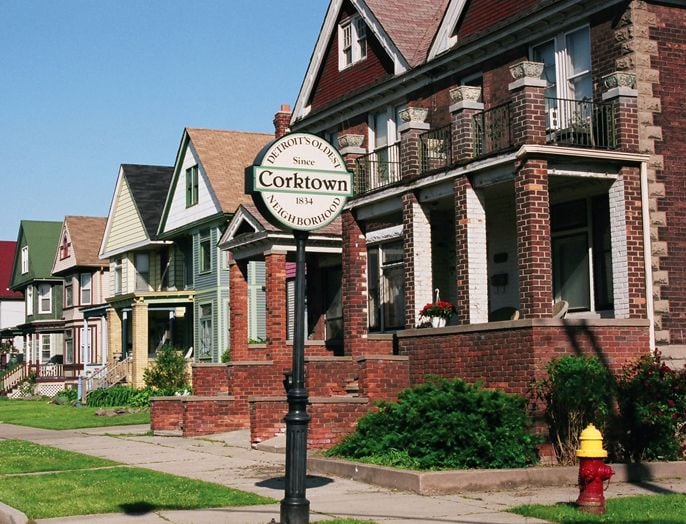
Corktown's surviving residential buildings are generally modest in scale. That is part of their importance.
Early Federal-style houses and rowhouses were joined by one- and two-story Victorian homes with Italianate, Gothic, and Queen Anne details. Narrow lots, front porches, wood framing, and buildings positioned near the sidewalk created a compact neighborhood meant to be experienced on foot.
These were not Detroit's grandest houses. They document the lives of laborers, craftspeople, shopkeepers, immigrants, and families who built the city without living in its mansions.
A small worker's cottage can reveal construction methods, household size, changing utilities, neighborhood density, and the compromises families made as needs changed. Additions, enclosed porches, replacement siding, and altered windows are not automatically evidence that a house has lost its story. They may be evidence of how people kept using it.

Michigan Avenue was Corktown's working spine
Michigan Avenue connected downtown Detroit to the west and brought movement through the neighborhood. Shops, taverns, churches, factories, and homes developed around that circulation.
Commercial corridors are where neighborhood identity becomes visible to outsiders, but they also serve everyday needs. A business sign, a church tower, a corner entrance, or a familiar storefront can become an orientation point for generations.
Most Holy Trinity Catholic Church remains closely associated with Corktown's Irish heritage. Other institutions served later communities. The neighborhood's history becomes clearer when we look beyond one ethnic identity and ask how different residents used the same streets over time.
Industry belonged to the landscape as well. Carhartt operated a factory on Michigan Avenue, producing work clothing in a neighborhood filled with people whose labor powered the city. Corktown was never only a picturesque collection of houses. It was connected to manufacturing, transportation, commerce, faith, and work.
Michigan Central Station changed Corktown before it became its symbol
Michigan Central Station now towers over the western edge of the neighborhood as one of Detroit's most recognizable buildings. Yet its construction required major changes to the surrounding community.
Beginning in 1908, the Michigan Central Railroad assembled approximately 50 acres for a new station and rail facilities. About 300 small wood-frame houses were purchased or condemned. The station opened in 1913, giving Detroit a monumental gateway while removing part of the neighborhood that preceded it.
That history is important because landmarks are rarely created on empty ground. Celebrating an extraordinary building should not prevent us from asking what was displaced to make room for it.
After passenger service ended in 1988, the station became a famous ruin. Ford Motor Company purchased it in 2018 and undertook a vast restoration. Its return has changed how the world sees Corktown, but it has also intensified questions about development, housing costs, investment, and who will be able to remain nearby.
Watch: Detroit built Michigan Central
This History Loves Company film compares Detroit's station with New York's Grand Central and asks why Michigan Central became such a powerful symbol of the city's ambition, abandonment, and return.
Watch Grand Central versus Michigan Central Station on YouTube.
Tiger Stadium made the neighborhood part of Detroit's family calendar
Baseball arrived at the corner of Michigan and Trumbull before the building remembered as Tiger Stadium took its final form. Bennett Park opened in 1896. Navin Field followed in 1912, later becoming Briggs Stadium and then Tiger Stadium.
For generations, game days changed Corktown's rhythm. Fans filled sidewalks, restaurants, bars, yards, and improvised parking spaces. The stadium connected the neighborhood to memories far beyond its boundaries.
The Tigers played their final game there in 1999. Demolition was completed in 2009, despite a long preservation effort. The site later became the Corner Ballpark, preserving baseball use while ending the physical life of the historic stadium.
That outcome raises a recurring preservation question: when a landmark cannot be saved completely, what should remain? The playing field? The dimensions? A wall, a gate, an artifact, a name, or the activity that gave the place meaning? There is no universal answer, but doing nothing guarantees that fewer layers survive.
Corktown was reduced by plans that never delivered what they promised
After World War II, planners proposed clearing large parts of Corktown for industrial expansion. Approximately 75 acres of homes and businesses were demolished, displacing hundreds of residents. The expected industrial development did not materialize.
The neighborhood suffered further losses during the 1960s from urban renewal, expansion of downtown's business district, and construction of the Lodge Freeway. Each project was presented through the language of modernization, mobility, or economic growth. Together, they erased residential blocks and weakened the connections between the remaining ones.
This is why Corktown's survival should not be confused with completeness. The historic district is a remnant of a much larger neighborhood. What remains is valuable partly because so much else disappeared.
Historic designation gave the surviving streets another tool
The Corktown Historic District was listed on the National Register of Historic Places in 1978. Corktown also has local historic-district protection through the City of Detroit.
Those designations are related, but they do different work. National Register listing recognizes significance and may create access to certain incentives or reviews when public funding and approvals are involved. It does not automatically prevent a private owner from changing or demolishing a building.
Local designation is the tool more likely to require design review for exterior work through Detroit's Historic District Commission. The exact rules depend on the property, the proposed work, and current city requirements, so owners should verify boundaries and approvals before beginning a project.
Designation did not freeze Corktown in the nineteenth century. It established a process for considering how change affects the features that make the district historically significant.
Revitalization creates a new preservation test
Corktown has attracted restaurants, businesses, housing investment, visitors, and major development. Reinvestment can repair buildings and return activity to vacant property. It can also increase rents, property taxes, land values, and pressure on longtime residents.
A neighborhood is not preserved if the buildings look historic but the people who sustained the community can no longer remain. Architectural preservation and affordability are not identical goals, yet a serious neighborhood strategy has to consider both.
The City of Detroit's Greater Corktown framework describes inclusive growth and preservation of community character as central goals. Whether those goals are achieved depends on decisions about housing, public space, development, transportation, and participation—not the language of a plan alone.
Corktown's next chapter should be measured by more than new investment. Ask who benefits, who participates, what is retained, and whether the neighborhood remains a place for ordinary daily life.
Watch: the river that brought people and opportunity to Detroit
Corktown's early growth was tied to Detroit's position on the Great Lakes and the movement of people through the city. Our riverfront walk explores the larger waterway that made Detroit a transportation, commercial, and industrial center.
Watch The River That Built Detroit on YouTube.
How to read Corktown on foot
Walk slowly enough to compare the layers. Notice where a small nineteenth-century house stands beside a later commercial building. Look for narrow lots, porch placement, siding changes, bricked-in openings, and traces of buildings that no longer exist.
Then look beyond the district's best-known landmarks. A surviving cottage may tell you more about everyday Detroit life than a monumental building. A church, corner store, former factory, or empty lot may reveal how different communities occupied the neighborhood.
Respect private property and remember that Corktown is a living neighborhood, not an outdoor museum. Preservation begins with curiosity, but it also requires consideration for the people who live there now.
Keep following Corktown's story
Explore more Detroit history, historic neighborhoods, and historic-home resources. If your family lived, worked, worshipped, operated a business, or attended a game in Corktown, share your memory with History Loves Company.
For the larger story of the forces that reshaped Detroit's neighborhoods, discover Christopher Hubel's book They Lied to Us About Detroit. You can also visit The Foundry by History Loves Company in downtown Pontiac and subscribe to Stories We Keep.
Corktown survived. The work now is to make sure its history—and its community—remain visible in what comes next.
Sources and further reading
- Detroit Historical Society: Corktown Historic District — immigration, architecture, demolition, designation, and neighborhood landmarks.
- National Park Service: Corktown Historic District — National Register record, boundaries, periods, architecture, and areas of significance.
- City of Detroit: Corktown Historic District Final Report — detailed local history and designation research.
- City of Detroit: Greater Corktown — planning framework and stated goals for inclusive growth and neighborhood character.
- Historic Detroit: Michigan Central Station — station construction, neighborhood land acquisition, decline, and restoration.
- Wikimedia Commons: Trumbull Avenue in Corktown and Michigan Avenue in the 1880s — image provenance and reuse terms.