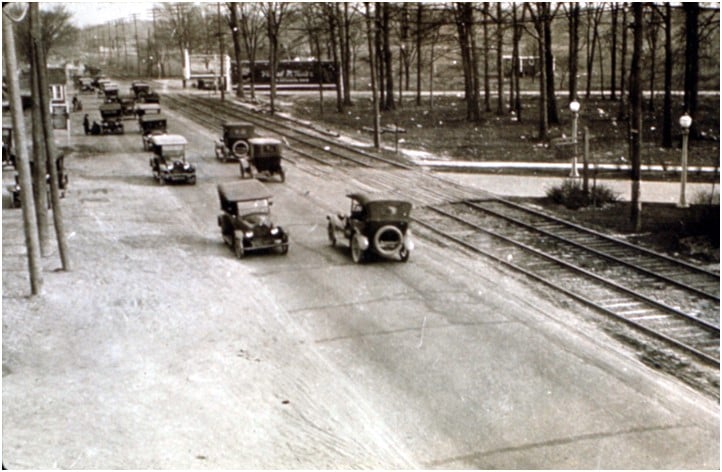
Woodward is not just a road. It is one of Detroit's clearest history lines: a route from the river toward the interior, a connection to Pontiac, a streetcar corridor, an automobile showcase, and a symbol of how the region kept moving north.

Woodward Began Before the Automobile
Long before Woodward became shorthand for cruising, car culture, and Detroit's north-south identity, the route followed older movement patterns. It connected Detroit to the interior of Michigan and eventually to Pontiac. MDOT notes that the first surveyed road in Michigan was Pontiac Road, now M-1 or Woodward Avenue, connecting Detroit and Pontiac in 1819.
That matters because Woodward's later automobile mythology can hide an older story. This corridor was not invented by cars. Cars inherited and transformed a route that already organized movement, settlement, commerce, and imagination.
The First Mile of Concrete Highway
In 1909, Wayne County built the nation's first mile of concrete highway on Woodward between Six Mile and Seven Mile. MDOT describes the project as a national transportation first. The point was not nostalgia. It was durability, speed, and proof that modern pavement could handle modern traffic.
That mile helped turn Woodward into a test strip for the road age. Detroit was becoming the Motor City, but the city also had to build the physical surface that a motor city required.
Streetcars, Cars, and Traffic Control
Woodward carried streetcars, pedestrians, early automobiles, commercial traffic, and downtown crowds at the same time. The corridor became a living laboratory for urban traffic. MDOT lists the nation's first four-way red-yellow-green electric traffic light at Woodward and Michigan in 1918, credited to Detroit police officer William Potts.
That intersection is a perfect Detroit history symbol: old movement systems and new movement systems sharing the same street until the city had to invent new rules for the conflict.
Watch: Woodward From the Skyline to the Historic Heart
Watch the History Loves Company Woodward drive on YouTube.
Why Woodward Belongs in Detroit's Bigger Story
Woodward connects multiple HLC topics at once: streetcars, downtown, Highland Park, Palmer Woods, suburbs, Pontiac, auto industry geography, and the way Detroit's center of gravity kept stretching outward.
- Detroit's Lost Streetcars
- Detroit Transportation History Guide
- Why America Really Built the Suburbs
- How Pontiac Helped Put America on Wheels
- They Lied To Us About Detroit Episode Archive
Keep Watching
- What Really Killed America's Streetcars?
- Why America Really Built the Suburbs
- Watch History Loves Company on YouTube
Sources and Further Reading
- MDOT: Transportation National Firsts
- MDOT: Road and Highway Facts
- MDOT: Horatio Good Roads Earle
- Historical Concrete Pavement Explorer: First Mile of Concrete Pavement
Woodward is Detroit's movement story in one corridor: trail, road, rail, concrete, signal, skyline, suburb, and memory.