STORIES WE KEEP · SEPTEMBER 26, 2026
Detroit's Lost Streetcars: How the Motor City Once Moved
Before freeways and automobile dependency, streetcars connected Detroit's neighborhoods, factories, downtown stores, and suburbs—and shaped the city still visible today.
By Christopher Hubel | September 26, 2026

Detroit is called the Motor City, so it is easy to imagine that the automobile always ruled its streets.
It did not.
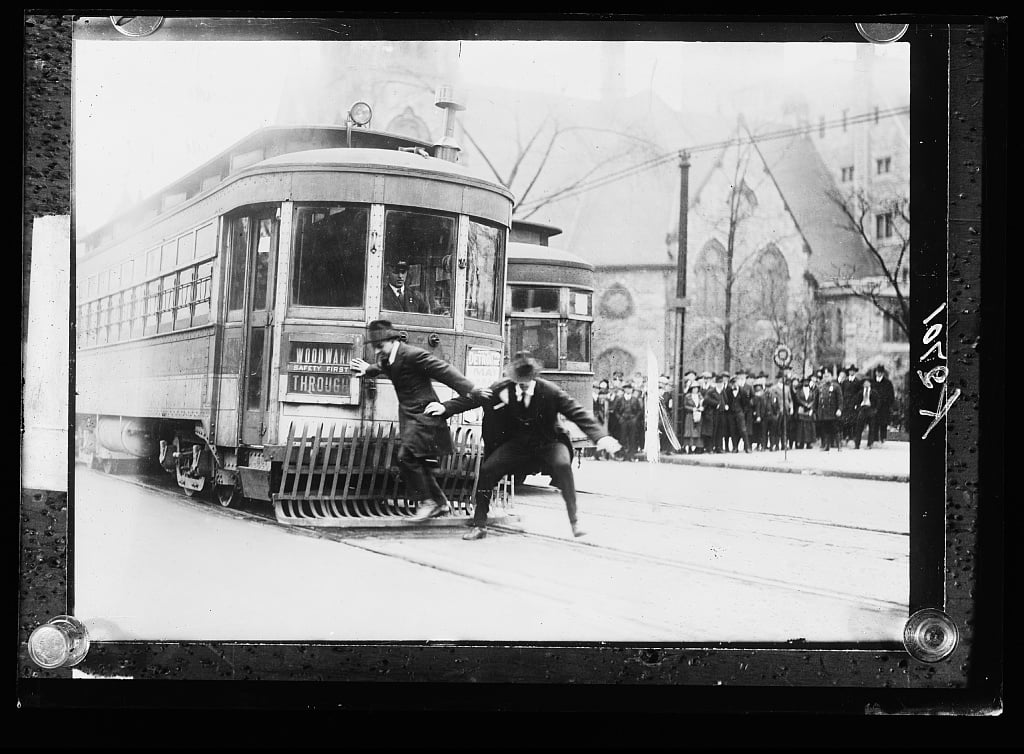
For generations, Detroiters organized daily life around rails. Streetcars carried workers to factories, shoppers downtown, families to amusement parks, and residents home along the city's great radial avenues. Tracks ran on Woodward, Jefferson, Michigan, Gratiot, Grand River, Fort, and dozens of connecting streets. Interurban cars reached far beyond the city.
In 1922, Detroit created what the Detroit Historical Society describes as the largest municipally owned street railway system in the United States. Thirty-four years later, the last streetcar rolled down Woodward Avenue.
The disappearance of Detroit's streetcars was not one villain's secret plot or an unavoidable march of progress. It was the result of repeated public and private choices about fares, roads, land use, technology, and whose movement mattered.
Detroit's streetcar story began with horses
In 1862, Detroit authorized street railway lines along the main avenues radiating from downtown. Early cars traveled on rails but were pulled by horses. Rails reduced friction and made a horse-drawn car smoother and more efficient than an ordinary wagon on rough streets.
The first routes followed the city's physical logic. Detroit had grown outward from the river along spoke-like roads. A transit line on Woodward or Jefferson could connect the commercial center with expanding residential districts while branch lines filled the spaces between them.
Electric power transformed the system during the 1890s. Electric trolleys moved faster, carried more people, and eliminated the expense and sanitation problems of keeping thousands of horses. By 1896, Detroit's horse-drawn streetcars had been replaced by electric service.
Multiple private companies competed, combined, failed, and reorganized. In 1900, the major remaining operators were consolidated into the Detroit United Railway, commonly called the DUR.
The streetcars extended Detroit's map
Transit did not merely serve neighborhoods after they appeared. It helped create them.
When a reliable line extended outward, land near its stops became practical for housing. Developers promoted subdivisions by advertising the trip downtown. Workers could live farther from the factory or office without owning a car. Commercial buildings followed riders, producing the familiar pattern of apartments above shops along major avenues.
Many places now celebrated for historic architecture grew during this streetcar era. Boston-Edison, Arden Park, the North End, Southwest Detroit, and neighborhoods along East Jefferson and Grand River were connected to a larger network of employment and shopping. Even households wealthy enough to own an automobile benefited from the walkable commercial corridors and compact development transit helped produce.
The interurban network reached farther. Detroit United Railway cars traveled to communities including Pontiac, Royal Oak, Grosse Pointe, Wyandotte, Ann Arbor, Flint, Port Huron, Jackson, and Toledo. The lines blurred the boundary between local transit and regional rail.
That regional reach is difficult to imagine today. A resident could board an electric car within Detroit and continue toward cities that now require a highway trip.
Public ownership created the DSR
Private ownership generated years of political conflict over fares, service, franchise terms, and control of the streets. Detroiters eventually approved municipal ownership, and in 1922 the city acquired the urban system from the Detroit United Railway.
The new Department of Street Railways—the DSR—became a source of civic pride. In 1923, it recorded 357,386,437 rides on its rail lines. That figure reveals more than popularity. It shows how completely public transportation was woven into ordinary Detroit life.
The nickel fare carried political meaning. Affordable transportation allowed workers to reach employment and made the city accessible across income levels. But keeping fares low while labor, maintenance, materials, and expansion costs increased placed the system under financial pressure.
Street railways also carried obligations that automobiles did not. Transit companies were often responsible for maintaining pavement around their tracks. Streetcars operated in mixed traffic, so the congestion created by growing automobile use made rail service slower while cars received expanding public investment in roads.
The city owned the DSR, but that did not free it from political cycles, deferred maintenance, changing travel patterns, or pressure to keep fares below the cost of long-term modernization.
Downtown moved on rails
Streetcars made Detroit's concentrated downtown retail district possible at an enormous scale. Riders arrived at Hudson's, Crowley's, Kern's, theaters, offices, hotels, and restaurants without requiring a parking space for every customer.
Photographs of Campus Martius and lower Woodward show the transportation mix changing in real time. Streetcars share the road with pedestrians, horse-drawn vehicles, and early automobiles beneath a web of electrical wires.

The streetcar shaped downtown architecture. Large department stores could draw customers from across the city because transit delivered them directly to the commercial core. Office workers did not need acres of nearby parking. Buildings could meet the sidewalk, storefronts could remain close together, and streets could carry enormous numbers of people.
When transportation policy later favored the private automobile, downtown had to compete with shopping centers and office parks built around parking lots and freeway access. Transit change did not single-handedly empty downtown, but it altered the geography of what was convenient.
Watch: what really killed America's streetcars?
The common story says General Motors secretly destroyed public transportation so everyone would have to buy a car. The real history includes corporate misconduct—but also public ownership, fare policy, traffic, deferred investment, suburbanization, and widespread enthusiasm for buses and automobiles.
Watch What Really Killed America's Streetcars? | They Lied to Us Episode 2 on YouTube.
Buses looked like flexibility and modernization
Buses did not appear after the streetcars vanished. They grew within the same municipal system.
A bus could operate without rails and overhead wires. Routes could be extended or changed more easily. New service did not require the same upfront investment in tracks, electrical infrastructure, or carhouses. To officials facing rapid outward growth and constrained budgets, rubber-tired transit promised flexibility.
The comparison was not neutral, however. Streetcars carried the cost of maintaining fixed infrastructure while public road spending supported the surface buses and automobiles used. A bus could look cheaper partly because important costs were paid through a different public account.
Automobile ownership also changed public expectations. Cars offered private, door-to-door travel. Road widening and freeway construction promised speed. Federal, state, and local policy increasingly subsidized an automobile-oriented metropolitan region.
At the same time, many streetcars and tracks were aging. Crowded cars, slow travel in traffic, and unreliable service made replacement attractive. The DSR gradually converted rail routes to buses while continuing to operate both.
The conspiracy story is real—and incomplete
General Motors, Firestone, Standard Oil of California, Phillips Petroleum, Mack Trucks, and other interests did participate in a national network connected to National City Lines. In 1949, several companies were convicted of conspiring to monopolize the sale of buses, fuel, tires, and related supplies to transit companies controlled by National City Lines. They were acquitted of conspiring to monopolize ownership of the transit systems themselves.
That case matters. Corporate actors had a financial interest in replacing electric rail with products they supplied.
But National City Lines did not own Detroit's street railway. Detroit's system was municipally controlled. The city's conversion cannot be accurately explained as GM simply purchasing the DSR and tearing out the tracks.
Automobile companies still influenced Detroit's culture, employment, politics, and physical growth. Buses and cars benefited manufacturers. Yet local officials, voters, planners, riders, federal highway policy, suburban development, congestion, system finances, and consumer preference all shaped the outcome.
The more useful question is not “Was there a conspiracy?” It is: Why did so many public and private institutions repeatedly choose systems that made automobile dependence more likely?
Detroit briefly invested in modern streetcars—then abandoned them
The end was not a straight line from obsolete equipment to buses. Detroit purchased modern PCC streetcars after World War II. The streamlined cars began serving Woodward in 1947, and additional cars arrived in 1949.
Those purchases demonstrated that rail could still be modernized. Yet the city continued converting other routes. By 1952, streetcars remained only on Jefferson, Michigan, Gratiot, and Woodward. Jefferson converted to buses, followed by Michigan and Gratiot.
Woodward was last. On April 8, 1956, a farewell parade marked the end of Detroit streetcar service after more than ninety years. Buses replaced the remaining route, and many of Detroit's PCC cars were sold to Mexico City.
The date carries painful symbolism. The federal Interstate Highway Act became law the same year, accelerating road construction that would demolish neighborhoods, separate communities, and reorganize metropolitan life around the car.
Transportation decisions became neighborhood decisions
A transportation network determines more than how people travel. It influences where homes are built, which business districts receive customers, what land must be cleared, and who can reach opportunity without owning a vehicle.
Streetcars encouraged concentrated development along corridors. Freeways and automobile ownership enabled development to spread across a much larger area. Jobs, retail, and tax base moved outward. Parking requirements consumed urban land. Buildings were demolished for roads and lots.
The consequences were not evenly distributed. Federal housing policy, racial covenants, redlining, discriminatory lending, and suburban exclusion meant many Black Detroiters could not follow investment outward on equal terms. Highway construction cut through Black Bottom and other established communities. Later redevelopment decisions—including the clearance of Poletown—again presented neighborhood destruction as the price of regional mobility or industrial survival.
Transit decline did not cause every part of Detroit's crisis. It removed one of the systems that had allowed a dense city to function without requiring every household to buy, maintain, fuel, insure, and park an automobile.
Watch: Woodward after the streetcar era
Woodward Avenue still reveals the layers created by transit, automobiles, institutions, and neighborhood change. Drive north with History Loves Company from Detroit's new skyline into the city's historic heart.
Watch Driving North on Woodward: From Detroit's New Skyline to Its Historic Heart on YouTube.
The QLINE returned rails—but not the old network
Streetcars returned to Woodward Avenue when the QLINE opened in 2017. Its 3.3-mile route connects downtown, Midtown, New Center, and the North End.
The return is historically meaningful, but the QLINE is not a restoration of the DSR. The earlier system carried hundreds of millions of annual rides across a citywide and regional network. Today's line serves one corridor and must connect with buses, walking, cycling, and regional services to become part of a larger transportation system.
That distinction matters because nostalgia can reduce transit to a charming vehicle. The real value of a streetcar is not the bell, the paint, or the tracks. It is whether the system reliably connects people with work, school, health care, shopping, culture, and one another.
You can still read the streetcar city
Even where the rails are gone, Detroit's streetcar geography remains visible.
Look along the radial avenues for clusters of older storefronts at former transfer points. Notice apartment buildings positioned near major routes, narrow commercial lots, theaters without large historic parking areas, and neighborhoods whose density made frequent transit practical. In some streets, rails remain buried beneath later pavement.
Old maps, timetables, fare tokens, transfer slips, photographs, and family stories can rebuild the network in memory. Ask older relatives which line they rode, where they transferred, how long the trip took, and what destinations they associated with the route.
Explore more Detroit history, historic neighborhoods, Southeast Michigan stories, and the places remembered through Buildings We've Lost. If your family rode or worked for the DSR, share your transit story with History Loves Company.
For the larger story of the policies that separated Detroit from opportunity, discover Christopher Hubel's book They Lied to Us About Detroit. Visit The Foundry by History Loves Company in downtown Pontiac, and subscribe to Stories We Keep.
Detroit did not simply lose its streetcars. It chose a different kind of city—and we are still living inside that choice.
Sources and further reading
- Detroit Historical Society: Detroit's Streetcars—Past and Present — municipal ownership, ridership, system conversion, final service, and the QLINE.
- Detroit Historical Society: Detroit United Railway — private consolidation, interurban expansion, and the transition to the DSR.
- City of Detroit: 100 Years of Detroit Transit — DDOT and Department of Street Railways history.
- WDET: Did Detroit Automakers Sabotage Public Transit? — evidence and context surrounding the national streetcar-conspiracy claim.
- Detroit Transit History: The End of Detroit's PCC Streetcars — route conversions and the 1956 farewell.
- Library of Congress: Detroit Streetcar Safety Demonstration and Hotel Pontchartrain and Campus Martius — image provenance and reproduction information.
Detroit transportation history cluster
Keep following the movement story through the full HLC transportation cluster.