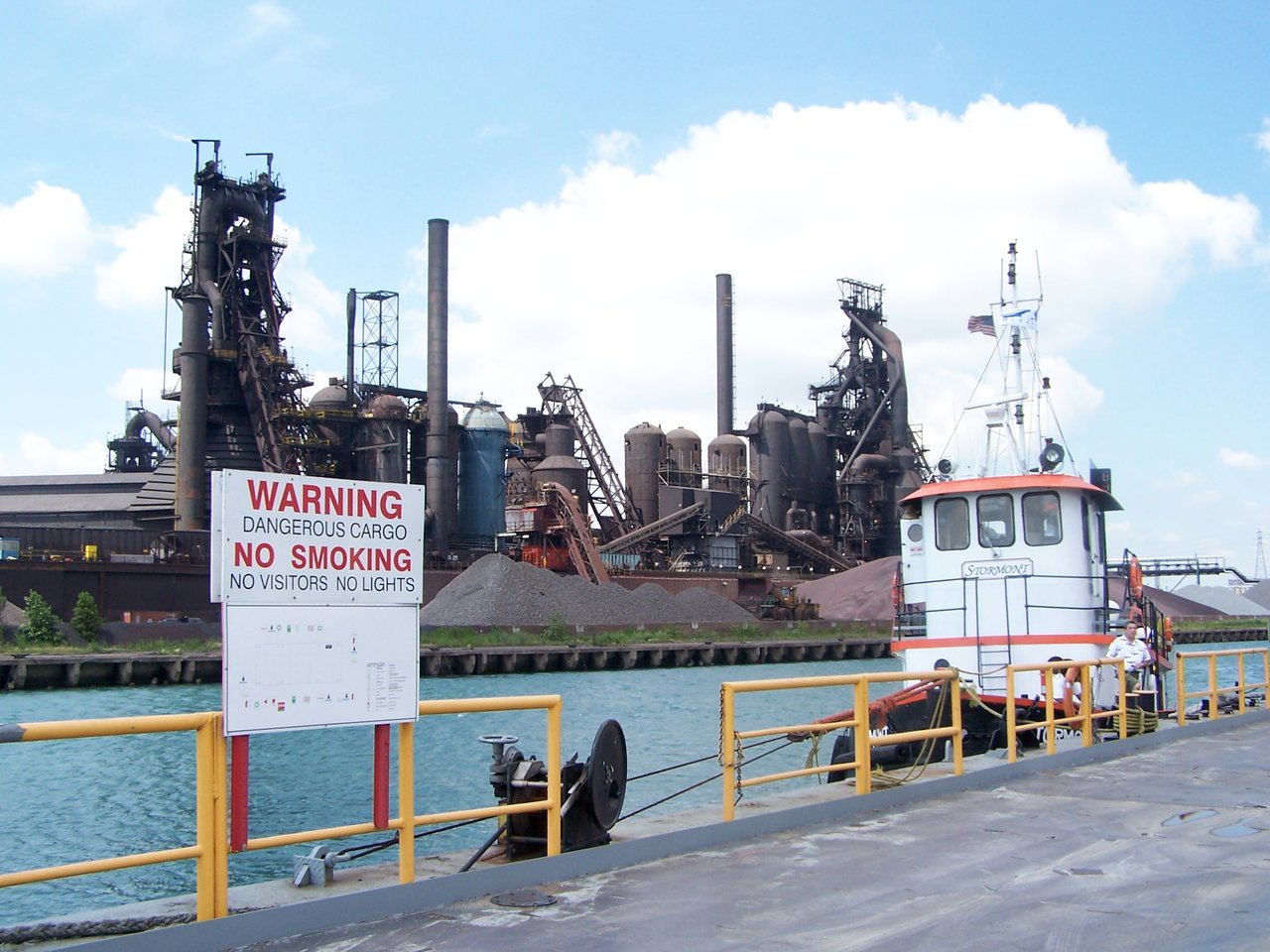
Cover photograph: Zug Island from the truck ferry, July 9, 2008. Tara (taubuch), via Wikimedia Commons, CC BY 2.0. Display crop may vary.
Zug Island is one of those places that makes people stop and ask what happened there. The riverfront machinery is enormous. The photographs span very different eras. And the stories surrounding the island can move quickly from steelmaking to pollution to a sound heard across an international border.
Our new Zug Island Part 2 documentary follows those connections. This companion guide gives you a closer look at the industrial processes, the Windsor Hum research, and the work still shaping the Lower Rouge River. If you are starting with the island’s origins, read our original Zug Island history first.
Watch Zug Island Part 2
Join History Loves Company for the next chapter of the island’s story.
Watch the full Zug Island Part 2 documentary on YouTube.

Start with the map: Zug Island is in River Rouge
Zug Island sits at the meeting of the Rouge and Detroit rivers, immediately beside Detroit’s southern boundary. Its industrial history is closely tied to Detroit, but its municipality is River Rouge. The Detroit Historical Society dates the canal that separated the land from the mainland to 1888 and the beginning of blast-furnace construction to 1902.
Those two changes help explain the landscape. A waterway reshaped the property; industrial investment reshaped its purpose. The island became part of a region where ships, rail lines, furnaces and factories depended on one another. Read the Detroit Historical Society’s Zug Island entry.
How the island fit into steelmaking
A steel complex contains several kinds of work, and the distinctions are useful when looking at old photographs. Coke, ironmaking, steelmaking and finishing describe different stages. A furnace on the waterfront tells only part of the production story.
A Michigan air-quality inspection from 2015 described iron ore being converted into pig iron in Zug Island’s operating blast furnaces. The report documented raw materials entering from above and hot metal being loaded into rail cars for transfer to the main plant’s basic oxygen process shop. That movement of material is a reminder that the island’s machinery belonged to a larger working system. Michigan’s 2015 inspection record.
When you hear someone recall a job “at the steel mill,” ask which department and which years. The answer can place a family story within that process: maintaining a conveyor, moving a rail car, working a furnace, or handling a finished product. Preserving the specific task gives the next generation something more useful than a company name alone.
What the Windsor Hum investigations found
Beginning in 2011, residents in Windsor and nearby communities reported an intermittent low-frequency sound. The complaints led to research on both the sound itself and its possible origin.
The Canadian government’s published study summaries contain two different findings. The University of Windsor team considered Zug Island blast-furnace operations a likely source based on the sound’s characteristics. It also reported that conclusive source-identification measurements were unavailable because the Hum was absent during the river deployments.
Western University’s team could not establish a definite location using common bearings from its arrays. Most of its observations did not support Zug Island as the source, and its report discussed the difficulties of local sound propagation. The research therefore leaves room for uncertainty that a short headline can easily lose. Read both Windsor Hum study summaries.
Residents’ reports and the limits of the measurements both belong in this story.
What has changed at Great Lakes Works?
For an industrial site, the date attached to a source matters. U.S. Steel’s locations page, reviewed in October 2026, describes Great Lakes Works in Ecorse and River Rouge as containing finishing facilities serving primarily automotive customers. Its equipment list marks the basic oxygen vessels, continuous slab casters and hot-strip mill as permanently idled.
That is a more precise description than assigning a single operating status to an entire island. Great Lakes Works is a broader facility, and a company’s list does not inventory every industrial operation or parcel on Zug Island. Read U.S. Steel’s current facility descriptions.
This is also why we date archival images. A photograph can show how equipment was arranged and how the waterfront looked at a particular moment. It cannot establish what is running today.
The Lower Rouge River cleanup is another chapter
The river’s environmental history extends well beyond one property. EPA’s Rouge River Area of Concern covers a watershed of 466 square miles and 48 communities. The designation dates to 1987, with industrial activity, sewer overflows and runoff among the problems documented by the agency. Explore EPA’s Rouge River overview.
On March 30, 2026, EPA announced the resumption of dredging in the Lower Rouge River Old Channel. The announcement described the final phase of an $84 million project addressing sediment contaminated with coal tar and petroleum products. Plans called for dredging about 70,000 cubic yards and isolating roughly 35,000 cubic yards beneath a cap. Read the project announcement.
The scale gives a sense of how long an industrial legacy can remain part of a river’s future. The March announcement documents work and its intended scope; it does not establish completion. Agency updates and monitoring records are the place to follow the next stage.
Questions viewers ask about Zug Island
Can you visit Zug Island?
Zug Island is a private industrial site. This article and documentary are historical resources, not permission to enter restricted property. Keep any visit to lawful public locations and respect posted restrictions.
Was the Windsor Hum conclusively traced to one furnace?
The published studies did not conclusively identify one machine. The University of Windsor’s likely-source assessment and Western University’s inconclusive location findings should be read together.
Where should I start if my family worked there?
Start with a name, employer, department and approximate date. Then gather photographs, union material and other records that identify the actual job. Ask relatives what a normal shift involved, how they got to work, and which details they remember firsthand. Keep uncertain dates marked as uncertain.
Keep the story going
Watch the film, then compare what you see with the dated photographs and source links above. The questions become more interesting as the places, processes and people come into focus.
Continue with our first Zug Island article, explore Detroit’s automotive history, or share a working-life memory with History Loves Company. An ordinary detail from a shift, a river crossing or a family photograph may be the piece someone else has been trying to find.
Historical and project sources reviewed October 12, 2026.


