THE STORIES WE KEEP · DETROIT HISTORY · OCTOBER 2, 2026
At Woodward and Canfield, a rose-colored mansion still holds the ambition of Gilded Age Detroit—and more than a century of stories that refuse to leave.
At a glance
Completed: 1894
Architect: Gordon W. Lloyd
Style: Romanesque Revival
Location: 4421 Woodward Avenue, Detroit
Historic status: Listed on the National Register of Historic Places
There are Detroit buildings that reveal themselves all at once. The Whitney is not one of them.
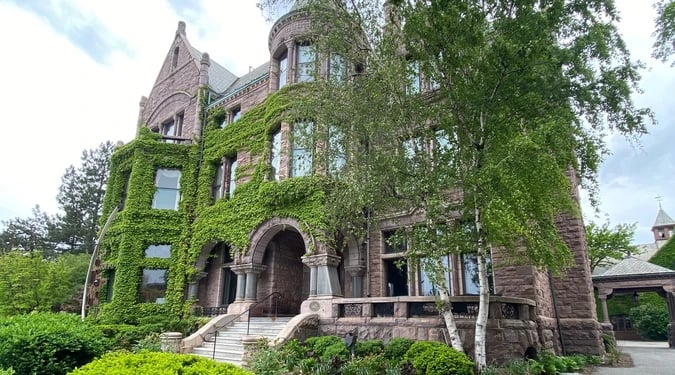
Its rose-colored stone rises heavily from the corner of Woodward and Canfield. Rounded arches, carved details, a copper-capped tower and a slate roof make it feel less like a house than a private fortress.
Then the front door opens.
Inside are warm woods, patterned floors, stained glass, fireplaces and rooms created for a kind of entertaining that belonged to another Detroit.
The mansion has survived wealth, loss, institutional use, the threat of demolition, restoration and reinvention. Today it is known as one of Detroit’s most distinctive restaurants.
It is also known for something harder to document: stories of unexplained footsteps, moving shadows and a presence that some visitors believe never left.
History can tell us who built this house and why. Folklore tells us how people have continued to experience it. The story of The Whitney lives somewhere between the two.
Watch: Inside Detroit’s Whitney Mansion
Walk through the mansion with History Loves Company and explore the documented history, extraordinary architecture and enduring legends of The Whitney.
Watch Inside Detroit’s Whitney Mansion on YouTube.

A fortune built from Michigan’s forests
David Whitney Jr. arrived in Detroit in 1857 and built an extraordinary fortune in lumber. His business interests reached beyond Michigan into other parts of the Great Lakes region, and he also invested in real estate, shipping and banking.
By the late nineteenth century, he stood among the wealthiest people in Michigan.
That wealth was inseparable from the landscape. White pine helped build cities, businesses and family fortunes across the Midwest. It also transformed Michigan’s forests on an enormous scale.
The Whitney mansion is therefore more than a monument to one successful businessman. It is a physical record of the resources, labor and ambition that powered Detroit before the automobile became the city’s defining industry.
In 1890, Whitney commissioned architect Gordon W. Lloyd to design a new residence at Woodward and Canfield. Construction lasted four years.
When it was completed in 1894, the house was estimated to have cost $400,000—a staggering sum at the time—before its artwork and furnishings were counted.
A Romanesque Revival landmark
Lloyd designed the house in the Romanesque Revival style, an architectural language built around weight, permanence and drama.
The rough-faced pink stone, broad arches, asymmetrical massing and rounded tower give the exterior its unmistakable presence. This was architecture intended to communicate stability and power.
The scale is just as remarkable. The mansion contains roughly 22,000 square feet, 52 rooms, 20 fireplaces and 218 windows.
Historic accounts describe it as Detroit’s first private residence with an elevator intended for personal use. The interior combined carved hardwoods, marble, elaborate plasterwork, imported decoration and stained glass associated with Tiffany & Co.

The central hall was designed to impress. Its staircase rises beneath a monumental stained-glass window depicting a medieval knight.
Nearby rooms were finished for music, dining, reading, smoking and receiving guests. Tapestries in the dining room reportedly concealed a vault. On the upper floors were bedrooms, a ballroom, guest rooms, servant spaces and an art gallery illuminated from above.
Yet the house was not simply a showroom. It was a family home supported by the labor of servants whose work made its elegance possible.
Gilded Age mansions often preserve the names of owners more clearly than the names of the people who cooked, cleaned, maintained fires, tended horses and kept these enormous households running.
Remembering the whole house means remembering both worlds.

Only six years in the finished house
David Whitney Jr. died in 1900, only six years after the mansion was completed. His widow, Sara, remained there until her death in 1917.
The building then entered a long period of transition—one that ultimately helped preserve it.
The Wayne County Medical Society began using the house in 1932, and the Whitney family formally donated it to the organization in 1941.
The Visiting Nurse Association, which had already occupied the carriage house, purchased the property in 1957 and continued using it for offices.
By 1979, the mansion faced an uncertain future. Businessman and preservationist Richard Kughn purchased it when demolition appeared possible.
He invested millions in restoration, and The Whitney opened as a restaurant in 1986. That adaptive reuse changed the house from a private symbol of wealth into a place thousands of people could enter, experience and remember.
Preservation does not always freeze a building in one moment. Sometimes survival means giving an old place a new reason to remain.
Is The Whitney haunted?
This is where documented history gives way to Detroit folklore.
Over the years, guests and employees have reported unexplained sounds, fleeting figures, doors that seem to move without help and an uneasy feeling in certain rooms.
David Whitney’s name is often attached to the stories. So is that of his widow. The mansion’s third-floor lounge is now called the Ghostbar, a name inspired by the building’s persistent supernatural reputation.
None of those accounts proves that the mansion is haunted.
Old houses create their own theater: settling wood, complicated heating systems, reflections in antique glass, unfamiliar floor plans and the suggestive power of a story already heard. Once someone tells you to listen for footsteps, every creak becomes a possibility.
But folklore still matters.
Ghost stories often gather where memory feels especially dense. The Whitney has witnessed private celebrations, grief, medical work, preservation battles, fire, restoration and countless public gatherings.
Even without accepting a supernatural explanation, it is easy to understand why people feel the past so strongly inside its walls.
The larger Detroit story
The Whitney’s survival offers a counterpoint to the many extraordinary Detroit buildings that disappeared.
Its continued presence was not inevitable. People chose to maintain it, reuse it and invest in it. That choice allowed the mansion to outlive the social world that created it.
Today, visitors can walk through rooms once reserved for one of Michigan’s wealthiest families. They can study the woodwork, look into the stained glass and decide for themselves whether the house feels merely old—or occupied by something more difficult to name.
Perhaps that is why The Whitney remains so compelling.
It is not just a mansion, a restaurant or a collection of ghost stories. It is evidence that a building can change its purpose without surrendering its identity.
Every home has a story. Every city carries memory. These are the stories we keep.
Keep exploring Detroit’s story
Watch the film, read more Michigan history, and help us keep documenting the places that shaped us.
Go deeper: They Lied to Us About Detroit
Detroit’s history is bigger than the version most of us were handed. Chris Hubel’s new book follows the power, policies, people and places that shaped the city—and challenges the simplest stories told about its rise and fall.
Related stories
- Detroit’s Hidden Mansion Forest: Inside Palmer Woods
- Historic Fort Wayne: Detroit’s Forgotten Star Fort
- Visit The Foundry by History Loves Company in downtown Pontiac
Sources and further reading
- The Whitney — History of Detroit’s Most Iconic Mansion
- Historic Detroit — The Whitney
- National Park Service — National Register of Historic Places
- Wikimedia Commons — Whitney House, circa 1900s
- Wikimedia Commons — Grand staircase photograph and rights information
- Wikimedia Commons — Stained-glass window photograph and rights information
Historical claims are based on the sources listed above. Supernatural stories are presented as folklore and reported experiences, not verified fact.
