Detroit Buildings We Lost
Hudson’s history becomes clearer when the building, the business, and the memories are put on separate timelines. A store directory explains how shoppers navigated it. An employee handbook reveals the organization behind the counters. A lunch menu preserves a small part of an ordinary day downtown. Together, those records bring the vanished Woodward Avenue landmark closer than a demolition photograph can.
This guide follows the dates and surviving evidence. For the wider narrative of the store and metropolitan change, read J.L. Hudson’s: the department store that made downtown Detroit a destination.

In this guide: Key dates · Inside the store · Working at Hudson’s · The parade · Closure and demolition
When did Hudson’s open, close, and disappear?
- 1881: Joseph Lowthian Hudson established his clothing business inside the old Detroit Opera House.
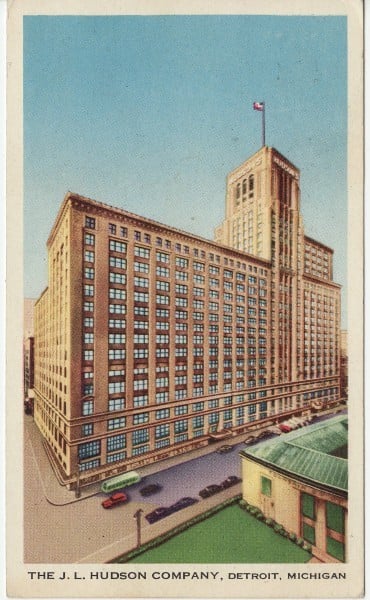
- 1891: The store moved to Gratiot and Farmer. Later additions filled the block between Woodward, Farmer, Gratiot, and Grand River.
- January 17, 1983: Downtown retail operations closed.
- 1990: The building’s remaining office workforce left.
- October 24, 1998: The former store was imploded.
The Detroit Historical Society’s Hudson’s history establishes the company’s beginnings and the block’s growth. Dan Austin’s Historic Detroit account distinguishes the retail closing from the later end of office use. Those are different events, and treating them as one creates a misleading picture of the building’s last fifteen years.
How did people find their way around Hudson’s?
A circa-1967 downtown store directory, catalog 2014.002.939, divides the business into an upstairs store and a budget store. It sorts departments by customer groups and household needs, with separate entries for services. Its small folded format made a complicated building portable: a shopper could carry its organization in a pocket or handbag.
That division is more revealing than simply calling Hudson’s luxurious. The document shows a retailer addressing different budgets within the same downtown institution. It also gives family memories a useful point of comparison. A recollection of shopping downstairs and another of browsing an upper-floor department can belong to the same building while describing quite different trips.
What was behind the customer experience?
The museum’s Welcome to Hudson’s employee manual, catalog 2011.004.019, is a twenty-page booklet dated circa 1941. Its catalog description identifies company history, employee regulations, and customer services. A handwritten December 10, 1942 notation on the cover gives this particular copy another layer of history.
Read beside the customer directory, the handbook changes the viewpoint. The shopper needed to find a department; an employee needed to understand expectations and procedures. The distinction helps explain why a store can live in memory as both a special outing and a demanding workplace. The cover notation does not, by itself, identify its owner or establish what happened that day. Those questions remain open rather than becoming invented biography.
What did a Hudson’s lunch preserve?
A 1941 jubilee menu, catalog 2014.002.905, lists a sixty-cent shopper’s luncheon alongside seventy-five-cent and eighty-five-cent alternatives. Its cover carries E.E. Anthony’s illustration of the University of Michigan’s old University Hall. A passage by Burton Historical Collection historian Milo Milton Quaife appears on the back.
This is an unusually compact meeting of commerce and public history. Someone coming downtown for a meal could encounter an image of an earlier Michigan and a historian’s account without entering a museum. The menu also preserves choices at one moment in time. Its prices should be read as 1941 prices, not as a measure of affordability without evidence about wages and household circumstances.
How did Hudson’s help create Detroit’s Thanksgiving tradition?
The first Hudson’s Thanksgiving parade traveled Woodward in 1924. The Detroit Historical Society’s parade history describes a Mother Goose float, papier-mâché heads, and seven marching bands. Radio carried it in 1931; local television followed in 1948. Wartime shortages interrupted the event in 1943 and 1944.
Hudson’s sponsorship continued through 1980, before the downtown store closed. The parade’s survival under later organizations shows how a commercial promotion can become a civic tradition with a life beyond its founder. A photograph of Santa or a parade float therefore belongs to two histories at once: the store’s holiday business and the city’s shared use of Woodward Avenue.
Why does Northland belong in the downtown story?
Northland Center opened in Southfield on March 22, 1954, with Hudson’s as its anchor. Victor Gruen’s design gathered shops, landscaped spaces, artwork, and civic services within a setting surrounded by extensive parking. It offered a new way to arrange the activities that downtown visitors had combined along city streets.
The relationship was more complicated than a rival taking business away. Hudson’s participated in building the suburban shopping system. Comparing the two locations means asking how the same retailer changed its surroundings: a vertical downtown complex on one hand, a planned regional center on the other. That comparison connects a store history to transportation and the changing shape of metropolitan life.
Was the building empty from 1983 until 1998?
No. Retail closure did not immediately mean abandonment. Historic Detroit records roughly 1,200 remaining office workers and a Farmer Street entrance serving the continued business use. Employees remained until 1990. The distinction restores a chapter often lost between photographs of bustling counters and the 1998 implosion.
What occupies the site now?
The present Hudson’s Detroit development carries the historic name, but it is a new project. Its developer, Bedrock, dates groundbreaking to 2017 and presents a series of personal recollections about the original store. Those accounts are valuable testimony about remembered experiences; they are not a substitute for dated records of construction, employment, or closure.
At the block, compare the streets with the postcard above. Then follow the lost-buildings walking route to place Hudson’s within the surrounding downtown. The building is gone, but its documents still let us move between the scale of a city block and the scale of a person’s working day.
Watch with this page
Pair this article with History Loves Company on YouTube and the They Lied To Us About Detroit episode archive.
Where this fits in Detroit history
Follow the store outward into the surrounding streets, retail districts, and other landmarks Detroiters remember. The linked guides connect this block to the wider city.
- The Hudson’s narrative — the store, its workers, and metropolitan change
- Tiger Stadium Detroit History - Corktown, baseball, reuse
- Olympia Stadium Detroit History - Hockeytown before downtown arenas
- Joe Louis Arena Detroit History - Riverfront, Red Wings, redevelopment
- Detroit Lost Schools and Neighborhood Landmarks - Demolished Cooley High School and neighborhood memory
- Detroit Lost Theaters and Movie Palaces - Movie palaces, adaptive reuse, ruins
Sources and further reading
- J. L. Hudson Department Store and Addition overview
- Historic Detroit Hudson's Department Store entry
- Hudson's Detroit history page
- Image source: JLHudsonsPostcard.jpg
Expanded and source-checked October 8, 2026. This page is part of the History Loves Company Detroit topic library, built to connect landmark stories, neighborhood memory, and Detroit history videos in one place.
Keep Exploring Detroit History
Hudson’s is the downtown retail anchor of the lost-buildings cluster. These pages help readers connect shopping, architecture, demolition, and public memory.
Lost buildings guide
Use the guide as the index for every demolished-place story in this cluster.
Public-domain photos
Find archive-image sources for lost buildings and downtown streetscapes.
Back to Detroit Buildings We Lost | Watch the HLC episode archive | Watch HLC on YouTube

