Detroit Buildings We Lost
Tiger Stadium’s history begins with a distinction: baseball at Michigan and Trumbull predates the steel-and-concrete ballpark that generations knew. Bennett Park, Navin Field, Briggs Stadium, and Tiger Stadium connect different eras at the same Corktown corner. The grandstands disappeared, but the site continues to serve sports through Detroit PAL’s Corner Ballpark.

In this guide: Names and dates · The right-field overhang · Night baseball · Archive records · The final game · The site today
Bennett Park, Navin Field, Briggs Stadium, Tiger Stadium
Professional baseball arrived at the corner on April 28, 1896, at wooden Bennett Park. Frank Navin replaced that facility with a larger steel-and-concrete stadium designed by Osborn Engineering. Navin Field opened on April 20, 1912. Expansions in the 1930s produced the enclosed, double-decked park familiar from later photographs. Briggs Stadium was the intermediate name; Tiger Stadium followed in 1961.
The Detroit Historical Society’s stadium entry traces the succession. The Tigers played their last game here on September 27, 1999, and moved to Comerica Park for the 2000 season. Demolition occurred in 2008–2009. The last baseball season and the last year of the structure’s existence must therefore be kept separate.
Why was Tiger Stadium’s right field so distinctive?
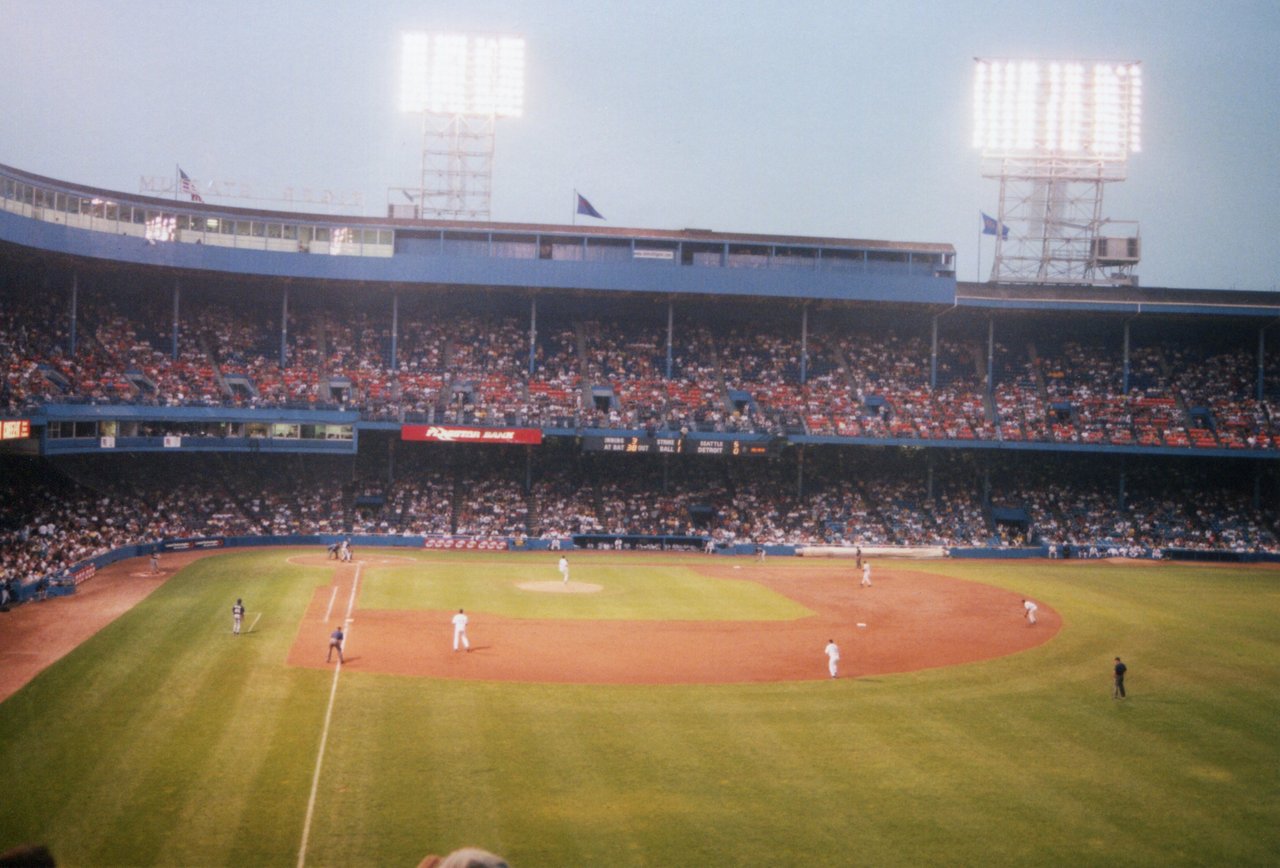
The street boundary shaped the ballpark. Scott Ferkovich’s Society for American Baseball Research history explains how expansion toward Trumbull Avenue produced an upper deck projecting ten feet closer to home plate than the lower deck. With the right-field fence at 325 feet, the upper seating edge was about 315 feet away. A deep fly could reach seats above space that otherwise looked playable.
The entrance had its own geographical surprise. Home plate shifted when Bennett Park was replaced, while the principal Michigan-and-Trumbull entrance remained. Entering there brought spectators toward the right-field corner rather than directly behind the catcher. These details make the old photographs easier to read: the stadium grew through alterations within a city block, and its quirks record those compromises.
When did night baseball arrive at Briggs Stadium?
On June 15, 1948, Detroit beat the Philadelphia Athletics 4–1 in its first major-league night game at the park. The Tigers were the last American League club to add lights. Scott Dominiak’s SABR account records eight towers and a crowd of 54,480 for the occasion.
Lighting changed more than visibility. It made attendance possible after a conventional daytime shift, changing the relationship between work and leisure. The account also notes that a planned wartime installation had been abandoned when the steel was redirected to the war effort. The arrival of night baseball thus sits within both the business of attracting spectators and the material demands of World War II.
Three records that put a game day back together
A 1950 plan locates the spectator
The museum’s June 22, 1950 blueprint, catalog 2014.004.001, records stadium sections and aisle letters. Its annotations connect the copy to G.S. Hellier and a Ford employee, with a factory-manager receipt stamp dated February 6, 1951. This is a plan of the ballpark in use, rather than simply an exterior portrait. It can help locate a remembered seat, although it cannot establish who actually sat there.
A 1946 scorecard captures the commercial setting
An official 1946 scorecard, catalog 2011.050.002, combines a roster, schedule, scoring boxes, and advertisements. The blank scoring space invited its purchaser to create a personal record inside a printed commercial object. For a family historian, a completed scorecard can preserve attention as well as attendance: which plays someone recorded, how they kept score, and what they chose to save.
A 1945 film preserves movement and crowds
The 1945 World Series film, catalog 2002.004.271, contains views of queues outside Briggs Stadium, spectators, warmups, and game action. The archive credits Lew Fonseca as writer and director and Bob Elson as narrator. Its description follows the series from Detroit to Chicago, so not every scene depicts this ballpark.
Read together, these sources answer different questions. The plan describes arrangement, the scorecard provides a framework for following a game, and the film records selected moments in motion. None captures every fan’s experience. Their value lies in combining evidence without assuming that one image or souvenir stands for an entire generation.
What happened in the final Tiger Stadium game?
The Tigers defeated Kansas City 8–2 on September 27, 1999. Robert Fick’s eighth-inning grand slam struck the right-field roof, and Todd Jones recorded the final out against Carlos Beltrán. The on-field result was accompanied by ceremonies and the return of former players. Gregory H. Wolf’s documented game account captures both the farewell and the disagreement surrounding the move.
A last game is a clear date; a community’s relationship with a place rarely ends so neatly. Fans could remember an extraordinary afternoon while continuing to disagree about renovation, replacement, and the future of the land.
Why did the preservation fight continue after 1999?
One later proposal sought to retain the section between the dugouts and reuse it for commercial and community space while keeping the field for youth baseball. Historic Detroit’s demolition account describes the dispute over funding and viability, the decision to remove the remainder, and the final structural demolition on September 21, 2009.
The outcome separates two forms of preservation: keeping the historic stands and keeping sports on the historic site. The first failed; the second became part of the site’s next chapter. That distinction avoids describing the present field as the old stadium, while still recognizing the meaning of its location.
What is at Michigan and Trumbull now?
Detroit PAL identifies the Corner Ballpark as its first permanent home and names the playing surface the Willie Horton Field of Dreams. It supports several sports and lists the original Tiger Stadium flagpole among the site’s features. Check PAL’s current event information before planning entry; the presence of a field does not mean unrestricted access during every visit.
Pair the corner with our Corktown history and preservation guide. The ballpark belongs within a neighborhood of homes, businesses, and changing streets. Continue to Olympia Stadium and Joe Louis Arena to compare what Detroit retained, replaced, and remembered at other sporting landmarks.
Watch with this page
Pair this article with History Loves Company on YouTube and the They Lied To Us About Detroit episode archive.
Where this fits in Detroit history
Explore the surrounding Corktown neighborhood and compare the ballpark with Detroit’s other vanished sporting venues.
- Hudson's Department Store Detroit History - Retail, downtown memory, demolition
- Corktown history — homes, institutions, and preservation
- Olympia Stadium Detroit History - Hockeytown before downtown arenas
- Joe Louis Arena Detroit History - Riverfront, Red Wings, redevelopment
- Detroit Lost Schools and Neighborhood Landmarks - Demolished Cooley High School and neighborhood memory
- Detroit Lost Theaters and Movie Palaces - Movie palaces, adaptive reuse, ruins
Sources and further reading
- Tiger Stadium overview
- Detroit Photography Tiger Stadium entry
- Image source: Inside Tiger Stadium, Detroit
Expanded and source-checked October 8, 2026. This page is part of the History Loves Company Detroit topic library, built to connect landmark stories, neighborhood memory, and Detroit history videos in one place.
Keep Exploring Detroit History
Tiger Stadium belongs inside Detroit sports, Corktown, neighborhood memory, and the larger story of venues the city lost.
Joe Louis Arena
Continue through the hockey and arena-memory side of the cluster.
Detroit neighborhoods
Connect stadium history to neighborhood identity and change.
Back to Detroit Buildings We Lost | Watch the HLC episode archive | Watch HLC on YouTube